



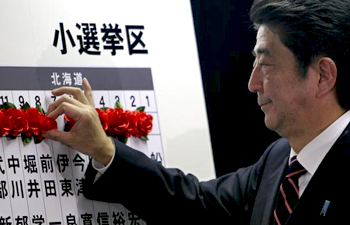
New Japan PM an old friend, will give priority to India: government

[email protected] (The Hindu)
December 18, 2012

Japan_Elc

New Delhi, December 18: More than incoming Japanese Prime Minister Shinzo Abe's professed proclivity towards India, New Delhi is hoping that the next Government in Tokyo will be more decisive on strategic issues.

The trend of India-Japan relations under three Prime Ministers of the previous Democratic Party of Japan (DPJ) remained positive but India's responses had to be re-calibrated because each Premier had a different take on the geo-political situation and trends, said Government sources.

Officials concede that Mr. Abe had set India-Japan ties on the high road when he was Prime Minister five years back. They also concur with the assessment by strategic experts that he retained his assessment of India as a key spoke in Japan's scheme of things even after demitting office. But they feel it would be wrong to talk about one entity. “The Government is not supporting one person or the other. It is wrong to crow about the importance of one entity. It is not as if he is special and others are not,” said the sources.

“The only thing we wish is that the new Government will be more decisive. The trend with the DPJ Government continued in the same positive vein as with Liberative Democratic Party (LDP) Governments. But certain decisions took time and the DPJ Government spoke in different voices at the same time,” they added.

The strategic orientation of each DPJ Prime Minister was different. When Yukio Hatoyama became Prime Minister, he tried to draw a line on U.S.-Japan-China relations. His successor Naoto Kan tried to but couldn't turn around this approach. And Yoshihiko Noda, who followed as Prime Minister, put up the U.S.-Japan alliance as the basis of Tokyo's foreign policy and international strategy.

The accent on different strategic line ups by successive Prime Ministers of the same party, feel the sources, is now in the past and India-Japan ties would further enhance and expand due to Mr. Abe's ideological orientation — he wants to revise Japan's Constitution by designating the defence forces as military and enhanced defence ties with nations (that includes India in the first tier) that do not harbour ill will against Japan.

This means that India's defence and strategic ties with Japan could become stronger. Even if the civil nuclear agreement could take some time, India could look forward to the removal of some of its companies from the list that restricts their interaction with Japanese companies.

The last such revision took place two years back, around the time India agreed to hold a 2 + 2 dialogue involving Defence and Foreign Secretaries from both countries. Ironically, the removal of some Indian companies from the Japanese export control list benefited Tokyo more during its time of need.

Indian Rare Earths Limited, which was on Japan's export control list but was removed in 2010, has come to the rescue of Japan's automobile industry by promising to supply the mineral. China had refused to supply rare earth materials.



Comments

Add new comment

  • Coastaldigest.com reserves the right to delete or block any comments.
  • Coastaldigset.com is not responsible for its readers’ comments.
  • Comments that are abusive, incendiary or irrelevant are strictly prohibited.
  • Please use a genuine email ID and provide your name to avoid reject.
News Network
April 27,2020

Seoul/South Korea, Apr 27: North Korean leader Kim Jong Un is "alive and well", a top security adviser to the South's President Moon Jae-in said, downplaying rumours over Kim's health following his absence from a key anniversary.
"Our government position is firm," said Moon's special adviser on national security Moon Chung-in, in an interview with CNN on Sunday. "Kim Jong Un is alive and well."

The adviser said that Kim had been staying in Wonsan -- a resort town in the country's east -- since April 13, adding: "No suspicious movements have so far been detected."

Conjecture about Kim's health has grown since his conspicuous absence from the April 15 celebrations for the birthday of his grandfather Kim Il Sung, the North's founder -- the most important day in the country's political calendar.

Kim has not made a public appearance since presiding over a Workers' Party politburo meeting on April 11, and the following day state media reported him inspecting fighter jets at an air defence unit.

North Korean leader Kim Jong Un was not gravely ill, two South Korean government sources said on Tuesday, following reports he had undergone a cardiovascular procedure and was now in "grave danger."

His absence unleashed a series of unconfirmed media reports over his condition, which officials in Seoul previously poured cold water on.

"We have nothing to confirm and no special movement has been detected inside North Korea as of now," the South's presidential office said in a statement last week.

South Korea's unification minister Kim Yeon-chul reiterated Monday that remained the case, adding the "confident" conclusion was drawn from "a complex process of intelligence gathering and assessment".

'Grave danger'

Daily NK, an online media outlet run mostly by North Korean defectors, has reported Kim was undergoing treatment after a cardiovascular procedure earlier this month.

Citing an unidentified source inside the country, it said Kim, who is in his mid-30s, had needed urgent treatment due to heavy smoking, obesity and fatigue.

Soon afterwards, CNN reported that Washington was "monitoring intelligence" that Kim was in "grave danger" after undergoing surgery, quoting what it said was an anonymous US official.

US President Donald Trump on Thursday rejected reports that Kim was ailing but declined to state when he was last in touch with him.

On Monday, the official Rodong Sinmun newspaper reported that Kim had sent a message of thanks to workers on the giant Wonsan Kalma coastal tourism project.

It was the latest in a series of reports in recent days of statements issued or actions taken in Kim's name, although none has carried any pictures of him.

Satellite images reviewed by 38North, a US-based think tank, showed a train probably belonging to Kim at a station in Wonsan last week.

It cautioned that the train's presence did not "indicate anything about his health" but did "lend weight" to reports he was staying on the country's eastern coast.

Reporting from inside the isolated North is notoriously difficult, especially regarding anything to do with its leadership, which is among its most closely guarded secrets.

Previous absences from the public eye on Kim's part have prompted speculation about his health.

In 2014 he dropped out of sight for nearly six weeks before reappearing with a cane. Days later, the South's spy agency said he had undergone surgery to remove a cyst from his ankle.

Comments

Add new comment

  • Coastaldigest.com reserves the right to delete or block any comments.
  • Coastaldigset.com is not responsible for its readers’ comments.
  • Comments that are abusive, incendiary or irrelevant are strictly prohibited.
  • Please use a genuine email ID and provide your name to avoid reject.
News Network
June 2,2020

London/Milan, Jun 2: World Health Organization experts and a range of other scientists said on Monday there was no evidence to support an assertion by a high profile Italian doctor that the coronavirus causing the COVID-19 pandemic has been losing potency.

Professor Alberto Zangrillo, head of intensive care at Italy's San Raffaele Hospital in Lombardy, which bore the brunt of Italy's COVID-19 epidemic, on Sunday told state television that the new coronavirus "clinically no longer exists".

But WHO epidemiologist Maria Van Kerkhove, as well as several other experts on viruses and infectious diseases, said Zangrillo's comments were not supported by scientific evidence.

There is no data to show the new coronavirus is changing significantly, either in its form of transmission or in the severity of the disease it causes, they said.

"In terms of transmissibility, that has not changed, in terms of severity, that has not changed," Van Kerkhove told reporters.

It is not unusual for viruses to mutate and adapt as they spread, and the debate on Monday highlights how scientists are monitoring and tracking the new virus. The COVID-19 pandemic has so far killed more than 370,000 people and infected more than 6 million.

Martin Hibberd, a professor of emerging infectious disease at the London School of Hygiene & Tropical Medicine, said major studies looking at genetic changes in the SARS-CoV-2 virus that causes COVID-19 did not support the idea that it was becoming less potent, or weakening in any way.

"With data from more than 35,000 whole virus genomes, there is currently no evidence that there is any significant difference relating to severity," he said in an emailed comment.

Zangrillo, well known in Italy as the personal doctor of former Prime Minister Silvio Berlusconi, said his comments were backed up by a study conducted by a fellow scientist, Massimo Clementi, which Zangrillo said would be published next week.

Zangrillo told Reuters: "We have never said that the virus has changed, we said that the interaction between the virus and the host has definitely changed."

He said this could be due either to different characteristics of the virus, which he said they had not yet identified, or different characteristics in those infected.

The study by Clementi, who is director of the microbiology and virology laboratory of San Raffaele, compared virus samples from COVID-19 patients at the Milan-based hospital in March with samples from patients with the disease in May.

"The result was unambiguous: an extremely significant difference between the viral load of patients admitted in March compared to" those admitted last month, Zangrillo said.

Oscar MacLean, an expert at the University of Glasgow's Centre for Virus Research, said suggestions that the virus was weakening were "not supported by anything in the scientific literature and also seem fairly implausible on genetic grounds."

Comments

Add new comment

  • Coastaldigest.com reserves the right to delete or block any comments.
  • Coastaldigset.com is not responsible for its readers’ comments.
  • Comments that are abusive, incendiary or irrelevant are strictly prohibited.
  • Please use a genuine email ID and provide your name to avoid reject.
News Network
March 5,2020

Washington, Feb 5: Experts warned a US government panel last night that India's Muslims face risks of expulsion and persecution under the country’s new Citizenship Amendment Act (CAA) which has triggered major protests.

The hearing held inside Congress was called by the US Commission on International Freedom, which has been denounced by the Indian government as biased.

Ashutosh Varshney, a prominent scholar of sectarian violence in India, told the panel that the law championed by prime minister Narendra Modi's government amounted to a move to narrow the democracy's historically inclusive and secular definition of citizenship.

"The threat is serious, and the implications quite horrendous," said Varshney, a professor at Brown University.

"Something deeply injurious to the Muslim minority can happen once their citizenship rights are taken away," he said.

Varshney warned that the law could ultimately lead to expulsion or detention -- but, even if not, contributes to marginalization.

"It creates an enabling atmosphere for violence once you say that a particular community is not fully Indian or its Indianness in grave doubt," he said.

India's parliament in December passed a law that fast-tracks citizenship for persecuted non-Muslim minorities from neighboring countries.

Responding to criticism at the time from the US commission, which advises but does not set policy, India's External Affairs Ministry said the law does not strip anyone's citizenship and "should be welcomed, not criticized, by those who are genuinely committed to religious freedom."

Fears are particularly acute in Assam, where a citizens' register finalized last year left 1.9 million people, many of them Muslims, facing possible statelessness.

Aman Wadud, a human rights lawyer from Assam who traveled to Washington for the hearing, said that many Indians lacked birth certificates or other documentation to prove citizenship and were only seeking "a dignified life."

The hearing did not exclusively focus on India, with commissioners and witnesses voicing grave concern over Myanmar's refusal to grant citizenship to the Rohingya, the mostly Muslim minority that has faced widespread violence.

Gayle Manchin, the vice chair of the commission, also voiced concern over Bahrain's stripping of citizenship from activists of the Shiite majority as well as a new digital ID system in Kenya that she said risks excluding minorities.

More than 40 people were killed last week in New Delhi in sectarian violence sparked by the citizenship law.

India on Tuesday lodged another protest after the UN human rights chief, Michele Bachelet, sought to join a lawsuit in India that challenges the citizenship law's constitutionality.

Comments

Add new comment

  • Coastaldigest.com reserves the right to delete or block any comments.
  • Coastaldigset.com is not responsible for its readers’ comments.
  • Comments that are abusive, incendiary or irrelevant are strictly prohibited.
  • Please use a genuine email ID and provide your name to avoid reject.