



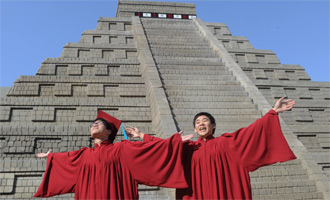
Mayan ‘doomsday' sweeps across world, no casualties

December 22, 2012
Mayans_End

Bugarach (France), December 22: Diehard doomsayers hunkered down to await the apocalypse on Friday, but most took a lighthearted view of the Mayan “prophecy” of the world's destruction, laying on stunts and parties to while away the end.

“If you're in an underground bunker with a lifetime's supply of baked beans how stupid do you feel now?” asked one person on Twitter, which saw dozens of posts every minute joking about the failure of the world to end.

In the southern French village of Bugarach — rumoured to be one of the few places that will be spared when the end comes — dozens of journalists from across the world were bitterly disappointed at the lack of New Age fanatics to interview.

Police had wrongly anticipated an influx of visitors and blocked access to the village and the nearby Pic de Bugarach, a mountain which some say will open on the last day and aliens will emerge with spaceships to save nearby humans.

Hundreds of reporters also wandered aimlessly around the tiny village of Sirince in Turkey, hoping to grab a mystic taking refuge there.

Doomsayers identified Sirince — said to be the site from which the Virgin Mary ascended to heaven — as a safe haven that will be spared destruction thanks to the positive energy flowing through it.

And in Serbia, a pyramid-shaped mountain believed by some to be a source of unusual electromagnetic waves that could shield it from catastrophe, attracted record numbers of visitors.

December 21 marks the end of an era that lasted over 5,000 years, according to the Mayan “Long Count” calendar. Some believe the date, which coincides with the December solstice, marks the end of the world as foretold by Mayan hieroglyphs.

But scholars have ridiculed the idea, and say the date simply marks the end of the old Mayan calendar and the beginning of a new one.

The central American region where the Mayans lived saw a tourism bonanza in the run-up to the fateful December 21 date, with tourists snapping up all-inclusive excursions to Mayan holy sites.

It was also a chance to celebrate the contributions of the Mayan civilisation to mankind, but indigenous groups have accused governments and businesses of profiting from Hollywood-inspired fiction about their culture.

Thousands gathered at the majestic Mayan ruins of Tikal in the jungles of present-day Guatemala to await a fiery climax to the ancient civilisation's calendar.

Actors in costumes and head-dresses staged elaborate dances to a mournful pan-pipe tune ahead of the apocalypse supposedly foreseen by the Mayans, who reached their peak of power in modern-day Mexico and parts of Central America between the years 250 and 900 AD.

Australia was one of the first countries to see the sun rise on December 21, and Tourism Australia's Facebook page was bombarded with posts asking if anyone had survived Down Under.

“Yes, we're alive,” the organisation responded to fretting users.

Tongue-in-cheek scientists in Taiwan planted an electronic countdown timer atop a two-storey replica of a Mayan pyramid, drawing crowds at the National Museum of Natural Science.

Seven-year-old Wang Si-shien was unimpressed. “I'm not scared at all,” she said as she visited the museum with her school class.

Some argued online that an impending milestone for the “Gangnam Style” video of South Korean rapper Psy — one billion views on YouTube — was itself a harbinger of doom, enlisting a fake Nostradamus verse in their cause.

Across Asia, Europe and North America, many planned to party like there's no tomorrow with apocalypse-themed dinners and pub nights.

Hong Kong's Aqua restaurant promised to pick up the tab for its HK$2,112.12 ($273) six-course meal if the end is nigh — though patrons will have to stump up if still alive at midnight.

But there has also been a darker side in China, with authorities arresting some 1,000 people in a crackdown on a Christian sect that spread doomsday rumours.

If the world does end, Chinese furniture maker Liu Qiyuan has his own safe haven, a fibre-glass pod he designed that can carry up to 30 people and withstand towering tsunamis and devastating earthquakes.

A Dutch Christian has meanwhile painstakingly prepared a lifeboat in his garden capable of saving 50 people ahead of the biblical floods he expects to accompany Friday's “doomsday”.'

Over the centuries, the end of the world has been predicted countless times, from the early Christians to controversial US pastor Harold Camping last year.

US space agency NASA has been contacted by thousands of worried people asking what to do. In a web page devoted to debunking the Mayan prophecies, it reassured them that the world will not end in 2012.

“Our planet has been getting along just fine for more than four billion years, and credible scientists worldwide know of no threat associated with 2012,” it said.



Comments

Add new comment

  • Coastaldigest.com reserves the right to delete or block any comments.
  • Coastaldigset.com is not responsible for its readers’ comments.
  • Comments that are abusive, incendiary or irrelevant are strictly prohibited.
  • Please use a genuine email ID and provide your name to avoid reject.
News Network
February 18,2020

Beijing, Feb 18: A hospital director at the epicentre of China's virus epidemic died on Tuesday, state media said, the latest medical worker to fall victim to the new coronavirus spreading across the country.

The COVID-19 virus, which is believed to have originated in Wuhan late last year, has infected more than 72,000 people and killed nearly 1,900.

Liu Zhiming, the director of Wuchang Hospital in Wuhan, died Tuesday morning after "all-out rescue efforts failed," state broadcaster CCTV reported.

China said last week that six medical workers had died from the virus, while 1,716 have been infected.

Liu's death was initially reported by Chinese media and bloggers shortly after midnight on Tuesday -- but the stories were later deleted and replaced with reports that doctors were still trying to save him.

After initial reports of his death were denied, the hospital told AFP on Tuesday morning that doctors were giving him life-saving treatment.

Liu's death has echoes of that of Wuhan ophthalmologist Li Wenliang, who had been punished by authorities for sounding the alarm about the virus in late December.

Li's death prompted a national outpouring of grief as well as anger against the authorities, who were accused of mishandling the crisis.

People took to social media to mourn Liu on Tuesday, with many users on the Twitter-like Weibo platform drawing critical comparisons between Liu's death and Li's.

In both cases their deaths were initially reported in state media posts -- later deleted -- and their deaths denied, before being finally confirmed again.

"Has everyone forgotten what happened to Li Wenliang? They forcefully attempted resuscitation after he died," one Weibo commenter wrote.

Another commenter said, Liu "already died last night, (but) some people are addicted to torturing corpses".

A hashtag about Liu's death had 29 million views by Tuesday afternoon.

Doctors in Wuhan face shortages of masks and protective bodysuits, with some even wearing makeshift hazmat suits and continuing to work despite showing respiratory symptoms, health workers have told AFP.

Hubei province and its capital Wuhan have been the hardest hit by the virus, accounting for nearly 1,800 of the deaths from the virus so far.

Comments

Add new comment

  • Coastaldigest.com reserves the right to delete or block any comments.
  • Coastaldigset.com is not responsible for its readers’ comments.
  • Comments that are abusive, incendiary or irrelevant are strictly prohibited.
  • Please use a genuine email ID and provide your name to avoid reject.
News Network
March 29,2020

Beijing, Mar 29: In a rare display of public anger in China, dozens of people in central Hubei province, the epicentre of the coronavirus outbreak till recently, attacked official vehicles after they were stopped from crossing a bridge and travel to neighbouring Jiangxi after the lifting of the lockdown.
Hubei province with over 56 million people was kept under lockdown from January 23 as part of aggressive measures to bring down COVID-19 cases which rapidly spread in the area.

Videos on Chinese social media on Friday showed unprecedented scenes of police from Hubei and Jiangxi clashing on the bridge connecting the two provinces over barricades erected from stopping Hubei people from moving out over fears of coronavirus spreading.

Policemen from both sides argued over how to verify if people were allowed to enter Jiangxi, according to local media reports.

It was a major relief for millions of people in Hubei province, when the Chinese government which kept it under lockdown lifted the restrictions on travel.

The government will permit people from the province to travel if they hold a green health code, meaning no contact with any infected or suspected COVID-19 cases.

But people of Hubei to their shock on Friday found roadblocks on the 1st Yangtze River Bridge that separates Huangmei county in Hubei erected by Huangmei county of Jiangxi province.

In local media reports, witnesses were quoted as saying that Huangmei police in Jiujiang erected roadblocks on the bridge to stop people from Hubei from crossing it, a move they alleged stigmatised them.

Video footage shared online showed rows of police armed with riot shields holding back the crowds, while members of the public could be seen damaging and even overturning police vehicles.

In a clip published by the Huanggang city government, which administers Huangmei, the county's Communist Party chief Ma Yanzhou could be heard speaking to the people through a loud hailer, warning them that by gathering in a large group they were increasing their chances of contracting the virus, Hong Kong-based South China Morning Post reported.

While it is unclear exactly how the clash started, police from the two sides published separate official statements online, which were quickly deleted, it said.

The incident underlines the problems China faces as it seeks a return to normalcy after months of lockdown, the Post said.

After the incident, the governments of Huangmei and Jiujiang on Friday issued a joint statement saying they had agreed to remove the barriers set up to restrict travel during the lockdown, and also to recognise each other's health screening codes to make it easier for people in good health to get to where they needed to be, the Post report said.

An article by the ruling Communist Party of China (CPC) mouthpiece, People''s Daily acknowledged the problems in getting the country back on its feet.

"In the past few days, all walks of life have called for governments to accept workers from Hubei," it said.

"However, it is undeniable that some places, intentionally or not, have set up obstacles for Hubei migrant workers to return to their posts and hold prejudices against them."

Comments

Add new comment

  • Coastaldigest.com reserves the right to delete or block any comments.
  • Coastaldigset.com is not responsible for its readers’ comments.
  • Comments that are abusive, incendiary or irrelevant are strictly prohibited.
  • Please use a genuine email ID and provide your name to avoid reject.
Agencies
January 21,2020

Fifty-six journalists were killed in 2019 and most of them died outside conflict zones, a United Nations spokesperson said.

The number dropped by nearly half from the year 2018, but perpetrators enjoyed almost total impunity, Xinhua news agency quoted Stephane Dujarric, spokesperson for UN Secretary-General Antonio Guterres, as saying on Monday citing Unesco figures.

The figure was published in the 'Unesco Observatory of Killed Journalists' on Monday.

In total, Unesco recorded 894 journalist killings in the decade from 2010 to 2019, an average of almost 90 per year. The number in 2019 was 99.

Journalists were murdered in all regions of the world, with Latin America and the Caribbean recording 22 killings, the highest number, followed by 15 in Asia-Pacific, and 10 in Arab States.

"The figures show that journalists not only suffer extreme risks when covering violent conflict, but that they are also targeted when reporting on local politics, corruption and crime - often in their hometowns," the Unesco said.

Almost two thirds (61 per cent) of the cases in 2019 occurred in countries not experiencing armed conflict, a notable spike in a wider trend in recent years, and a reversal of the situation of 2014, when this figure was one third.

More than 90 per cent of cases recorded in 2019 concerned local journalists, consistent with previous years, it added.

In response to these figures, Audrey Azoulay, the Director-General of Unesco, said: "Unesco remains deeply troubled by the hostility and violence directed at all too many journalists around the world.

"As long as this situation lasts, it will undermine democratic debate."

Comments

Add new comment

  • Coastaldigest.com reserves the right to delete or block any comments.
  • Coastaldigset.com is not responsible for its readers’ comments.
  • Comments that are abusive, incendiary or irrelevant are strictly prohibited.
  • Please use a genuine email ID and provide your name to avoid reject.