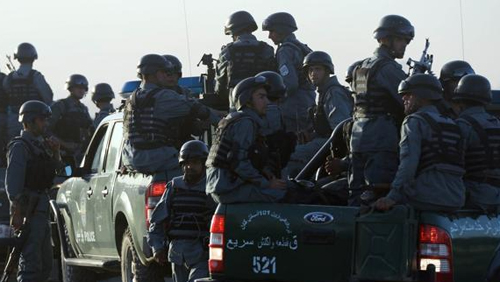
All seven militants dead at end of Kabul airport attack

June 10, 2013

Kabul_airport_attack

Kabul, Jun 10: All seven militants who launched an attack on Monday on Kabul airport died in the assault, Afghan police said, adding that no civilian and security force casualties had yet been reported.

"There were seven assailants — two (suicide bombers) died detonating themselves and five others were killed in fighting," Mohammad Ayoub Salangi, chief of Kabul police, told reporters.

"There have not been any casualties to the security forces, and we have not (received) any report of civilian casualties so far."

Comments

Add new comment

  • Coastaldigest.com reserves the right to delete or block any comments.
  • Coastaldigset.com is not responsible for its readers’ comments.
  • Comments that are abusive, incendiary or irrelevant are strictly prohibited.
  • Please use a genuine email ID and provide your name to avoid reject.
Agencies
June 16,2020

India continues to remain ranked 43rd on an annual World Competitiveness Index compiled by Institute for Management Development (IMD) with some traditional weaknesses like poor infrastructure and insufficient education investment keeping its ranking low, the international business school said on Tuesday.

Singapore has retained its top position on the 63-nation list.

Denmark has moved up to the second position (from 8th last year), Switzerland has gained one place to rank 3rd, the Netherlands has retained its 4th place and Hong Kong has slipped to the fifth place (from 2nd in 2019).

The US has moved down to 10th place (from 3rd last year), while China has also slipped from 14th to 20th place. Among the BRICS nations, India is ranked second after China, followed by Russia (50th), Brazil (56th) and South Africa (59th).

India was ranked 41st on the IMD World Competitiveness Ranking, being produced by the business school based in Switzerland and Singapore every year since 1989, but had slipped to 45th in 2017 before improving to 44th in 2018 and then to 43rd in 2019.

While its overall position has remained unchanged in the 2020 list, it has recorded improvements in areas like long-term employment growth, current account balance, high-tech exports, foreign currency reserves, public expenditure on education, political stability and overall productivity, the IMD said.

However, it has moved down in areas like exchange rate stability, real GDP growth, competition legislation and taxes.

Arturo Bris, Head of Competitiveness Center at IMD Business School, said India continues to struggle on the list and the recent country rating downgrade by Moody’s reflects the uncertainties regarding the economy’s future.

"In our ranking this year, we again emphasize the traditional weaknesses of India -- poor infrastructure, an important deficit in education investment, and a health system that does not reach everybody. For India to follow the path of China, it must stress its intangible infrastructure," Bris said.

"In a less global world, with China, USA, and Europe looking inwards, currencies like the rupee (and the Brazilian real for instance) are going to suffer and display high volatilities.

"Moody’s has threatened the country with a downgrade to junk and that would put India in a terrible position to attract foreign capital. So the urgency for the government should be to fix the short-term problems—and this requires to improve the credibility of the government itself," Bris added.

With the exception of Singapore, the Philippines, Taiwan and the Korean Republic, most Asian economies dropped in rankings this year, the IMD said.

The reason for the Asian economies’ less stellar performance as a region, this year is partly the result of the trade frictions between China and the US, particularly because these economies are highly dependent on trade with China.

About Singapore, which moved to the top rank last year, the IMD said its position is largely driven by the relative ease of setting up business, availability of skilled labour and its cutting-edge technological infrastructure.

The IMD said the impact of COVID-19 on the competitiveness ranking has partially been captured by executives’ opinions about the effectiveness of the different health systems.

In the ASEAN countries included in the survey, only Singapore and Thailand have a positive performance in the effectiveness of the health infrastructure.


Comments

Add new comment

  • Coastaldigest.com reserves the right to delete or block any comments.
  • Coastaldigset.com is not responsible for its readers’ comments.
  • Comments that are abusive, incendiary or irrelevant are strictly prohibited.
  • Please use a genuine email ID and provide your name to avoid reject.
News Network
July 2,2020

Washington, Jul 2: Former US Ambassador to the UN, Nikki Haley, on Wednesday (local time) hailed India's action to ban 59 apps linked to Chinese firms including Tik Tok and said New Delhi is continuing to show it will not back down from China's aggression.

"Good to see India banning 59 popular apps owned by Chinese firms, including TikTok, which counts India as one of its largest markets. India is continuing to show it won't back down from China's aggression," Haley tweeted.

The Indian government on Monday announced that it had decided to block 59 apps in view of the information available that "they are engaged in activities which are prejudicial to sovereignty and integrity of India, defence of India, the security of the state and public order".

Information Technology Minister, Ravi Shankar Prasad said that the government has banned the apps for the safety, security, defense, sovereignty, and integrity of India.

Haley'='s remarks come after US Secretary of State Mike Pompeo welcomed India''s ban on the Chinese apps and stressed that the move would "boost India''s integrity and national security".

"We welcome India''s ban on certain mobile apps. India''s clean app approach will boost India's sovereignty and boost integrity and national security," Pompeo said.

Comments

Add new comment

  • Coastaldigest.com reserves the right to delete or block any comments.
  • Coastaldigset.com is not responsible for its readers’ comments.
  • Comments that are abusive, incendiary or irrelevant are strictly prohibited.
  • Please use a genuine email ID and provide your name to avoid reject.
Agencies
May 28,2020

More than one in six youths were jobless since the onset of the COVID-19 pandemic while those who remain employed have seen their working hours cut by 23 per cent, according to a report by the International Labour Organisation (ILO).

According to the 'ILO Monitor: COVID-19 and the world of work: 4th edition' published on Wednesday, youths are being disproportionately affected by the pandemic, and the substantial and rapid increase in youth unemployment seen since February is affecting young women more than young men, reports Xinhua news agency.

The pandemic is inflicting a triple shock on young people.

Not only is it destroying their employment, but it is also disrupting education and training, and placing major obstacles in the way of those seeking to enter the labour market or to move between jobs, said the report.

At 13.6 per cent, the youth unemployment rate in 2019 was already higher than any other group.

There were around 267 million young people not in employment, education or training worldwide.

"If we do not take significant and immediate action to improve their situation, the legacy of the virus could be with us for decades," said ILO Director-General Guy Ryder.

"If their talent and energy is sidelined by a lack of opportunity or skills, it will damage all our futures and make it much more difficult to re-build a better, post-COVID economy."

The report called for urgent, large-scale and targeted policy responses to support youth, including broad-based employment/training guarantee programs in developed countries, and employment-intensive programs and guarantees in low- and middle-income economies.

Comments

Add new comment

  • Coastaldigest.com reserves the right to delete or block any comments.
  • Coastaldigset.com is not responsible for its readers’ comments.
  • Comments that are abusive, incendiary or irrelevant are strictly prohibited.
  • Please use a genuine email ID and provide your name to avoid reject.