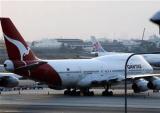
Stomach bug triggers mass vomiting on Qantas flight

August 1, 2013
Sydney, Aug 1: Dozens of people were rushed off a Qantas flight for medical treatment in Sydney today after a stomach bug struck mid-journey, triggering a mass vomiting episode. qantas

Qantas said a "number of passengers travelling in the same group on QF28 (between) Santiago and Sydney became unwell with a gastro intestinal illness" on the 14-hour journey to Australia.

Media reports said between 20 and 30 passengers were vomiting as they disembarked in Sydney and were met by a fleet of ambulances.

"It is believed the illness was contracted before boarding the aircraft and symptoms became evident during the flight," Qantas said in a statement.

"The aircraft has been met by medical staff to look after the unwell passengers."

As a precaution, Qantas said all other passengers on the flight were advised to monitor their health closely over the next 24-48 hours.

Health authorities said they had been advised that "26 passengers returning on a Qantas flight from Santiago, Chile, developed vomiting and diarrhoea on the plane, consistent with norovirus infection, a common cause of outbreaks of gastroenteritis in Australia and elsewhere".

"New South Wales Health has provided Qantas with a letter and factsheet about viral gastro to distribute to all departing passengers, as well as advice for cleaning and cabin staff," the state's health office said in a statement.

It said the sick group was assessed by paramedics and escorted out of the airport "with minimal exposure to other passengers" after they were cleared to go home.

Comments

Add new comment

  • Coastaldigest.com reserves the right to delete or block any comments.
  • Coastaldigset.com is not responsible for its readers’ comments.
  • Comments that are abusive, incendiary or irrelevant are strictly prohibited.
  • Please use a genuine email ID and provide your name to avoid reject.
News Network
June 6,2020

Washington, Jun 6: Washington mayor Muriel Bowser on Friday renamed an area near the White House that has become the epicenter of anti-racism protests over the past week "Black Lives Matter Plaza" -- unveiling a giant street mural.

But in so doing, the African-American mayor piqued the ire of the very movement she was supporting, as well as of President Donald Trump.

The protests are focused on the May 25 death in Minneapolis of 46-year-old black man George Floyd while in police custody. A white officer kneeled on his neck until he lost consciousness.

That officer and three others are now in custody and facing charges -- second-degree murder for the kneeling officer, and aiding and abetting that crime for his colleagues.

Just north of the White House, the words BLACK LIVES MATTER were painted in huge yellow letters along the street leading to the presidential mansion, along with the symbol from the DC flag.

"The section of 16th street in front of the White House is now officially 'Black Lives Matter Plaza'," Bowser tweeted.

A city worker put up a new street sign with the name.

"Determination to make America the land it ought to be," she said on Twitter.

The corner of 16th and H is significant -- in a controversial incident on Monday, peaceful protesters gathered there were dispersed with tear gas.

Shortly afterwards, Trump walked from the White House to a nearby church for a photo op, during which he held the Bible in his hand.

"There was a dispute this week about whose street this is. Mayor Bowser wanted to make it abundantly clear that this is DC's street and to honor demonstrators" who protested on Monday, her chief of staff John Falcicchio tweeted.

Rose Jaffe, one of the artists in the collective that painted the BLACK LIVES MATTER sign, told AFP it was "about reclaiming the streets of DC."

But she added that Bowser "has to do more than just a photo-op -- she must carry on when this is washed away" on issues like police accountability.

Stars Like LeBron James praised her move on Twitter, but the local chapter of the Black Lives Movement balked, calling the mural a "performative distraction from real policy changes."

"This is to appease white liberals while ignoring our demands," it said on Twitter, saying Bowser had "consistently been on the wrong side" of the movement.

'We are well equipped'

The US government deployed a significant contingent of federal officers and National Guard troops from other states -- many of them not wearing any identifying garb or badges -- to handle protests in Washington.

Bowser had called up the local Guardsmen but the Justice Department moved to take partial control of peacekeeping, with Guard troops from as far away as Utah brought in.

In a letter to Trump dated Thursday and tweeted early Friday, Bowser called for "all extraordinary federal law enforcement and military presence" to be removed.

She said their deployment was "inflaming demonstrators and adding to the grievances of those who, by and large, are peacefully protesting for change and for reforms to the racist and broken systems that are killing black Americans."

"These additional, unidentified units are operating outside of established chains of command," she added.

"We are well equipped to handle large demonstrations and First Amendment activities," including the right to assemble, Bowser said.

Trump reiterated on Friday that authorities need to "dominate the streets," and has been unapologetic about the deployment of forces.

And on Twitter, he lashed out at Bowser, calling her "incompetent" and saying the National Guard had saved her from "great embarrassment."

Senator Mike Lee of Utah accused Bowser of evicting Utah National Guard members from area hotels.

She replied: "DC residents cannot pay their hotel bills. The Army can clear that up with the hotel today, and we are willing to help."

Comments

Add new comment

  • Coastaldigest.com reserves the right to delete or block any comments.
  • Coastaldigset.com is not responsible for its readers’ comments.
  • Comments that are abusive, incendiary or irrelevant are strictly prohibited.
  • Please use a genuine email ID and provide your name to avoid reject.
News Network
May 7,2020

United Nations, May 7: An average of 80,000 COVID-19 cases were reported each day in April to the World Health Organization, the top UN health agency has said, noting that South Asian nations like India and Bangladesh are seeing a spike in the infections while the numbers are declining in regions such as Western Europe.

WHO Director-General Tedros Adhanom Ghebreyesus said on Wednesday that countries must also be able to manage any risk of the disease being imported into their territories, and communities should be fully educated to adjust to what will be a "new norm".

He said as the countries press forward in the common fight against COVID-19, they should also lay the groundwork for resilient health systems globally.

"More than 3.5 million cases of COVID-19 and almost 250,000 deaths have now been reported to the WHO. Since the beginning of April, an average of around 80,000 new cases have been reported to the WHO every day," Ghebreyesus said in Geneva yesterday.

Asserting that the virus cases were not just numbers, he said: "every single case is a mother, a father, a son, a daughter, a brother, sister or friend".

He said while the numbers are declining in Western Europe, more cases are being reported every day from Eastern Europe, Africa, South-East Asia, the Eastern Mediterranean and the Americas. Even within regions and within countries, there are divergent trends, the agency added.

While some countries are reporting an increase in COVID-19 cases over time, many have seen caseloads rise because they have ramped up testing, the WHO official said.

"We've also seen in Europe and Western Europe a fundamental decrease in the number of cases, but we have seen an associated increase in the number of cases reported in places like the Russian Federation. Southeast, the Western Pacific areas are relatively on the downward trend like Korea and others, but then we do see in South Asia, in places like Bangladesh, in India, some trends towards increase.

"So it's very difficult to say that any particular region is improving or (not improving). There are individual countries within each region that are having difficulties getting on top of this disease and I am particularly concerned about those countries that have (an) ongoing humanitarian crisis," WHO's Executive Director Michael Ryan said.

The death toll due to COVID-19 in India rose to 1,783 while the number of cases climbed to 52,952 on Thursday, registering an increase of 89 deaths and 3,561 cases in the last 24 hours, the Union Health Ministry said.

The number of active COVID-19 cases stood at 35,902 while 15,266 people have recovered, it said.

Noting that while seeing an increase in the number of cases is not good in terms of transmission, WHO's Emerging Diseases and Zoonoses Unit head Maria Van Kerkhove said: "but I don't want to equate that with something (being) wrong".

"I want to equate that with countries are working very hard to increase their ability to find the virus, to find people with the virus, to have testing in place to identify who has COVID-19, and putting into place what they need to do to care for those patients," Kerkhove said.

With more countries considering easing restrictions implemented to curb the spread of the coronavirus, the WHO has again reminded the authorities of the need to maintain vigilance.

"The risk of returning to lockdown remains very real if countries do not manage the transition extremely carefully, and in a phased approach," Ghebreyesus said.

He urged countries to consider the UN agency's six criteria for lifting stay-at-home measures.

That advice includes ensuring surveillance is strong, cases are declining and transmission is controlled. Health systems also must be able to detect, isolate, test and treat cases, and to trace all contacts.

Additionally, the risk of outbreak in settings such as health facilities and nursing homes needs to be minimised, while schools, workplaces and other public locations should have preventive measures in place.

"The COVID-19 pandemic will eventually recede, but there can be no going back to business as usual. We cannot continue to rush to fund panic but let preparedness go by the wayside," he said.

He said the crisis has highlighted the importance of strong national health systems as the foundation of global health security: not only against pandemics but also against the multitude of health threats that people across the world face every day.

"If we learn anything from COVID-19, it must be that investing in health now will save lives later," Ghebreyesus said.

While the world currently spends around USD 7.5 trillion on health annually, the WHO believes the best investments are in promoting health and preventing disease.

"Prevention is not only better than cure, it's cheaper, and the smartest thing to do," he said.

The deadly coronavirus, which originated from the Chinese city of Wuhan in December last year, has infected over 3.7 million people and killed 263,831 people globally, according to a tally by Johns Hopkins University.


Comments

Add new comment

  • Coastaldigest.com reserves the right to delete or block any comments.
  • Coastaldigset.com is not responsible for its readers’ comments.
  • Comments that are abusive, incendiary or irrelevant are strictly prohibited.
  • Please use a genuine email ID and provide your name to avoid reject.
Agencies
January 4,2020

Stockholm, Jan 4: “I’m not the kind of person who celebrates birthdays,” Greta Thunberg said as she turned 17 on Friday, marking the occasion in inimitable style - with a seven-hour hour protest outside the Swedish parliament.

The climate activist braved winter conditions in her native Stockholm to continue the weekly Friday School Strike for the Climate campaign that helped catapult her to international fame.

“I stand here striking from 8am until 3pm as usual ... then I’ll go home,” Thunberg, Time magazine’s Person of the Year for 2019, told Reuters.

“I won’t have a birthday cake but we’ll have a dinner.”

It’s been a busy 12 months for Thunberg, who crisscrossed the globe by car, train and boat - but not plane - to demand action on climate change.

“It has been a strange and busy year, but also a great one because I have found something I want to do with my life and what I am doing is having an impact,” she said.

When she was 15, Thunberg began skipping school on Fridays to demonstrate outside the Swedish parliament to push her government to curb carbon emissions. Her campaign gave rise to a grassroots movement that has gone global, inspiring millions of people to take action.

Comments

Add new comment

  • Coastaldigest.com reserves the right to delete or block any comments.
  • Coastaldigset.com is not responsible for its readers’ comments.
  • Comments that are abusive, incendiary or irrelevant are strictly prohibited.
  • Please use a genuine email ID and provide your name to avoid reject.