



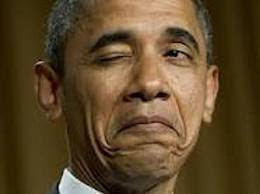
As Obama blinks on Syria, Israel and Saudi Arabia make common cause

September 2, 2013
Jerusalem/Riyadh, Sep 2: If President Barack Obama has disappointed Syrian rebels by deferring to Congress before bombing Damascus, he has also dismayed the United States' two main allies in the Middle East. obama_syria

Israel and Saudi Arabia have little love for each other but both are pressing their mutual friend in the White House to hit President Bashar al-Assad hard. And both do so with one eye fixed firmly not on Syria but on their common adversary — Iran.

Israel's response to Obama's surprise move to delay or even possibly cancel air strikes made clear that connection: looking soft on Assad after accusing him of killing hundreds of people with chemical weapons may embolden his backers in Tehran to develop nuclear arms, Israeli officials said. And if they do, Israel may strike Iran alone, unsure Washington can be trusted.

Neither US ally is picking a fight with Obama in public. Israeli Prime Minister Benjamin Netanyahu said on Sunday that the nation was "serene and self-confident"; Saudi foreign minister Prince Saud al-Faisal simply renewed a call to the "international community" to halt Assad's violence in Syria.

But the Saudi monarchy, though lacking Israel's readiness to attack Iran, can share the Jewish state's concern that neither may now look with confidence to Washington to curb what Riyadh sees as a drive by its Persian rival to dominate the Arab world.

Last year, Obama assured Israelis that he would "always have Israel's back". Now Netanyahu is reassuring them they can manage without uncertain US protection against Iran, which has called for Israel's destruction but denies developing nuclear weapons.

"Israel's citizens know well that we are prepared for any possible scenario," the hawkish prime minister said. "And Israel's citizens should also know that our enemies have very good reasons not to test our power and not to test our might."

That may not reassure a US administration which has tried to steer Netanyahu away from unilateral action against Iran that could stir yet more chaos in the already explosive Middle East.

Israel's state-run Army Radio was more explicit: "If Obama is hesitating on the matter of Syria," it said, "Then clearly on the question of attacking Iran, a move that is expected to be far more complicated, Obama will hesitate much more — and thus the chances Israel will have to act alone have increased."

Israelis contrast the "red line" Netanyahu has set for how close Iran may come to nuclear weapons capability before Israel strikes with Obama's "red line" on Assad's use of chemical weapons — seemingly passed without US military action so far.

'Head of the snake'

Saudi Arabia, like Israel heavily dependent on the United States for arms supplies, is engaged in a historic confrontation with Iran for regional influence — a contest shaped by their leading roles in the rival Sunni and Shia branches of Islam.

Riyadh is a prime backer of Sunni rebels fighting Assad, whose Alawite minority is a Shia offshoot. It sees toppling Assad as checking Iran's ambition not just in Syria but in other Arab states including the Gulf, where it mistrusts Shias in Saudi Arabia itself and in neighbouring Bahrain, Yemen and Iraq.

Saudi King Abdullah's wish for US action against Iran was memorably contained in leaked US diplomatic cables, including one in which a Saudi envoy said the monarch wanted Washington to "cut off the head of the snake" to end Tehran's nuclear threat.

Disappointment with Obama's hesitation against Assad came through on Sunday in the Saudi foreign minister's remarks to the Arab League in Cairo, where he said words were no longer enough.

Riyadh and its allies in the Gulf Cooperation Council (GCC) risk ending up empty-handed in their latest push for US backing in their campaign to rein in Iran, said Sami al-Faraj, a Kuwaiti analyst who advises the GCC on security matters:

"The idea of a punishment for a crime has lost its flavour. We are on the edge of the possibility that military action may not be conducted," he said. "Congress, for sure ... will attach conditions to what is already going to be a limited strike. At the end, we as Gulf allies, may end up with nothing."

Israel does not share the Saudi enthusiasm for the Syrian rebel cause, despite its concern about Assad's role as a link between Iran and Lebanese and Palestinian enemies. The presence in rebel ranks of Sunni Islamist militants, some linked to al-Qaida, worries the Jewish state — though Riyadh, too, is keen to curb al-Qaida, which calls the royal family American stooges.

Egyptian lessons

Saudi and Israeli support for US air strikes in response to Assad's alleged use of poison gas scarcely stands out less amid a global clamour of reproach for Damascus. However, the recent Egyptian crisis saw them more distinctly making common cause in lobbying Washington — since their preference for Egypt's army over elected Islamists was at odds with much of world opinion.

That, too, reflects shared anxieties about the strength of Islamic populism and about Iran, which found a more sympathetic ear in Cairo after the election of President Mohamed Mursi.

Israeli political commentators used terms such as "betrayal" and "bullet in the back from Uncle Sam" when Obama abandoned loyal ally Hosni Mubarak during the popular uprising of 2011.

While some western leaders voiced unease at the army's overthrow of Mursi in July and bloody crackdown on his Muslim Brotherhood, in Israel even Obama's mild rebuke to the generals — delaying delivery of four warplanes to Egypt — caused "raised eyebrows" of disapproval, an official there said.

A "gag order" from Netanyahu kept that quiet, however, as Israel's military kept open the communications with Egypt's armed forces, not least over militant attacks near their desert border, in a manner that has been the bedrock of the US-brokered peace treaty binding Israel and Egypt since 1979.

Unusually, it was Saudi Arabia which was the more vocally critical of Washington's allies over its Egypt policy.

As US lawmakers toyed with holding back aid to the new military-backed government, Riyadh and its Gulf allies poured in many more billions in aid and loans to Cairo.

And Saudi Arabia told Washington defiantly that it would make up any shortfall if the United States dared to turn off the taps: "To those who have declared they are stopping aid to Egypt or are waving such a threat, the Arab and Muslim nations ... will not shy away from offering a helping hand to Egypt," foreign minister Prince Saud said last month.

Discreet diplomacy

More quietly, Israel has been engaged in direct discussions with the White House, urging Obama not to waver in support of Egypt's military and saying it is time to act on Syria.

An official briefed on US-Israeli discussions said Israeli intercepts of Syrian communications were used by Obama administration officials in making their public case that Assad was behind the Aug. 21 gas attacks and must be penalised.

Netanyahu, whose frosty rapport with Obama blossomed into a display of harmony on the president's visit to Israel in March, has ordered his ministers not to criticise Obama publicly after the president's decision to take the Syrian issue to Congress.

A government source said the prime minister told his cabinet on Sunday: "We are in the middle of an ongoing event. It is not over and there are sensitive and delicate issues at play.

"There is no room here for individual comments," he said. "I'm asking you not to behave irresponsibly when it comes to our ally, just so you can grab a fleeting headline."

That did stop Tzachi Hanegbi, a Netanyahu confidant who sits on parliament's defence committee, complaining on "Army Radio" that Obama had delivered further proof to Iran — and North Korea — that "there is no enthusiasm in the world to deal with their ongoing defiance regarding nuclear weaponry".

"To us it says one thing: ... in the words of our sages: 'If I am not for myself, then who is?'"

Israel clearly hopes still that Congress will give Obama the green light for strikes against Assad but is also likely to be wary of deploying its own lobbying power among lawmakers.

That risks being counter-productive and, in any case, the president has made clear that threats to Israel from Syrian chemical weapons are among his own arguments for war.

Concern in Washington over a go-it-alone Israeli strike on Iran are still strong; Israel is unlikely to use the nuclear warheads it is assumed to possess but any strike on its distant and populous enemy would have unpredictable consequences.

As a result, US leaders have beaten a path to Jerusalem — Obama himself in March but also Secretary of State John Kerry several times, relaunching talks with the Palestinians in the process, and General Martin Dempsey, chairman of the US Joint Chiefs of Staff, who made his third visit to Israel last month.

Gadi Shamni, an Israeli military attache in the United States until last year, said that on the Iranian issue, "there were times when we were in the same book, then the same chapter.

"Right now we are on the same page. There is a lot of flow of intelligence and views and understanding."

Militant threat

For all the unease that Israel has about Syria's rebels, who have at times fired into the Israeli-occupied Golan Heights, it is pushing hard against Assad now after learning to live with the Syrian leader and his father over the past 40 years. One Israeli official said the message from Netanyahu was clear:

"There is a man in nominal control of Syria who is using chemical weapons against civilians. That has to be stopped."

That sentiment is echoed in Riyadh. Abdullah al-Askar, chairman of the foreign affairs committee in the Shoura Council, said that US strikes should aim to end Assad's rule.

Askar, who said he was speaking in a personal capacity, told Reuters: "If the attack is just a punishment to show that the international community will not stand for chemical attacks, Assad will just remain in his place and do his bloody work.

"The second scenario is to finish the business."

Mustafa Alani, a Gulf analyst with good connections to Saudi officials, said the kingdom was also warning Washington that a failure to attack Assad would benefit their common enemy al-Qaida: "No action will boost the extremist position," he said, explaining that rebel despair at US inaction on Syria would push more fighters to switch allegiance to Islamist militants.

Paraphrasing what he said was a Saudi argument, Alani said: "Without a punishment of the regime, extremists will enjoy wider support and attract more moderate fighters."

Riyadh already shares rebel frustrations with the shortage of US military aid reaching Syria, despite Obama's commitment in June to step up assistance after poison gas was first used.

A senior US official spoke of a "stable relationship" with Riyadh "on core national security areas". But the official also conceded: "While we do not agree on every issue, when we have different perspectives we have honest and open discussions."

As with Israel over Iran, those are likely to continue.

Robert Jordan, US ambassador to Riyadh in 2001-03, said intelligence chief Prince Bandar bin Sultan and ambassador to Washington Adel Jubeir had been "very outspoken" in their belief the rebels that can be trusted and should get military backing.

Obama denies seeking the "regime change" Riyadh wants. But Jordan added: "It doesn't mean they won't keep pushing for it."

Comments

Add new comment

  • Coastaldigest.com reserves the right to delete or block any comments.
  • Coastaldigset.com is not responsible for its readers’ comments.
  • Comments that are abusive, incendiary or irrelevant are strictly prohibited.
  • Please use a genuine email ID and provide your name to avoid reject.
News Network
April 15,2020

Wuhan, Apr 15: In the six days after top Chinese officials secretly determined they likely were facing a pandemic from a new coronavirus, the city of Wuhan at the epicenter of the disease hosted a mass banquet for tens of thousands of people; millions began traveling through for Lunar New Year celebrations.

President Xi Jinping warned the public on the seventh day, Janaury 20. But by that time, more than 3,000 people had been infected during almost a week of public silence, according to internal documents obtained by The Associated Press and expert estimates based on retrospective infection data.

That delay from Jan 14 to Jan. 20 was neither the first mistake made by Chinese officials at all levels in confronting the outbreak, nor the longest lag, as governments around the world have dragged their feet for weeks and even months in addressing the virus.

But the delay by the first country to face the new coronavirus came at a critical time — the beginning of the outbreak. China's attempt to walk a line between alerting the public and avoiding panic set the stage for a pandemic that has infected almost 2 million people and taken more than 126,000 lives.

A This is tremendous, a said Zuo-Feng Zhang, an epidemiologist at the University of California, Los Angeles. If they took action six days earlier, there would have been much fewer patients and medical facilities would have been sufficient. We might have avoided the collapse of Wuhan's medical system.

Other experts noted that the Chinese government may have waited on warning the public to stave off hysteria, and that it did act quickly in private during that time.

But the six-day delay by China's leaders in Beijing came on top of almost two weeks during which the national Center for Disease Control did not register any cases from local officials, internal bulletins obtained by the AP confirm. Yet during that time, from Jan 5 to Jan 17, hundreds of patients were appearing in hospitals not just in Wuhan but across the country.

It's uncertain whether it was local officials who failed to report cases or national officials who failed to record them. It's also not clear exactly what officials knew at the time in Wuhan, which only opened back up last week with restrictions after its quarantine.

But what is clear, experts say, is that China's rigid controls on information, bureaucratic hurdles and a reluctance to send bad news up the chain of command muffled early warnings. The punishment of eight doctors for rumor-mongering, broadcast on national television on Jan. 2, sent a chill through the city's hospitals.

Doctors in Wuhan were afraid, said Dali Yang, a professor of Chinese politics at the University of Chicago. It was truly intimidation of an entire profession. Without these internal reports, it took the first case outside China, in Thailand on Jan 13, to galvanize leaders in Beijing into recognising the possible pandemic before them. It was only then that they launched a nationwide plan to find cases distributing CDC-sanctioned test kits, easing the criteria for confirming cases and ordering health officials to screen patients, all without telling the public.

The Chinese government has repeatedly denied suppressing information in the early days, saying it immediately reported the outbreak to the World Health Organization.

Allegations of a cover-up or lack of transparency in China are groundless, said foreign ministry spokesman Zhao Lijian at a Thursday press conference.

The documents show that the head of China's National Health Commission, Ma Xiaowei, laid out a grim assessment of the situation on Jan. 14 in a confidential teleconference with provincial health officials.

A memo states that the teleconference was held to convey instructions on the coronavirus from President Xi Jinping, Premier Li Keqiang and Vice Premier Sun Chunlan, but does not specify what those instructions were.

The epidemic situation is still severe and complex, the most severe challenge since SARS in 2003, and is likely to develop into a major public health event, the memo cites Ma as saying.

The National Health Commission is the top medical agency in the country. In a faxed statement, the Commission said it had organised the teleconference because of the case reported in Thailand and the possibility of the virus spreading during New Year travel. It added that China had published information on the outbreak in an open, transparent, responsible and timely manner," in accordance with important instructions repeatedly issued by President Xi.

The documents come from an anonymous source in the medical field who did not want to be named for fear of retribution. The AP confirmed the contents with two other sources in public health familiar with the teleconference. Some of the memo's contents also appeared in a public notice about the teleconference, stripped of key details and published in February.

Under a section titled sober understanding of the situation, the memo said that clustered cases suggest that human-to-human transmission is possible. It singled out the case in Thailand, saying that the situation had changed significantly because of the possible spread of the virus abroad.

With the coming of the Spring Festival, many people will be traveling, and the risk of transmission and spread is high, the memo continued.

Comments

Add new comment

  • Coastaldigest.com reserves the right to delete or block any comments.
  • Coastaldigset.com is not responsible for its readers’ comments.
  • Comments that are abusive, incendiary or irrelevant are strictly prohibited.
  • Please use a genuine email ID and provide your name to avoid reject.
News Network
June 11,2020

Jun 11: The total death toll in the US from the novel coronavirus pandemic could hit the grim figure of 200,000 by September and expecting a dramatic decrease in COVID-19 cases in the country will be a "wishful thinking , an eminent Indian-American professor has warned.

Ashish Jha, the head of Harvard's Global Health Institute, told CNN on Wednesday that he is not trying to scare people to stay at home rather urged everyone to wear masks, adhere to the social distancing rules and called for ramping up testing and tracing infrastructure.

Anybody who's expecting a dramatic decrease in cases is almost surely engaging in wishful thinking. And if it (COVID numbers) stays just flat for the next three months, we're going to hit 200,000 deaths sometime in September and that is just awful, Jha said.

Jha said the 200,000 death toll is not just a guess . Currently 800-1000 people are dying daily in America from the virus and all data suggest that the situation is going to get worse.

We're gonna have increases, but even if we assume that it's going to be flat all summer, that nothing is going to get worse... even if we pick that low number of 800 a day, that is 25,000 (deaths) a month in three and a half months. We're going to add another 88,000 people and we will hit 200,000 sometime in September, Jha said.

The United States is by far the hardest-hit country in the global pandemic, in terms of both confirmed infections and deaths.

According to data by the Johns Hopkins University, the number of coronavirus cases in the US currently is nearly two million and about 112,900 people have died in the country, the most in the world.

When asked about an improvement in states like New York, which had been the epicenter of the COVID19 pandemic in the US, Jha said while coronavirus cases are declining in New York, New Jersey, Connecticut and Massachusetts, the numbers are increasing in states such as Arizona, Florida, Texas, North and South Carolina while the country as a whole is pretty flat.

He said, people should take measures as that will help suppress the virus and ensure people could get back outside safely but he voiced concern that this was not the situation in reality.

We're not doing that and so we're going to unfortunately have another 25,000 deaths a month until September, and then it'll keep going. It's not going to magically disappear. We've got a turn around. This is not the future I want, he said.

Jha said he had expected the situation to improve in the summer months but on the contrary the numbers have continued to rise even in the warm weather.

Summer was supposed to be our better months - warmer weather, people outside, a little less transmission. This is not the time (summer) I was expecting a lot more cases. We're seeing a lot more cases, especially in states like Arizona where the numbers look really scary, he said.

Jha added that he was hopeful that maybe the summer months would give us more of a break. I think I may have been too optimistic on that.

Comments

Add new comment

  • Coastaldigest.com reserves the right to delete or block any comments.
  • Coastaldigset.com is not responsible for its readers’ comments.
  • Comments that are abusive, incendiary or irrelevant are strictly prohibited.
  • Please use a genuine email ID and provide your name to avoid reject.
News Network
February 22,2020

Johannesburg, Feb 22: To meet shortage of skilled nursing staff, private hospitals in South Africa are recruiting senior Indian nurses for their good work ethics and ability to become efficient trainers for the local staff, according to a media report.

A report at a 2018 jobs summit indicated that the country had a shortage of more than 47,000 nurses.

The shortage of the skilled nursing staff has been attributed to several factors, including preference of highly qualified nurses to emigrate or take up contract employment in countries such as the UK, the United Aarb Emirates, Saudi Arabia or New Zealand for want of higher salaries, a report in the weekly Business Times said.

Mediclinic, one of South Africa's largest private hospital groups, confirmed that it is recruiting 150 nurses from India this year.

“To supplement our training, as an internal strategy, we will continue to recruit senior registered nurses from India,” a Mediclinic spokesperson told the Business Times.

Mediclinic started recruiting nurses from India in 2005 but could not provide details about how many among the more than 8,800 nurses it employs at its hospitals are from India.

Another company, Life Healthcare SA, said it employed 135 Indian nurses between 2008 and 2014.

Top managements at the hospital groups lauded senior Indian nurses as being very efficient trainers for local staff.

“But we find that many of them prefer coming here on short-term contracts due to family commitments," a hospital executive said on the basis of anonymity.

The official said that the few who apply for long-term positions are usually young newly-qualified nurses, which is not the group in demand.

“They work hard, with a patient-oriented work ethic, and do not have the nine-to-five approach of many local nurses, especially those who are unionised," the official said.

“We would be very happy to take in more nursing staff from India," the official added.

Comments

Add new comment

  • Coastaldigest.com reserves the right to delete or block any comments.
  • Coastaldigset.com is not responsible for its readers’ comments.
  • Comments that are abusive, incendiary or irrelevant are strictly prohibited.
  • Please use a genuine email ID and provide your name to avoid reject.