



US rejects Sharif's call to get involved on Kashmir

October 21, 2013
kerry
Washington, Oct 21: Even before Pakistan Prime Minister Nawaz Sharif landed here for a four-day visit, the US rejected out of hand his call for Washington to get involved to resolve the Kashmir issue.

"On Kashmir, our policy has not changed an iota," a senior administration official said in a background conference call Sunday reiterating US' oft-stated stand that Kashmir issue was a bilateral one between the two South Asian neighbours.

While it encouraged a dialogue between the two countries "the pace, scope, and character of India and Pakistan's dialogue on Kashmir is for those two countries to determine with each other," the official said.

The official was responding to comments made earlier Sunday by Sharif in London on way to Washington that even though India does not want it, world powers should get involved to resolve the Kashmir issue.

The world powers should do so as India and Pakistan both were nuclear powers and the region was a nuclear flash point, he was quoted as saying by the Associated Press of Pakistan.

But the US official did expect "India to come up at some point" during Sharif's first meeting Wednesday with US President Barack Obama nearly a month after Indian Prime Minister's Sep 27 summit with Obama at the White House.

While the focus of the Obama-Sharif meeting would be bilateral relationship, including energy, economy and extremism, in addition to Afghanistan, the official said, "We expect India to come up at some point."

"We have been very encouraged by steps that both India and Pakistan have taken," he said "to resolve issues on the trade and energy side, in keeping with the "energy and economy theme" that Obama and Sharif would explore here.

"Obviously (they are) very positive," he said referring to the steps taken since Sharif's meeting with Manmohan Singh on the sidelines of the UN general assembly in New York just two days after a summit with Obama where he had called Pakistan as the epicentre of terrorism.

Like India, US officials too expressed concern that terrorism emanating from inside Pakistan could derail on-going peace talks between India and Pakistan after Sharif was voted to power in May this year.

"Cleary we would be concerned about the terrorist groups that would derail that dialogue process," the official said.

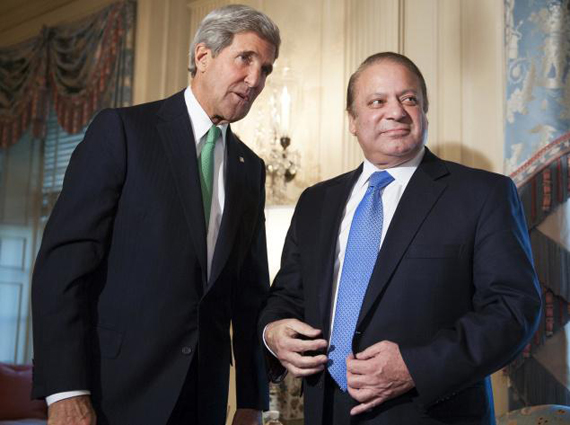
Meanwhile, meeting Sharif over dinner Sunday night, Secretary of State John Kerry said "We're very anxious to have a series of high-level, important discussions over the course of the next few days - the Vice President (Joe Biden), the President, tonight's dinner."

"We have a lot to talk about and the relationship with Pakistan could not be more important. On its own, a democracy that is working hard to get its economy moving and deal with insurgency and also important to the regional stability," he said.

Sharif, who last visited Washington in 1999 during the Kargil war before he was overthrown in a coup by Gen Pervez Musharraf, will hold a series of meetings with the top US officials and lawmakers on Capitol Hill.

Earlier
Nawaz Sharif meets US Secretary of State John Kerry

Washington, Oct 21: Visiting Pakistan Prime Minister Nawaz Sharif on Monday met U.S. Secretary of State John Kerry and discussed a wide range of bilateral and regional issues, the State Department said.

“Secretary Kerry's meeting with the PM (Sharif) is their third in three months, and continued the robust dialogue on our shared goal of a stable, secure and prosperous Pakistan,” a statement issued by the State Department said.

Sharif is in Washington on a four-day official visit to the U.S., and is scheduled to meet President Barack Obama on October 23.

He is accompanied by a high-powered delegation that includes Finance Minister Ishaq Dar, Adviser to the Prime Minister on National Security and Foreign Affairs Sartaj Aziz and Foreign Secretary Jalil Abbas Jilani.

Monday's discussions covered a broad range of domestic and regional issues including peace and security, counter-terrorism cooperation, collaboration on Pakistan's energy sector, increasing bilateral trade and investment and the common interest of a secure, stable Afghanistan, it said.

“Both sides agreed on the importance of our continued counterterrorism cooperation, and that extremism is countered in part by opportunities arising from greater economic stability.

“To that end, the U.S., Pakistan's largest trading partner, remains committed to an economic relationship increasingly based on trade and investment,” the statement said.

Meanwhile, the Obama administration has requested the U.S. Congress to resume the security assistance to Pakistan, which now stands at 305 million U.S. dollars for fiscal year 2014, a drop of 35 per cent as compared to the 2012 fiscal.

The drop is because the Administration has not asked for a renewal of temporary Pakistan Counterinsurgency Capability Fund (PCCF), which was started in the year 2009, a senior administration official told PTI.

Comments

Add new comment

  • Coastaldigest.com reserves the right to delete or block any comments.
  • Coastaldigset.com is not responsible for its readers’ comments.
  • Comments that are abusive, incendiary or irrelevant are strictly prohibited.
  • Please use a genuine email ID and provide your name to avoid reject.
News Network
May 24,2020

Beijing, May 24: The Chinese virology institute in the city where COVID-19 first emerged has three live strains of bat coronavirus on-site, but none match the new contagion wreaking chaos across the world, its director has said.

Scientists think COVID-19 -- which first emerged in Wuhan and has killed some 340,000 people worldwide -- originated in bats and could have been transmitted to people via another mammal.

But the director of the Wuhan Institute of Virology told state broadcaster CGTN that claims made by US President Donald Trump and others that the virus could have leaked from the facility were "pure fabrication".

"Now we have three strains of live viruses... But their highest similarity to SARS-CoV-2 only reaches 79.8 percent," she said, referring to the coronavirus strain that causes COVID-19.

US demands immediate start to WHO review

The United States called on the World Health Organisation on Friday to begin working immediately on investigating the source of the novel coronavirus, as well as its handling of the response to the pandemic.

One of their research teams, led by Professor Shi Zhengli, has been researching bat coronaviruses since 2004 and focused on the "source tracing of SARS", the strain behind another virus outbreak nearly two decades ago.

"We know that the whole genome of SARS-CoV-2 is only 80 percent similar to that of SARS. It's an obvious difference," she said.

"So, in Professor Shi's past research, they didn't pay attention to such viruses which are less similar to the SARS virus."

Conspiracy rumours that the biosafety lab was involved in the outbreak swirled online for months before Trump and US Secretary of State Mike Pompeo brought the theory into the mainstream by claiming that there is evidence the pathogen came from the institute.

The lab has said it received samples of the then-unknown virus on December 30, determined the viral genome sequence on January 2 and submitted information on the pathogen to the WHO on January 11.

Wang said in the interview that before it received samples in December, their team had never "encountered, researched or kept the virus."

"In fact, like everyone else, we didn't even know the virus existed," she said. "How could it have leaked from our lab when we never had it?"

The World Health Organization said Washington had offered no evidence to support the "speculative" claims.

In an interview with Scientific American, Shi said the SARS-CoV-2 genome sequence did not match any of the bat coronaviruses her laboratory had previously collected and studied.

Comments

Add new comment

  • Coastaldigest.com reserves the right to delete or block any comments.
  • Coastaldigset.com is not responsible for its readers’ comments.
  • Comments that are abusive, incendiary or irrelevant are strictly prohibited.
  • Please use a genuine email ID and provide your name to avoid reject.
News Network
July 1,2020

Jul 1: Hong Kong police moved swiftly on Wednesday against protesters gearing up for the first rally since the introduction of sweeping security legislation, making their first arrest under it and warning of punishment for pro-independence material.

Beijing on Tuesday unveiled the details of the much-anticipated law after weeks of uncertainty, pushing China's freest city and one of the world's most glittering financial hubs onto a more authoritarian path.

As hundreds of protesters gathered downtown for an annual rally marking the 23rd anniversary of the former British colony's handover to China, riot police used pepper spray to arrest at least two people, while one metro station closed.

Police, who earlier banned the rally, cited the law for the first time in confronting protesters and they also made their first arrest under it - a man holding a flag advocating independence.

"You are displaying flags or banners/chanting slogans/or conducting yourselves with an intent such as secession or subversion, which may constitute offences under the ... national security law," police said in a message displayed on a purple banner.

The law will punish crimes of secession, subversion, terrorism and collusion with foreign forces with up to life in prison, heralding a more authoritarian era for the Asian financial hub.

China's parliament adopted it in response to months of pro-democracy protests last year triggered by fears that Beijing was stifling the city's freedoms, guaranteed by a "one country, two systems" formula agreed when it returned to Chinese rule.

Authorities in Beijing and Hong Kong have repeatedly said the legislation is aimed at a few "troublemakers" and will not affect rights and freedoms, nor investor interests.

But critics fear it will crush the freedoms that are seen as key to Hong Kong's success as a financial centre.

"With the release of the full detail of the law, it should be clear to those in any doubt that this is not the Hong Kong they grew up in," said Hasnain Malik, head of equity research, Tellimer in Dubai.

"The difference is that U.S. and China relations are far worse and this could be used as a pretext to impede the role of Hong Kong as a finance hub."

In Beijing, Zhang Xiaoming, executive deputy director of Beijing's Hong Kong and Macau Affairs Office, told reporters suspects arrested by Beijing's new security office in Hong Kong could be tried on the mainland.

He said the mainland's national security office abided by Chinese law and that Hong Kong's legal system could not be expected to implement the laws of the mainland. Article 55 of the law states that Beijing's national security office in Hong Kong could exercise jurisdiction over "complex" or "serious" cases.

Mainland security agencies will also be based in Hong Kong officially for the first time, with powers that go beyond city laws.

"The law is a birthday gift to (Hong Kong) and will show its precious value in the future," Zhang said, adding the law would not be applied retroactively.

On July 1 last year, hundreds of protesters stormed and vandalised the city's legislature to protest against a now-scrapped bill that would have allowed extraditions to mainland China.

Those protests evolved into calls for greater democracy, paralysing parts of the city and paving the way for Beijing's imposition of the law this week.

'INEVITABLE'

Speaking at a flag-raising ceremony to mark the handover anniversary, the city's Beijing-backed leader, Carrie Lam, said the law was the most important development since the city's return to Chinese rule.

"It is also an inevitable and prompt decision to restore stability," Lam said at the same harbour-front venue where 23 years ago the last colonial governor, Chris Patten, a staunch critic of the security law, tearfully handed back Hong Kong to Chinese rule.

Some pro-Beijing officials and political commentators say the law is aimed at sealing Hong Kong's "second return" to the motherland after the first failed to bring residents to heel.

Luo Huining, the head of Beijing's top representative office in Hong Kong, said at the ceremony the law was a "common aspiration" of Hong Kong citizens.

Critics denounced the lack of transparency surrounding the details of the legislation until it was unveiled. It came into force at 11 p.m. (1500 GMT) on Tuesday.

Some pro-democracy activists gave up membership of their groups just before the law came into force, though calling for the campaign for democracy to go on offshore.

"I saw this morning there are celebrations for Hong Kong's handover, but to me it is a funeral, a funeral for 'one country two systems'," said democracy lawmaker Kwok Ka-ki.

Comments

Add new comment

  • Coastaldigest.com reserves the right to delete or block any comments.
  • Coastaldigset.com is not responsible for its readers’ comments.
  • Comments that are abusive, incendiary or irrelevant are strictly prohibited.
  • Please use a genuine email ID and provide your name to avoid reject.
Agencies
May 8,2020

United Nations, May 8: UN Secretary-General Antonio Guterres said Friday the coronavirus pandemic keeps unleashing a tsunami of hate and xenophobia, scapegoating and scare-mongering. 

The UN chief said anti-foreigner sentiment has surged online and in the streets, anti-Semitic conspiracy theories have spread, and COVID-19-related anti-Muslim attacks have occurred. 

Guterres said migrants and refugees have been vilified as a source of the virus -- and then denied access to medical treatment. 

With older persons among the most vulnerable, contemptible memes have emerged suggesting they are also the most expendable, he said. 

And journalists, whistleblowers, health professionals, aid workers and human rights defenders are being targeted simply for doing their jobs. 

Guterres appealed for an all-out effort to end hate speech globally. The secretary-general called on political leaders to show solidarity with all people, on educational institutions to focus on digital literacy at a time when extremists are seeking to prey on captive and potentially despairing audiences. 

He called on the media, especially social media, to remove racist, misogynist and other harmful content, on civil society to strengthen their outreach to vulnerable people, and on religious figures to serve as models of mutual respect. 

And I ask everyone, everywhere, to stand up against hate, treat each other with dignity and take every opportunity to spread kindness, Guterres said.

The secretary-general stressed that COVID-19 does not care who we are, where we live, what we believe or about any other distinction. His global appeal to address and counter COVID-19-related hate speech follows his April 23 message calling the coronarivus pandemic a human crisis that is fast becoming a human rights crisis. 

Guterres said then that the pandemic has seen disproportionate effects on certain communities, the rise of hate speech, the targeting of vulnerable groups, and the risks of heavy-handed security responses undermining the health response. 

With rising ethno-nationalism, populism, authoritarianism and a push back against human rights in some countries, the crisis can provide a pretext to adopt repressive measures for purposes unrelated to the pandemic, he warned.

In February, Guterres issued a call to action to countries, businesses and people to help renew and revive human rights across the globe, laying out a seven-point plan amid concerns about climate change, conflict and repression.

Comments

Add new comment

  • Coastaldigest.com reserves the right to delete or block any comments.
  • Coastaldigset.com is not responsible for its readers’ comments.
  • Comments that are abusive, incendiary or irrelevant are strictly prohibited.
  • Please use a genuine email ID and provide your name to avoid reject.