



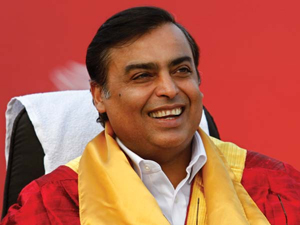
With $21-bn networth, Mukesh Ambani India's richest for 6th yr

October 29, 2013

Mukesh_AmbaniNew York, Oct 29: With a networth of USD 21 billion, Mukesh Ambani has retained his title as India's wealthiest for sixth year in a row, while the country's 100 richest persons saw their collective wealth soar by a modest 3 per cent in a year.

NRI steel tycoon Lakshmi Mittal (USD 16 billion) also continues to hold the second position, while Sun Pharma's Dilip Shanghvi has jumped to third place with about 50 per cent surge in his wealth to USD 13.9 billion, pushing IT czar Azim Premji to fourth place (USD 13.8 billion).

As per US-based business magazine Forbes' annual list of India's 100 richest, released today, their total wealth grew by a modest 3 per cent from a year ago to USD 259 billion.

"Growth in wealth was lacklustre due to India's stumbling economy, which has been hit by inflation and a falling rupee," Forbes said.

Amid the sluggishness, Reliance Industries chief Mukesh Ambani and ArcelorMittal's Lakshmi Mittal saw no change in their respective networths, but pharmaceutical industry titan Shanghi managed to buck the trend with a surge of USD 4.7 billion in his wealth to USD 13.9 billion.

Premji's wealth also rose by USD 1.6 billion, but he could not retain his third slot.

Pallonji Mistry, patriarch of construction giant Shapoorji Pallonji Group which is the biggest shareholder in Tata Sons, has moved down one place to fifth rank with a networth of USD 12.5 billion. His younger son Cyrus Mistry last year succeeded Ratan Tata as new Tata group head.

NRI businessmen Hinduja brothers have moved up to sixth place (USD 9 billion), from their 9th position last year.

Shiv Nadar (USD 8.6 billion) have moved into top-ten at the 7th place, while Sunil Mittal has also returned to this league at 10th place (USD 6.6 billion). On the other hand, Essar group's Ruia brothers and Jindal group's Savitri Jindal have moved out from the group.

Adi Godrej has slipped two places to 8th rank (USD 8.3 billion), while Aditya Birla group Chairman Kumar Mangalam Birla has gained one position to 9th (USD 7.6 billion).

Anil Ambani has also retained his 11th rank, although his wealth rose to USD 6.2 billion, from USD 6 billion a year ago.

In the top-20, he is followed by Shashi and Ravi Ruia (USD 5.5 billion), Micky Jagtiani (USD 5 billion), Savitri Jindal (USD 4.9 billion), Uday Kotak (USD 4.1 billion), Cyrus Poonawalla (USD 4 billion), Anand Burman (USD 3.7 billion), Kushal Pal Singh (USD 3.4 billion), Desh Bandhu Gupta (USD 3.2 billion) and Bajaj Family (USD 3.1 billion).

There are a total of 65 billionaires on the list, four more than last year. Some of these have made their fortunes in the Middle East, including Bahrain resident Ravi Pillai (richest newcomer with USD 1.7 billion) of Saudi construction group, Nasser S Al-Hajri Corp, and retail mogul M A Yusuff Ali (USD 1.6 billion) of Abu Dhabi-based Lulu Group.

As many as 15 new members have entered the top-100 list even as more than half of last year's rich listers, including Savitri Jindal whose wealth declined by USD 3.3 billion, have seen a fall in their fortunes.

The minimum net worth to make to the list has increased to USD 635 million from USD 460 million last year.

Forbes said that the list has been compiled using shareholder and financial information obtained from families, individuals, stock exchanges, analysts and regulators.

The ranking lists family fortunes, including those shared among extended families such as the Bajaj family, while the wealth figures were calculated based on stock prices and exchange rates as of October 18, 2013.

Privately-held companies were valued based on the valuation of similar publicly-traded companies.

Others on the list include Vedanta group's Anil Agarwal at 21st position (USD 3 billion), Gautam Adani (22, USD 2.65 billion), Kalanithi Maran (23, USD 2.6 billion), Venugopal Dhoot (30, USD 1.8 billion), Ajay Piramal (41, USD 1.55 billion), Nandan Nilekani (50, USD 1.3 billion), Rakesh Jhunjhunwala (61, USD 1.15 billion) and Anu Aga (86, USD 730).

The youngest on the list is 38-year old Shivinder Mohan Singh, who along with his 40-year-old brother Malvinder Mohan Singh have been ranked at 26th place (USD 2.3 billion).

Besides, 40-year old Ranjan Pai of Manipal group is at 51st place (USD 1.25 billion).

Others aged below 50 include Glenn Saldanha ranked 57 with net worth of USD 1.19 billion, Nirav Modi (64, USD 1.01 billion) and Vikas Oberoi (79, USD 780 billion) among others.

Women on the list include Savitri Jindal, Anu Aga, Kiran Mazumdar-Shaw and Shobhana Bhartia.

Those aged above 80 years of age include Brij Mohan Lal Munjal (90 years), Samprada Singh (87 yrs), Pallonji Mistry (84 yrs), Devendra Jain (84 yrs) and Kushal Pal Singh (82 yrs).

On Mukesh Ambani, Forbes said he plans to invest USD 25 billion in his businesses over the next 3 years.

Regarding L N Mittal, the magazine said "no turnaround yet for troubled steel baron Lakshmi Mittal whose ArcelorMittal is facing weak demand amid supply glut."

Mittal has put one of three houses he owns on London's billionaires' row up for sale, the magazine said.

Meanwhile, his son-in-law Amit Bhatia's family has partnered Air Asia's Tony Fernandes and the Tata group, for a new budget airline.

The list forms part of Forbes India edition which would hit the stands on November 7.

Shanghvi, who moved into the top five last year, is the third richest for the first time. Despite the rise, Sun reported a USD 210 million loss in the last quarter, after making a provision for settling a patent dispute over Pfizer's acid-reflux drug Protonix.

"Wipro chairman Azim Premji, whose fortune is up USD 1.6 billion in past year, got boost after spinning off its (the company's) consumer products business in March," Forbes said.

Comments

Add new comment

  • Coastaldigest.com reserves the right to delete or block any comments.
  • Coastaldigset.com is not responsible for its readers’ comments.
  • Comments that are abusive, incendiary or irrelevant are strictly prohibited.
  • Please use a genuine email ID and provide your name to avoid reject.
News Network
May 27,2020

Washington, May 27: Most viruses and other germs do not spread easily on flights, the US Center for Disease Control and Prevention has said in its COVID-19 guidelines which do not recommend following social distancing between two passengers inside a plane or keeping the middle seat unoccupied.

As a result of coronavirus pandemic, air traffic inside the US has come to a near halt. Air traffic is said to be down to about 90 per cent. For all travellers coming from overseas, the Center for Disease Control and Prevention (CDC) has recommended 14 days quarantine.

"Most viruses and other germs do not spread easily on flights because of how air circulates and is filtered on aeroplanes," the CDC has said in its set of COVID-19 guidelines for air travellers.

However, it noted that the air travellers were not risk-free especially in the time of the coronavirus pandemic and recommended Americans to avoid travel as far as possible.

"Air travel requires spending time in security lines and airport terminals, which can bring you in close contact with other people and frequently touched surfaces," it said.

"Social distancing is difficult on crowded flights, and you may have to sit near others (within six feet), sometimes for hours. This may increase your risk for exposure to the virus that causes COVID-19," the CDC said.

But instead of recommended social distancing inside commercial planes, the CDC has advised a series of preventive and hygienic measures to be taken by the airlines pilot and crew to prevent the spread of coronavirus.

The US Department of Transportation and Federal Aviation Administration in its latest safety alerts for operators on May 11 said that air carriers and crews conducting flight operations having a nexus to the US, including both domestic and foreign air carriers, should follow CDC's occupational health and safety guidance.

The CDC issued its guidelines in first guidelines for the airlines and airline crew on March and again in May.

The CDC, which has issued an exhaustive social guideline measures in various sections, is silent on keeping the middle seat of a plane unoccupied so as to maintain the six feet distance between two passengers.

It calls for the plane crew to report to the CDC a traveller with specific COVID-19 symptoms like fever, persistent cough, difficulty in breathing and appearing unwell.

Asking the airlines and cabin crew to review infection control guidelines for cabin crew, the CDC recommends several measures for cabin crew to protect themselves and others, manage a sick traveller, clean contaminated areas, and take actions after a flight.

Prominent among them include washing hands often with soap and water for at least 20 seconds, particularly after assisting sick travellers or touching potentially contaminated body fluids or surfaces and use of alcohol-based hand sanitizer (containing at least 60 per cent alcohol) if soap and water are not available.

Airlines should consider providing alcohol-based hand sanitizer to cabin and flight crews for their personal use, it said.

The CDC guidelines do not recommend following social distancing inside a plane between two passengers or keeping the middle seat unoccupied. But it asks to minimise contact between passengers and cabin crew and the sick person.

"If possible, separate the sick person from others (by a distance of 2 meters or 6 feet, ideally) and designate one crew member to serve the sick person. Offer a facemask, if available and if the sick person can tolerate it. If a facemask is not available or cannot be tolerated, ask the sick person to cover their mouth and nose with tissues when coughing or sneezing," said the CDC guidelines.

If no symptomatic passengers were identified during or immediately after the flight, the CDC recommends airlines to follow routine operating procedures for cleaning aircraft, managing solid waste, and wearing PPE.

"If symptomatic passengers are identified during or immediately after the flight, routine cleaning procedures should be followed, and enhanced cleaning procedures should also be used," it said.

Clean porous (soft) surfaces (e.g, cloth seats, cloth seat belts) at the seat of the symptomatic passengers and within 6 feet of the symptomatic passengers in all directions, it added.

Comments

Add new comment

  • Coastaldigest.com reserves the right to delete or block any comments.
  • Coastaldigset.com is not responsible for its readers’ comments.
  • Comments that are abusive, incendiary or irrelevant are strictly prohibited.
  • Please use a genuine email ID and provide your name to avoid reject.
News Network
May 22,2020

May 22: A Pakistan International Airlines (PIA) flight on its way from Lahore to Karachi, crashed in the area near Jinnah International Airport on Friday, according to Civil Aviation Authority officials.

Geo News reported that the plane crashed at the Jinnah Ground area near the airport as it was approaching for landing. There were more than 90 passengers on board the Airbus aircraft. Black smoke could be seen from afar at the crash site, say eye witnesses.

There were no immediate reports on the number of casualties. The aircraft arriving from the eastern city of Lahore was carrying 99 passengers and 8 crew members, news agency AP said, quoting Abdul Sattar Kokhar, spokesman for the country’s civil aviation authority.

Witnesses said the Airbus A320 appeared to attempt to land two or three times before crashing in a residential area near Jinnah International Airport.

Flight PK-303 from Lahore was about to land in Karachi when it crashed at the Jinnah Garden area near Model Colony in Malir, just a minute before its landing, Geo News reported.

Local television reports showed smoke coming from the direction of the airport. Ambulances were on their way to the airport.

News agency said Sindh’s Ministry of Health and Population Welfare has declared emergency in all major hospitals of Karachi due to the plane crash.

It’s the second plane crash for Pakistani carrier in less than four years. The airline’s chairman resigned in late 2016, less than a week after the crash of an ATR-42 aircraft killed 47 people. The incident comes as Pakistan was slowly resuming domestic flights in the wake of the coronavirus pandemic, Bloomberg reported.

Comments

Add new comment

  • Coastaldigest.com reserves the right to delete or block any comments.
  • Coastaldigset.com is not responsible for its readers’ comments.
  • Comments that are abusive, incendiary or irrelevant are strictly prohibited.
  • Please use a genuine email ID and provide your name to avoid reject.
Agencies
July 8,2020

Washington D.C, Jul 8:  US Secretary of State, Mike Pompeo on Tuesday (local time) announced visa restrictions on some Chinese officials under the Reciprocal Access to Tibet Act, 2018.

"Today I am announcing visa restrictions on PRC government and Chinese Communist Party officials determined to be "substantially involved in the formulation or execution of policies related to access for foreigners to Tibetan areas," pursuant to the Reciprocal Access to Tibet Act of 2018," Pompeo said.

"Access to Tibetan areas is increasingly vital to regional stability, given the PRC's human rights abuses there, as well as Beijing's failure to prevent environmental degradation near the headwaters of Asia's major rivers," he said.

The US Secretary of State pointed out that Beijing has continued "systematically to obstruct travel to the Tibetan Autonomous Region (TAR) and other Tibetan areas" by U.S. diplomats and other officials, journalists, and tourists, while PRC officials and other citizens enjoy far greater access to the United States.

"The United States will continue to work to advance the sustainable economic development, environmental conservation, and humanitarian conditions of Tibetan communities within the People's Republic of China and abroad," he said.

Pompeo said US also remains "committed to supporting meaningful autonomy for Tibetans, respect for their fundamental and unalienable human rights, and the preservation of their unique religious, cultural, and linguistic identity".

"In the spirit of true reciprocity, we will work closely with the U.S. Congress to ensure U.S. citizens have full access to all areas of the People's Republic of China, including the TAR and other Tibetan areas," he said.

Comments

Add new comment

  • Coastaldigest.com reserves the right to delete or block any comments.
  • Coastaldigset.com is not responsible for its readers’ comments.
  • Comments that are abusive, incendiary or irrelevant are strictly prohibited.
  • Please use a genuine email ID and provide your name to avoid reject.