


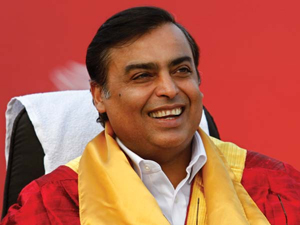
With $21-bn networth, Mukesh Ambani India's richest for 6th yr

October 29, 2013

Mukesh_AmbaniNew York, Oct 29: With a networth of USD 21 billion, Mukesh Ambani has retained his title as India's wealthiest for sixth year in a row, while the country's 100 richest persons saw their collective wealth soar by a modest 3 per cent in a year.

NRI steel tycoon Lakshmi Mittal (USD 16 billion) also continues to hold the second position, while Sun Pharma's Dilip Shanghvi has jumped to third place with about 50 per cent surge in his wealth to USD 13.9 billion, pushing IT czar Azim Premji to fourth place (USD 13.8 billion).

As per US-based business magazine Forbes' annual list of India's 100 richest, released today, their total wealth grew by a modest 3 per cent from a year ago to USD 259 billion.

"Growth in wealth was lacklustre due to India's stumbling economy, which has been hit by inflation and a falling rupee," Forbes said.

Amid the sluggishness, Reliance Industries chief Mukesh Ambani and ArcelorMittal's Lakshmi Mittal saw no change in their respective networths, but pharmaceutical industry titan Shanghi managed to buck the trend with a surge of USD 4.7 billion in his wealth to USD 13.9 billion.

Premji's wealth also rose by USD 1.6 billion, but he could not retain his third slot.

Pallonji Mistry, patriarch of construction giant Shapoorji Pallonji Group which is the biggest shareholder in Tata Sons, has moved down one place to fifth rank with a networth of USD 12.5 billion. His younger son Cyrus Mistry last year succeeded Ratan Tata as new Tata group head.

NRI businessmen Hinduja brothers have moved up to sixth place (USD 9 billion), from their 9th position last year.

Shiv Nadar (USD 8.6 billion) have moved into top-ten at the 7th place, while Sunil Mittal has also returned to this league at 10th place (USD 6.6 billion). On the other hand, Essar group's Ruia brothers and Jindal group's Savitri Jindal have moved out from the group.

Adi Godrej has slipped two places to 8th rank (USD 8.3 billion), while Aditya Birla group Chairman Kumar Mangalam Birla has gained one position to 9th (USD 7.6 billion).

Anil Ambani has also retained his 11th rank, although his wealth rose to USD 6.2 billion, from USD 6 billion a year ago.

In the top-20, he is followed by Shashi and Ravi Ruia (USD 5.5 billion), Micky Jagtiani (USD 5 billion), Savitri Jindal (USD 4.9 billion), Uday Kotak (USD 4.1 billion), Cyrus Poonawalla (USD 4 billion), Anand Burman (USD 3.7 billion), Kushal Pal Singh (USD 3.4 billion), Desh Bandhu Gupta (USD 3.2 billion) and Bajaj Family (USD 3.1 billion).

There are a total of 65 billionaires on the list, four more than last year. Some of these have made their fortunes in the Middle East, including Bahrain resident Ravi Pillai (richest newcomer with USD 1.7 billion) of Saudi construction group, Nasser S Al-Hajri Corp, and retail mogul M A Yusuff Ali (USD 1.6 billion) of Abu Dhabi-based Lulu Group.

As many as 15 new members have entered the top-100 list even as more than half of last year's rich listers, including Savitri Jindal whose wealth declined by USD 3.3 billion, have seen a fall in their fortunes.

The minimum net worth to make to the list has increased to USD 635 million from USD 460 million last year.

Forbes said that the list has been compiled using shareholder and financial information obtained from families, individuals, stock exchanges, analysts and regulators.

The ranking lists family fortunes, including those shared among extended families such as the Bajaj family, while the wealth figures were calculated based on stock prices and exchange rates as of October 18, 2013.

Privately-held companies were valued based on the valuation of similar publicly-traded companies.

Others on the list include Vedanta group's Anil Agarwal at 21st position (USD 3 billion), Gautam Adani (22, USD 2.65 billion), Kalanithi Maran (23, USD 2.6 billion), Venugopal Dhoot (30, USD 1.8 billion), Ajay Piramal (41, USD 1.55 billion), Nandan Nilekani (50, USD 1.3 billion), Rakesh Jhunjhunwala (61, USD 1.15 billion) and Anu Aga (86, USD 730).

The youngest on the list is 38-year old Shivinder Mohan Singh, who along with his 40-year-old brother Malvinder Mohan Singh have been ranked at 26th place (USD 2.3 billion).

Besides, 40-year old Ranjan Pai of Manipal group is at 51st place (USD 1.25 billion).

Others aged below 50 include Glenn Saldanha ranked 57 with net worth of USD 1.19 billion, Nirav Modi (64, USD 1.01 billion) and Vikas Oberoi (79, USD 780 billion) among others.

Women on the list include Savitri Jindal, Anu Aga, Kiran Mazumdar-Shaw and Shobhana Bhartia.

Those aged above 80 years of age include Brij Mohan Lal Munjal (90 years), Samprada Singh (87 yrs), Pallonji Mistry (84 yrs), Devendra Jain (84 yrs) and Kushal Pal Singh (82 yrs).

On Mukesh Ambani, Forbes said he plans to invest USD 25 billion in his businesses over the next 3 years.

Regarding L N Mittal, the magazine said "no turnaround yet for troubled steel baron Lakshmi Mittal whose ArcelorMittal is facing weak demand amid supply glut."

Mittal has put one of three houses he owns on London's billionaires' row up for sale, the magazine said.

Meanwhile, his son-in-law Amit Bhatia's family has partnered Air Asia's Tony Fernandes and the Tata group, for a new budget airline.

The list forms part of Forbes India edition which would hit the stands on November 7.

Shanghvi, who moved into the top five last year, is the third richest for the first time. Despite the rise, Sun reported a USD 210 million loss in the last quarter, after making a provision for settling a patent dispute over Pfizer's acid-reflux drug Protonix.

"Wipro chairman Azim Premji, whose fortune is up USD 1.6 billion in past year, got boost after spinning off its (the company's) consumer products business in March," Forbes said.

Comments

Add new comment

  • Coastaldigest.com reserves the right to delete or block any comments.
  • Coastaldigset.com is not responsible for its readers’ comments.
  • Comments that are abusive, incendiary or irrelevant are strictly prohibited.
  • Please use a genuine email ID and provide your name to avoid reject.
Agencies
February 17,2020

Islamabad, Feb 17: Prime Minister Imran Khan on Monday warned that Pakistan may face another refugee crisis if the international community failed to take notice of the current situation in India.

Speaking at the two-day refugee summit in Islamabad on 40 years of hosting Afghan refugees in Pakistan, he said India’s "ultranationalist ideology going unchecked could lead to destruction and the region could become a flashpoint", The Express Tribune quoted him as saying.

Khan said if the international community does not take notice of this situation, it will create another refugee crisis for Pakistan as Muslims of India will move to Pakistan.

"This is not the India of Jawaharlal Nehru and Mahatma Gandhi. The United Nations (UN) must play its role otherwise it will become a very big problem in the future," Duniya News quoted Khan as saying.

He said said that Prime Minister Narendra Modi’s statement that India can destroy Pakistan in 11 days is not a responsible statement by a premier of a nuclear state with a huge population, the paper reported.

Khan made the statement in the presence of visiting UN Secretary General Antonio Guterres, who was also attending the summit.

He said because of the "Hindutva" ideology, Kashmiris have been lockdown for over 200 days. He alleged under the same ideology, the BJP-led government passed two discriminatory nationalistic legislations, targeting 200 million Muslims in India.

Khan was referring to India's Citizenship (Amendment) Act and the revocation of the special status to Jammu and Kashmir.

The new citizenship law passed by the Indian Parliament in December 2019 offers citizenship to non-Muslim persecuted religious minorities from Pakistan, Bangladesh and Afghanistan.

The Indian government has maintained that the CAA is an internal matter of the country and stressed that the goal is to protect the oppressed minorities of neighbouring countries.

India revoked Jammu and Kashmir's special status on August 5. Reacting to India's move, Pakistan downgraded diplomatic ties with New Delhi and expelled the Indian High Commissioner.

India has always maintained that Jammu and Kashmir is its integral part and ruled out any third party mediation, including either from the UN or the US, saying it is a bilateral issue with Pakistan.

Comments

Add new comment

  • Coastaldigest.com reserves the right to delete or block any comments.
  • Coastaldigset.com is not responsible for its readers’ comments.
  • Comments that are abusive, incendiary or irrelevant are strictly prohibited.
  • Please use a genuine email ID and provide your name to avoid reject.
News Network
June 2,2020

Jun 2: A new female billionaire has emerged from one of Asia's most-expensive breakups.

Du Weimin, the chairman of Shenzhen Kangtai Biological Products Co., transferred 161.3 million shares of the vaccine maker to his ex-wife, Yuan Liping, according to a May 29 filing, immediately catapulting her into the ranks of the world's richest.

The stock was worth $3.2 billion as of Monday's close.

Yuan, 49 this year, owns the shares directly, but signed an agreement delegating the voting rights to her ex-husband, the filing shows. The Canadian citizen, who resides in Shenzhen, served as a director of Kangtai between May 2011 and August 2018. She's now the vice general manager of subsidiary Beijing Minhai Biotechnology Co. Yuan holds a bachelor's degree in economics from Beijing's University of International Business and Economics.

Kangtai shares have more than doubled in the past year and have continued their ascent since February, when the company announced a plan to develop a vaccine to fight the coronavirus. They slipped for a second day Tuesday following news of the divorce terms, losing 3.1% as of 9:43 a.m. in Hong Kong and bringing the company's market value to $12.9 billion.

Du's net worth has now dropped to about $3.1 billion from $6.5 billion before the split, excluding his pledged shares.

The 56-year-old was born into a farming family in China's Jiangxi province. After studying chemistry in college, he began working in a clinic in 1987 and became a sales manager for a biotech company in 1995, according to the prospectus of Kangtai's 2017 initial public offering. In 2009, Kangtai acquired Minhai, the company Du founded in 2004, and he became the chairman of the combined entity.

China's rapidly growing economy has been an engine for the country's richest, and Du is not the only tycoon who's had to pay a steep price for a divorce. In 2012, Wu Yajun, at one point the nation's richest woman, transferred a stake worth about $2.3 billion to her ex-husband, Cai Kui, who co-founded developer Longfor Group Holdings Ltd. In 2016, tech billionaire Zhou Yahui gave $1.1 billion of shares in his online gaming company, Beijing Kunlun Tech Co., to ex-wife Li Qiong after a civil court settlement.

Sometimes, a goodbye can be time-consuming too. South Korean tycoon Chey Tae-won's wife filed a lawsuit in December asking for a 42.3% stake in SK Holdings Co. valued at $1.2 billion. That would make her the second-largest shareholder of the company should she win the case, which is still ongoing.

The most expensive divorce in history is that of Jeff and MacKenzie Bezos. The Amazon.com Inc. founder gave 4% of the online retailer to Mackenzie, who now has a $48 billion fortune and is the world's fourth-richest woman.

Comments

Add new comment

  • Coastaldigest.com reserves the right to delete or block any comments.
  • Coastaldigset.com is not responsible for its readers’ comments.
  • Comments that are abusive, incendiary or irrelevant are strictly prohibited.
  • Please use a genuine email ID and provide your name to avoid reject.
News Network
January 23,2020

Jan 23: Pakistan's Prime Minister Imran Khan called on Wednesday for the United Nations to help mediate between nuclear armed India and Pakistan over the disputed territory of Kashmir.

"This is a potential flashpoint," Khan said during a media briefing at the annual meeting of the World Economic Forum in Davos, Switzerland, adding that it was time for the "international institutions ... specifically set up to stop this" to "come into action".

The Indian government in August revoked the constitutional autonomy of Indian-administered Kashmir, splitting the Muslim-majority region into two federal territories in a bid to integrate it fully with the rest of the country.

Kashmir is claimed in full by both India and Pakistan. The two countries have gone to war twice over it, and both rule parts of it. India's portion has been plagued by separatist violence since the late 1980s.

Khan said his biggest fear was how New Delhi would respond to ongoing protests in India over a citizenship law that many feel targets Muslims.

"We're not close to a conflict right now ... What if the protests get worse in India, and to distract attention from that, what if ..."

The prime minister said he had discussed the prospect of war between his country and India in a Tuesday meeting with US President Donald Trump. Trump later said he had offered to help mediate between the two countries.

Khan said Pakistan and the United States were closer in their approach to the Taliban armed rebellion in Afghanistan than they had been for many years. He said he had never seen a military solution to that conflict.

"Finally the position of the US is there should be negotiations and a peace plan."

In a separate on-stage conversation later on Wednesday, Khan said he had told Trump in their meeting that a war with Iran would be "a disaster for the world". Trump had not responded, Khan said.

Khan made some of his most straightforward comments when asked why Pakistan has been muted in defence of Uighurs in China.

China has been widely condemned for setting up complexes in remote Xinjiang province that Beijing describes as "vocational training centres" to stamp out ""extremism and give people new skills.

The United Nations says at least one million ethnic Uighurs and other Muslims have been detained.

When pressed on China's policies, Khan said Pakistan's relations with Beijing were too important for him to speak out publicly.

"China has helped us when we were at rock bottom. We are really grateful to the Chinese government, so we have decided that any issues we have had with China we will handle privately."

Comments

Add new comment

  • Coastaldigest.com reserves the right to delete or block any comments.
  • Coastaldigset.com is not responsible for its readers’ comments.
  • Comments that are abusive, incendiary or irrelevant are strictly prohibited.
  • Please use a genuine email ID and provide your name to avoid reject.