


With $21-bn networth, Mukesh Ambani India's richest for 6th yr

October 29, 2013

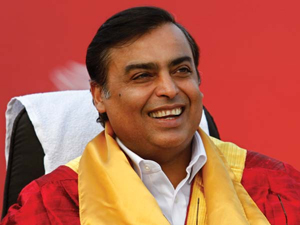
Mukesh_AmbaniNew York, Oct 29: With a networth of USD 21 billion, Mukesh Ambani has retained his title as India's wealthiest for sixth year in a row, while the country's 100 richest persons saw their collective wealth soar by a modest 3 per cent in a year.

NRI steel tycoon Lakshmi Mittal (USD 16 billion) also continues to hold the second position, while Sun Pharma's Dilip Shanghvi has jumped to third place with about 50 per cent surge in his wealth to USD 13.9 billion, pushing IT czar Azim Premji to fourth place (USD 13.8 billion).

As per US-based business magazine Forbes' annual list of India's 100 richest, released today, their total wealth grew by a modest 3 per cent from a year ago to USD 259 billion.

"Growth in wealth was lacklustre due to India's stumbling economy, which has been hit by inflation and a falling rupee," Forbes said.

Amid the sluggishness, Reliance Industries chief Mukesh Ambani and ArcelorMittal's Lakshmi Mittal saw no change in their respective networths, but pharmaceutical industry titan Shanghi managed to buck the trend with a surge of USD 4.7 billion in his wealth to USD 13.9 billion.

Premji's wealth also rose by USD 1.6 billion, but he could not retain his third slot.

Pallonji Mistry, patriarch of construction giant Shapoorji Pallonji Group which is the biggest shareholder in Tata Sons, has moved down one place to fifth rank with a networth of USD 12.5 billion. His younger son Cyrus Mistry last year succeeded Ratan Tata as new Tata group head.

NRI businessmen Hinduja brothers have moved up to sixth place (USD 9 billion), from their 9th position last year.

Shiv Nadar (USD 8.6 billion) have moved into top-ten at the 7th place, while Sunil Mittal has also returned to this league at 10th place (USD 6.6 billion). On the other hand, Essar group's Ruia brothers and Jindal group's Savitri Jindal have moved out from the group.

Adi Godrej has slipped two places to 8th rank (USD 8.3 billion), while Aditya Birla group Chairman Kumar Mangalam Birla has gained one position to 9th (USD 7.6 billion).

Anil Ambani has also retained his 11th rank, although his wealth rose to USD 6.2 billion, from USD 6 billion a year ago.

In the top-20, he is followed by Shashi and Ravi Ruia (USD 5.5 billion), Micky Jagtiani (USD 5 billion), Savitri Jindal (USD 4.9 billion), Uday Kotak (USD 4.1 billion), Cyrus Poonawalla (USD 4 billion), Anand Burman (USD 3.7 billion), Kushal Pal Singh (USD 3.4 billion), Desh Bandhu Gupta (USD 3.2 billion) and Bajaj Family (USD 3.1 billion).

There are a total of 65 billionaires on the list, four more than last year. Some of these have made their fortunes in the Middle East, including Bahrain resident Ravi Pillai (richest newcomer with USD 1.7 billion) of Saudi construction group, Nasser S Al-Hajri Corp, and retail mogul M A Yusuff Ali (USD 1.6 billion) of Abu Dhabi-based Lulu Group.

As many as 15 new members have entered the top-100 list even as more than half of last year's rich listers, including Savitri Jindal whose wealth declined by USD 3.3 billion, have seen a fall in their fortunes.

The minimum net worth to make to the list has increased to USD 635 million from USD 460 million last year.

Forbes said that the list has been compiled using shareholder and financial information obtained from families, individuals, stock exchanges, analysts and regulators.

The ranking lists family fortunes, including those shared among extended families such as the Bajaj family, while the wealth figures were calculated based on stock prices and exchange rates as of October 18, 2013.

Privately-held companies were valued based on the valuation of similar publicly-traded companies.

Others on the list include Vedanta group's Anil Agarwal at 21st position (USD 3 billion), Gautam Adani (22, USD 2.65 billion), Kalanithi Maran (23, USD 2.6 billion), Venugopal Dhoot (30, USD 1.8 billion), Ajay Piramal (41, USD 1.55 billion), Nandan Nilekani (50, USD 1.3 billion), Rakesh Jhunjhunwala (61, USD 1.15 billion) and Anu Aga (86, USD 730).

The youngest on the list is 38-year old Shivinder Mohan Singh, who along with his 40-year-old brother Malvinder Mohan Singh have been ranked at 26th place (USD 2.3 billion).

Besides, 40-year old Ranjan Pai of Manipal group is at 51st place (USD 1.25 billion).

Others aged below 50 include Glenn Saldanha ranked 57 with net worth of USD 1.19 billion, Nirav Modi (64, USD 1.01 billion) and Vikas Oberoi (79, USD 780 billion) among others.

Women on the list include Savitri Jindal, Anu Aga, Kiran Mazumdar-Shaw and Shobhana Bhartia.

Those aged above 80 years of age include Brij Mohan Lal Munjal (90 years), Samprada Singh (87 yrs), Pallonji Mistry (84 yrs), Devendra Jain (84 yrs) and Kushal Pal Singh (82 yrs).

On Mukesh Ambani, Forbes said he plans to invest USD 25 billion in his businesses over the next 3 years.

Regarding L N Mittal, the magazine said "no turnaround yet for troubled steel baron Lakshmi Mittal whose ArcelorMittal is facing weak demand amid supply glut."

Mittal has put one of three houses he owns on London's billionaires' row up for sale, the magazine said.

Meanwhile, his son-in-law Amit Bhatia's family has partnered Air Asia's Tony Fernandes and the Tata group, for a new budget airline.

The list forms part of Forbes India edition which would hit the stands on November 7.

Shanghvi, who moved into the top five last year, is the third richest for the first time. Despite the rise, Sun reported a USD 210 million loss in the last quarter, after making a provision for settling a patent dispute over Pfizer's acid-reflux drug Protonix.

"Wipro chairman Azim Premji, whose fortune is up USD 1.6 billion in past year, got boost after spinning off its (the company's) consumer products business in March," Forbes said.

Comments

Add new comment

  • Coastaldigest.com reserves the right to delete or block any comments.
  • Coastaldigset.com is not responsible for its readers’ comments.
  • Comments that are abusive, incendiary or irrelevant are strictly prohibited.
  • Please use a genuine email ID and provide your name to avoid reject.
Agencies
February 4,2020

As the deadly coronavirus has spread worldwide, it has carried with it xenophobia -- and Asian communities around the world are finding themselves subject to suspicion and fear.

When a patient on Australia's Gold Coast refused to shake the hand of her surgeon Rhea Liang, citing the virus that has killed hundreds, the medic's first response was shock.

But after tweeting about the incident and receiving a flood of responses, the respected doctor learned her experience was all too common.

There has been a spike in reports of anti-Chinese rhetoric directed at people of Asian origin, regardless of whether they have ever visited the centre of the epidemic or been in contact with the virus.

Chinese tourists have reportedly been spat at in the Italian city of Venice, a family in Turin was accused of carrying the disease, and mothers in Milan have used social media to call for children to be kept away from Chinese classmates.

In Canada, a white man was filmed telling a Chinese-Canadian woman "you dropped your coronavirus" in the parking lot of a local mall.

In Malaysia, a petition to "bar Chinese people from entering our beloved country" received almost 500,000 signatures in one week.

The incidents are part of what the Australasian College for Emergency Medicine has described as "misinformation" which it says is fuelling "racial profiling" where "deeply distressing assumptions are being made about 'Chinese' or 'Asian-looking' people." Disease has long been accompanied by suspicions of foreigners -- from Irish immigrants being targeted in the Typhoid Mary panic of 1900s America to Nepali peacekeepers being accused of bringing cholera to earthquake-struck Haiti in the last decade.

"It's a common phenomenon," said Rob Grenfell, director of health and biosecurity for Australia's science and research agency CSIRO.

"With outbreaks and epidemics along human history, we've always tried to vilify certain subsets of the population," he said, comparing the behaviour to 1300s plague-ridden medieval Europe, where foreigners and religious groups were often blamed.

"Sure it emerged in China," he said of the coronavirus, "but that's no reason to actually vilify Chinese people." In a commentary for the British Medical Journal, doctor Abraar Karan warned this behaviour could discourage people with symptoms from coming forward.

Claire Hooker, a health lecturer at the University of Sydney, said the responses from governments may have compounded prejudice.

The World Health Organisation has warned against "measures that unnecessarily interfere with international travel and trade", but this has not stopped scores of countries from introducing travel bans.

The tiny Pacific nation of Micronesia has banned its citizens from visiting mainland China altogether.

"Travel bans respond largely to people's fears," said Hooker, and while sometimes warranted, they often "have the effect of cementing an association between Chinese people and scary viruses".

Abbey Shi, a Shanghai-born student in Sydney, said the attitude shown by some of her peers has "become almost an attack on students who are Chinese".

While Australia's conservative government has banished its citizens returning from Wuhan -- the central Chinese city at the epicentre of the virus -- to a remote island for quarantine, thousands of students still stuck in China risk their studies being torpedoed.

"Right now it looks like they have to miss the semester's start and potentially the whole year, because of the way the courses are set up," Shi said.

According to Hooker, studies in Toronto on the impact of Severe Acute Respiratory Syndrome, or SARS -- another global coronavirus outbreak in 2002 -- showed the impact of xenophobic sentiment often lasted much longer than the public health scare.

"While there may be a cessation of direct forms of racism as news about the disease dies down, it takes quite a bit of time for economic recovery and people continue to feel unsafe," she said.

People may not rush back to Chinese businesses or restaurants, and may even heed some of the more outlandish viral social media disinformation -- such as one popular post imploring people to avoid eating noodles for their own safety.

"In one sense you might think the effects lasted from the last coronavirus to this one because the representation as China being a place where diseases come from has been persistent," Hooker said.

Comments

Add new comment

  • Coastaldigest.com reserves the right to delete or block any comments.
  • Coastaldigset.com is not responsible for its readers’ comments.
  • Comments that are abusive, incendiary or irrelevant are strictly prohibited.
  • Please use a genuine email ID and provide your name to avoid reject.
News Network
January 27,2020

Kabul, Jan 27: A passenger plane crashed on Monday in a Taliban-held area of Afghanistan's Ghazni province, local officials said.

Arif Noori, spokesman for the provincial governor, said the plane went down around 1:10 p.m. local time in Deh Yak district, which is held by the Taliban. Two provincial council members also confirmed the crash.

The number of people on board and their fate was not immediately known, nor was the cause of the crash.

Ariana Airlines, Afghanistan's national carrier, dismissed the claim that one of their planes had crashed in a statement on their website, saying all their aircraft were operational and safe.

The mountainous Ghazni province sits in the foothills of the Hindu Kush mountains and is bitterly cold in winter.

The last major commercial air crash in Afghanistan occurred in 2005 when a Kam Air flight from western Herat to the capital Kabul crashed into the mountains as it tried to land in snowy weather.

The war however has seen a number of deadly crashes of military aircraft. One of the most spectacular occurred in 2013 when an American Boeing 747 cargo jet crashed shortly after takeoff from Bagram air base north of Kabul en route to Dubai in the United Arab Emirates. All seven crew member were killed.

Afghanistan's aviation industry suffered desperately during the rule of the Taliban when its only airline Ariana was subject to punishing sanctions and allowed to fly only to Saudi Arabia for Hajj flights.

Since the overthrow of the religious regime smaller private airlines have emerged but the industry is still a nascent one.

Comments

Add new comment

  • Coastaldigest.com reserves the right to delete or block any comments.
  • Coastaldigset.com is not responsible for its readers’ comments.
  • Comments that are abusive, incendiary or irrelevant are strictly prohibited.
  • Please use a genuine email ID and provide your name to avoid reject.
News Network
March 18,2020

Melbourne, Mar 18: Australian Prime Minister Scott Morrison on Wednesday warned its citizens not to travel abroad and banned "non-essential" gatherings of 100 people or more as the government declared the deadly coronavirus, that has infected over 450 people in the country, a "human biosecurity emergency".

Prime Minister Morrison on Wednesday said Australians should abandon all overseas travel because of the coronavirus epidemic. There have been 40 new cases since Tuesday.

Of the 454 confirmed cases in Australia, 43 have recovered and 5 have died from the COVID-19, according to the official figures.

Morrison declared a national "human biosecurity emergency" and ordered a halt to "non-essential" indoor gatherings of more than 100 people, on top of an existing ban on outdoor events of more than 500.

He said, "We haven't seen this sort of thing in Australia since the end of the First World War. This is a once-in-a-100-year-type event," Morrison said.

"Life is changing in Australia, as it is changing all around the world. Life is going to continue to change. The travel advice to every Australian is do not travel abroad. Do not go overseas."

However, schools across the country were still to remain open.

Morrison said Australia should prepare for "at least six months" of disruption as health authorities attempt to get on top of the coronavirus.

"For those of you thinking about going overseas for the school holidays, don’t. Don't go overseas," he said.

Morrison said there would be no short-term, quick fix to deal with the COVID-19 crisis in Australia, and warned that "tens of thousands of jobs" could be lost.

Responding to the panic buying, the prime minister urged the public to "Stop hoarding."

"I can't be more blunt about it. Stop it. It is not sensible, it is not helpful and it has been one of the most disappointing things I have seen in Australian behaviour in response to this crisis," he said.

On Wednesday, the New South Wales recorded a massive jump in new 59 cases as travellers returned from overseas. The cases jumped from 210 to 269 in the past 24 hours, according to the media reports here.

Queensland's total number of confirmed cases stood at 94.

State Premier Annastacia Palaszczuk said it is now "a different world" from just last week.

For Victoria, the Premier Daniel Andrew said the government could also ban gatherings of fewer than 100 people, noting he could not rule out further changes.

Chief Health Officer Brett Sutton said the spike in cases has been due to people who have travelled overseas.

Sutton said that the transmission in Victoria was not because of community transition like Italy.

Sutton has continued to urge people to wash their hands, socially distance and stay home if they are unwell.

"These are critical measures to be applied regardless of the 100 and 500 threshold,” he said.

In Western Australia, Health Minister Roger Cook said four new coronavirus cases have been confirmed overnight, taking the State's total to 35.

McGowan also condemned panic buyers in supermarkets as "jerks, drongos and bloody idiots."

He said there was "plenty of food to go round" and no need for people to buy in excessive quantities.

The outbreak, which first emerged in China's Wuhan city last year, has marched across the globe, infecting 198,006 people and killing 7,948, according to a tracker maintained by the Johns Hopkins University.

Comments

Add new comment

  • Coastaldigest.com reserves the right to delete or block any comments.
  • Coastaldigset.com is not responsible for its readers’ comments.
  • Comments that are abusive, incendiary or irrelevant are strictly prohibited.
  • Please use a genuine email ID and provide your name to avoid reject.