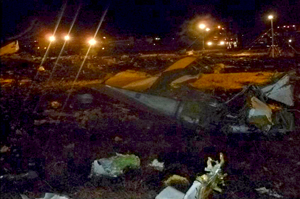
Boeing crashes in Russia, 50 killed

November 18, 2013

RUSSIA-CRASHMoscow, Nov 18: A Boeing 737-500 airliner crashed on landing in the Russian city of Kazan on Sunday, killing all 50 on board and highlighting the poor safety record of Russian airlines that ply internal routes across the world's largest nation.

The Tatarstan airlines flight from Moscow was trying to abort its landing in order to make a second approach, but it exploded on hitting the runway, killing all 44 passengers and six crew on board, emergency officials said.

The only picture shown from the scene on Russian television reports was a blurred still shot of the plane's fuselage with firefighters in the foreground, apparently after they had extinguished a fire at the scene.

Flight U363 took off from Moscow's Domodedovo airport at 6:25 pm (1425 GMT) and crashed just over an hour later, emergency officials said.

The plane was 23 years old.

According to eyewitness reports, the Boeing lost altitude quickly and its fuel tank exploded on impact. There were high winds and cloudy skies over the airport in central Russia.

Boeing officials at the Dubai Airshow declined to comment on the crash.

Kazan, which is 800 km east of Moscow, is capital of the largely-Muslim, oil-rich region of Tatarstan. A new runway was built at the airport ahead of the World Student Games, held in the city earlier this year.

Russia will host the Winter Olympics in the southern city of Sochi early next year.

Russia spans nine time zones, from the Baltic Sea to the Pacific across large areas of largely uninhabited land, making efficient air travel and train links especially important to the country's economy.

A spokesman for state aviation oversight agency Rosaviatsia said authorities woulds search for the flight recorders. "The plane touched the ground and burst into flame," Sergei Izvolsky said. "The cause of the crash as of now is unknown."

Russia and the former Soviet republics combined had one of the world's worst safety records in 2011, with a total accident rate almost three times the world average, according to the International Air Transport Association.

Comments

Add new comment

  • Coastaldigest.com reserves the right to delete or block any comments.
  • Coastaldigset.com is not responsible for its readers’ comments.
  • Comments that are abusive, incendiary or irrelevant are strictly prohibited.
  • Please use a genuine email ID and provide your name to avoid reject.
Agencies
July 15,2020

Washington, Jul 15: The Trump administration has agreed to rescind its July 6 rule, which temporarily barred international students from staying in the United States unless they attend at least one in-person course, a federal district court judge said on Tuesday.

The U-turn by the Trump administration comes following a nationwide outrage against its July 6 order and a series of lawsuits filed by a large number of educational institutions, led by the prestigious Harvard University and Massachusetts Institute of Technology (MIT), seeking a permanent injunctive relief to bar the Department of Homeland Security (DHS) and the US Immigration and Customs Enforcement (ICE) from enforcing the federal guidelines barring international students attending colleges and universities offering only online courses from staying in the country.

As many as 17 US states and the District of Columbia, along with top American IT companies such as Google, Facebook and Microsoft, joined MIT and Harvard in the US District Court in Massachusetts against the DHS and the ICE in seeking an injunction to stop the entire rule from going into effect.

"I have been informed by the parties that they have come to a resolution. They will return to the status quo," Judge Allison Burroughs, the federal district judge in Boston, said in a surprise statement at the top of the hearing on the lawsuit.

The announcement comes as a big relief to international students, including those from India. In the 2018-2019 academic year, there were over 10 lakh international students in the US. According to a recent report of the Student and Exchange Visitor Program (SEVP), 1,94,556 Indian students were enrolled in various academic institutions in the US in January.

Judge Burroughs said the policy would apply nationwide.

"Both the policy directive and the frequently asked questions would not be enforced anyplace," she said, referring to the agreement between the US government and MIT and Harvard.

Congressman Brad Scneider said this is a great win for international students, colleges and common sense.

"The Administration needs to give us a plan to tackle our public health crisis - it can't be recklessly creating rules one day and rescinding them the next," he said in a tweet.

Last week, more than 136 Congressmen and 30 senators wrote to the Trump administration to rescind its order on international students.

"This is a major victory for the students, organisers and institutions of higher education in the #MA7 and all across the country that stood up and fought back against this racist and xenophobic rule," said Congresswoman Ayanna Pressley.

"Taking online classes shouldn't force international students out of our country," Congressman Mikie Sherrill said in a tweet.

In its July 6 notice, the ICE had said all student visa holders, whose university curricula were only offered online, "must depart the country or take other measures, such as transferring to a school with in-person instruction to remain in lawful status".

"If not, they may face immigration consequences, including but not limited to the initiation of removal proceedings," it had said.

In their lawsuit, the 17 states and the District of Columbia said for many international students, remote learning in the countries and communities they come from would impede their studies or be simply impossible.

The lawsuit alleged that the new rule imposes a significant economic harm by precluding thousands of international students from coming to and residing in the US and finding employment in fields such as science, technology, biotechnology, healthcare, business and finance, and education, and contributing to the overall economy.

In a separate filing, companies like Google, Facebook and Microsoft, along with the US Chamber of Commerce and other IT advocacy groups, asserted that the July 6 ICE directive will disrupt their recruiting plans, making it impossible to bring on board international students that businesses, including the amici, had planned to hire, and disturb the recruiting process on which the firms have relied on to identify and train their future employees.

The July 6 directive will make it impossible for a large number of international students to participate in the CPT and OPT programmes. The US will "nonsensically be sending...these graduates away to work for our global competitors and compete against us...instead of capitalising on the investment in their education here in the US", they said.

Comments

Add new comment

  • Coastaldigest.com reserves the right to delete or block any comments.
  • Coastaldigset.com is not responsible for its readers’ comments.
  • Comments that are abusive, incendiary or irrelevant are strictly prohibited.
  • Please use a genuine email ID and provide your name to avoid reject.
News Network
February 24,2020

Beijing, Feb 24: The lockdown of Guo Jing's neighbourhood in Wuhan -- the city at the heart of China's new coronavirus epidemic -- came suddenly and without warning.

Unable to go out, the 29-year-old is now sealed inside her compound where she has to depend on online group-buying services to get food.

"Living for at least another month isn't an issue," Guo told news agency, explaining that she had her own stash of pickled vegetables and salted eggs.

But what scares her most is the lack of control -- first, the entire city was sealed off, and then residents were limited to exiting their compound once every three days.

Now even that has been taken away.

Guo is among some 11 million residents in Wuhan, a city in central Hubei province that has been under effective quarantine since January 23 as Chinese authorities race to contain the epidemic.

Since then, its people have faced a number of tightening controls over daily life as the death toll from the virus swelled to over 2,500 in China alone.

But the new rules this month barring residents from leaving their neighbourhoods are the most restrictive yet -- and for some, threaten their livelihoods.

"I still don't know where to buy things once we've finished eating what we have at home," said Pan Hongsheng, who lives with his wife and two children.

Some neighbourhoods have organised group-buying services, where supermarkets deliver orders in bulk.

But in Pan's community, "no one cares".

"The three-year-old doesn't even have any milk powder left," Pan told news agency, adding that he has been unable to send medicine to his in-laws -- both in their eighties -- as they live in a different area.

"I feel like a refugee."

The "closed management of neighbourhoods is bound to bring some inconvenience to the lives of the people", Qian Yuankun, vice secretary of Hubei's Communist Party committee, said at a press briefing last week.

Authorities on Monday allowed healthy non-residents of the city to leave if they never had contact with patients, but restrictions remained on those who live in Wuhan.

Demand for group-buying food delivery services has rocketed with the new restrictions, with supermarkets and neighbourhood committees scrambling to fill orders.

Most group-buying services operate through Chinese messaging app WeChat, which has ad-hoc chat groups for meat, vegetables, milk -- even "hot dry noodles", a famous Wuhan dish.

More sophisticated shops and compounds have their own mini-app inside WeChat, where residents can choose packages priced by weight before orders are sent in bulk to grocery stores.

In Guo's neighbourhood, for instance, a 6.5-kilogramme (14.3-pound) set of five vegetables, including potatoes and baby cabbage, costs 50 yuan ($7.11).

"You have no way to choose what you like to eat," Guo said. "You cannot have personal preferences anymore."

The group-buying model is also more difficult for smaller communities to adopt, as supermarkets have minimum order requirements for delivery.

"To be honest, there's nothing we can do," said Yang Nan, manager of Lao Cun Zhang supermarket, which requires a minimum of 30 orders.

"We only have four cars," she said, explaining that the store did not have the staff to handle smaller orders.

Another supermarket told AFP it capped its daily delivery load to 1,000 orders per day.

"Hiring staff is difficult," said Wang Xiuwen, who works at the store's logistics division, adding that they are wary about hiring too many outsiders for fear of infection.

Closing off communities has split the city into silos, with different neighbourhoods rolling out controls of varying intensity.

In some compounds, residents have easier access to food -- albeit a smaller selection than normal -- and one woman said her family pays delivery drivers to run grocery errands.

Her compound has not been sealed off either, the 24-year-old told AFP under condition of anonymity, though they are limited to one person leaving at a time.

Some districts have implemented their own rules, such as prohibiting supermarkets from selling to individuals, forcing neighbourhoods to buy in bulk or not at all.

"In the neighbourhood where I live, the reality is really terrible," said David Dai, who is based on the outskirts of Wuhan.

Though his apartment complex has organised group-buying, Dai said residents were unhappy with price and quality.

"A lot of tomatoes, a lot of onions -- they were already rotten," he told , estimating over a third of the food had to be thrown away.

His family must "totally depend" on themselves, added the 49-year-old, who has resorted to saving and drying turnip skins to add nutrients to future meals.

The uncertainty of not knowing when the controls will be lifted is also frustrating, said Ma Chen, a man in his 30s who lives alone.

"I have no way of knowing how much (food) I should buy."

Comments

Add new comment

  • Coastaldigest.com reserves the right to delete or block any comments.
  • Coastaldigset.com is not responsible for its readers’ comments.
  • Comments that are abusive, incendiary or irrelevant are strictly prohibited.
  • Please use a genuine email ID and provide your name to avoid reject.
News Network
June 6,2020

United Nations, Jun 6: US President Donald Trump’s response to protests against the killing of African-American George Floyd has included language “directly associated with racial segregationists” from America's past, a group of UN human rights experts have said.

There have been widespread protests across the United States as Floyd, 46, was killed by a white police officer in Minneapolis. People from diverse backgrounds have called for justice and have voiced their support to the protests.

In the wake of protests over the killing of Floyd, Trump had tweeted that “when the looting starts, the shooting starts.”

“The response of the President of the United States to the protests at different junctures has included threatening more state violence using language directly associated with racial segregationists from the nation’s past, who worked hard to deny black people fundamental human rights," a statement issued on Friday by over 60 independent experts of the Special Procedures of the United Nations Human Rights Council said.

"We are deeply concerned that the nation is on the brink of a militarised response that reenacts the injustices that have driven people to the streets to protest,” it said.

A report in The New York Times had said that the phrase "When the looting starts, the shooting starts” was used by Miami’s former police chief Walter Headley in 1967. Headley had been “long accused of using racist tactics in his force’s patrols of black neighbourhoods,” the NYT had said.

They said the recent killing of Floyd has shocked many in the world, “but it is the lived reality of black people across the United States. The uprising nationally is a protest against systemic racism that produces state-sponsored racial violence, and licenses impunity for this violence.”

They noted that following the recent spate of killings of African-Americans, many in the United States and abroad are finally acknowledging that “the problem is not a few bad apples” but instead the problem is the very way that economic, political and social life are structured in a country that prides itself in liberal democracy, and with the largest economy in the world.

Separately, 28 UN experts called on the US Government to take decisive action to address systemic racism and racial bias in the country's criminal justice system by launching independent investigations and ensuring accountability in all cases of excessive use of force by police.

“Exactly 99 years after the massacre in Tulsa, involving the killing of people of African descent and the massive loss of life, destruction of property and loss of wealth on ‘Black Wall Street’, African Americans continue to experience racial terror in state-sponsored and privately organised violence,” the experts said.

Strongly condemning the killings of Ahmaud Arbery, Breonna Taylor and George Floyd, the experts called for systemic reform and justice. “Given the track record of impunity for racial violence of this nature in the United States, Black people have good reason to fear for their lives.”

Taylor, a 25-year-old emergency medical technician was shot in her bed when police raided the wrong house; Arbery, 25, was fatally shot while jogging near his home by three white men who chased and cornered him; and Floyd was accused of using counterfeit currency in a store and died in the street while a white officer knelt on his neck and three others participated and observed.

“The origin story of policing in the United States of America starts with slave patrols and social control, where human property of enslavers was ‘protected’ with violence and impunity against people of African descent. In the US, this legacy of racial terror remains evident in modern-day policing,” the experts said.

The experts also raised concern about the police response to demonstrations in several US cities, termed by some the ‘Fed Up-rising’, that have been marked by violence, arbitrary arrest, militarisation and the detention of thousands of protesters. Reporters of colour have been targeted and detained, and some journalists have faced violence and harassment.

“Statements from the US Government inciting and threatening violence against protesters stand in stark contrast to calls for leniency and understanding which the Government had issued in the wake of largely white protests against COVID-19 restrictions on services like barbershops, salons, and spas,” the experts said.

Comments

Add new comment

  • Coastaldigest.com reserves the right to delete or block any comments.
  • Coastaldigset.com is not responsible for its readers’ comments.
  • Comments that are abusive, incendiary or irrelevant are strictly prohibited.
  • Please use a genuine email ID and provide your name to avoid reject.