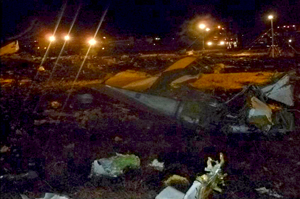
Boeing crashes in Russia, 50 killed

November 18, 2013

RUSSIA-CRASHMoscow, Nov 18: A Boeing 737-500 airliner crashed on landing in the Russian city of Kazan on Sunday, killing all 50 on board and highlighting the poor safety record of Russian airlines that ply internal routes across the world's largest nation.

The Tatarstan airlines flight from Moscow was trying to abort its landing in order to make a second approach, but it exploded on hitting the runway, killing all 44 passengers and six crew on board, emergency officials said.

The only picture shown from the scene on Russian television reports was a blurred still shot of the plane's fuselage with firefighters in the foreground, apparently after they had extinguished a fire at the scene.

Flight U363 took off from Moscow's Domodedovo airport at 6:25 pm (1425 GMT) and crashed just over an hour later, emergency officials said.

The plane was 23 years old.

According to eyewitness reports, the Boeing lost altitude quickly and its fuel tank exploded on impact. There were high winds and cloudy skies over the airport in central Russia.

Boeing officials at the Dubai Airshow declined to comment on the crash.

Kazan, which is 800 km east of Moscow, is capital of the largely-Muslim, oil-rich region of Tatarstan. A new runway was built at the airport ahead of the World Student Games, held in the city earlier this year.

Russia will host the Winter Olympics in the southern city of Sochi early next year.

Russia spans nine time zones, from the Baltic Sea to the Pacific across large areas of largely uninhabited land, making efficient air travel and train links especially important to the country's economy.

A spokesman for state aviation oversight agency Rosaviatsia said authorities woulds search for the flight recorders. "The plane touched the ground and burst into flame," Sergei Izvolsky said. "The cause of the crash as of now is unknown."

Russia and the former Soviet republics combined had one of the world's worst safety records in 2011, with a total accident rate almost three times the world average, according to the International Air Transport Association.

Comments

Add new comment

  • Coastaldigest.com reserves the right to delete or block any comments.
  • Coastaldigset.com is not responsible for its readers’ comments.
  • Comments that are abusive, incendiary or irrelevant are strictly prohibited.
  • Please use a genuine email ID and provide your name to avoid reject.
News Network
March 3,2020

Mar 3: Just hours after the ending of a week-long “reduction” in violence that was crucial for Donald Trump’s peace deal in Afghanistan, the Taliban struck again: On Monday, they killed three people and injured about a dozen at a football match in Khost province. This resumption of violence will not surprise anyone actually invested in peace for that troubled country. The point of the U.S.-Taliban deal was never peace. It was to try and cover up an ignominious exit for the U.S., driven by an election-bound president who feels no responsibility toward that country or to the broader region.

Seen from South Asia, every point we know about in the agreement is a concession by Trump to the Taliban. Most importantly, it completes a long-term effort by the U.S. to delegitimize the elected government in Kabul — and, by extension, Afghanistan’s constitution. Afghanistan’s president is already balking at releasing 5,000 Taliban prisoners before intra-Afghan talks can begin — a provision that his government did not approve.

One particularly cringe-worthy aspect: The agreement refers to the Taliban throughout  as “the Islamic Emirate of Afghanistan that is not recognized by the United States as a state and is known as the Taliban.” This unwieldy nomenclature validates the Taliban’s claim to be a government equivalent to the one in Kabul, just not the one recognised at the moment by the U.S. When read together with the second part of the agreement, which binds the U.S. to not “intervene in [Afghanistan’s] domestic affairs,” the point is obvious: The Taliban is not interested in peace, but in ensuring that support for its rivals is forbidden, and its path to Kabul is cleared.

All that the U.S. has effectively gotten in return is the Taliban’s assurance that it will not allow the soil of Afghanistan to be used against the “U.S. and its allies.” True, the U.S. under Trump has shown a disturbing willingness to trust solemn assurances from autocrats; but its apparent belief in promises made by a murderous theocratic movement is even more ridiculous. Especially as the Taliban made much the same promise to an Assistant Secretary of State about Osama bin Laden while he was in the country plotting 9/11.

Nobody in the region is pleased with this agreement except for the Taliban and their backers in the Pakistani military. India has consistently held that the legitimate government in Kabul must be the basic anchor of any peace plan. Ordinary Afghans, unsurprisingly, long for peace — but they are, by all accounts, deeply skeptical about how this deal will get them there. The brave activists of the Afghan Women’s Network are worried that intra-Afghan talks will take place without adequate representation of the country’s women — who have, after all, the most to lose from a return to Taliban rule.

But the Pakistani military establishment is not hiding its glee. One retired general tweeted: “Big victory for Afghan Taliban as historic accord signed… Forced Americans to negotiate an accord from the position of parity. Setback for India.” Pakistan’s army, the Taliban’s biggest backer, longs to re-install a friendly Islamist regime in Kabul — and it has correctly estimated that, after being abandoned by Trump, the Afghan government will have sharply reduced bargaining power in any intra-Afghan peace talks. A deal with the Taliban that fails also to include its backers in the Pakistani military is meaningless.

India, meanwhile, will not see this deal as a positive for regional peace or its relationship with the U.S. It comes barely a week after Trump’s India visit, which made it painfully clear that shared strategic concerns are the only thing keeping the countries together. New Delhi remembers that India is not, on paper, a U.S. “ally.” In that respect, an intensification of terrorism targeting India, as happened the last time the U.S. withdrew from the region, would not even be a violation of Trump’s agreement. One possible outcome: Over time the government in New Delhi, which has resolutely sought to keep its ties with Kabul primarily political, may have to step up security cooperation. Nobody knows where that would lead.

The irresponsible concessions made by the U.S. in this agreement will likely disrupt South Asia for years to come, and endanger its own relationship with India going forward. But worst of all, this deal abandons those in Afghanistan who, under the shadow of war, tried to develop, for the first time, institutions that work for all Afghans. No amount of sanctimony about “ending America’s longest war” should obscure the danger and immorality of this sort of exit.


Comments

Add new comment

  • Coastaldigest.com reserves the right to delete or block any comments.
  • Coastaldigset.com is not responsible for its readers’ comments.
  • Comments that are abusive, incendiary or irrelevant are strictly prohibited.
  • Please use a genuine email ID and provide your name to avoid reject.
News Network
July 18,2020

Global coronavirus infections passed 14 million on Friday, according to a Reuters tally, marking the first time there has been a surge of 1 million cases in under 100 hours.

The first case was reported in China in early January and it took three months to reach 1 million cases. It has taken just four days to climb to 14 million cases from 13 millionrecorded on July 13.

The United States, with more than 3.6 million confirmed cases, is still seeing huge daily jumps in its first wave of Covid-19 infections. The United States reported a daily global record of more than 77,000 new infections on Thursday, while Sweden has reported 77,281 total cases since the pandemic began.

Despite the surging cases, a cultural divide is growing in the country over wearing masks to slow the spread of the virus, a precaution routinely taken in many other nations.

U.S. President Donald Trump and his followers have resisted a full-throated endorsement of masks and have been calling for a return to normal economic activity and reopening schools despite the surging cases.

COVID-19 Pandemic Tracker: 15 countries with the highest number of coronavirus cases, deaths

Other hard-hit countries have “flattened the curve” and are easing lockdowns put in place to slow the spread of the novel virus while others, such as the cities of Barcelona and Melbourne, are implementing a second round of local shutdowns.

The number of cases globally is around triple that of severe influenza illnesses recorded annually, according to the World Health Organization.

The pandemic has now killed more than 590,000 people in almost seven months, edging towards the upper range of yearly influenza deaths reported worldwide. The first death was reported on Jan. 10 in Wuhan, China before infections and fatalities then surged in Europe and later in the United States.

The Reuters tally, which is based on government reports, shows the disease is accelerating the fastest in the Americas, which account for more than half the world’s infections and half its deaths.
In Brazil, more than 2 million people have tested positive including President Jair Bolsonaro, and more than 76,000 people have died.

India, the only other country with more than 1 millioncases, has been grappling with an average of almost 30,000 new infections each day for the last week.

Those countries were the main drivers behind the World Health Organization on Friday reporting a record one-day increase in global coronavirus cases of 237,743.

In countries with limited testing capacity, case numbers reflect only a proportion of total infections. Experts say official data likely under-represents both infections and deaths.

Comments

Add new comment

  • Coastaldigest.com reserves the right to delete or block any comments.
  • Coastaldigset.com is not responsible for its readers’ comments.
  • Comments that are abusive, incendiary or irrelevant are strictly prohibited.
  • Please use a genuine email ID and provide your name to avoid reject.
News Network
April 10,2020

Paris, Apr 10: French pharma major Sanofi said on Friday it has decided to donate 100 million doses of hydroxychloroquine, the anti-malaria drug which could be a potential weapon against novel coronavirus, across 50 countries.

The company has already doubled its incremental production capacity on top of the usual production for current indications across its eight hydroxychloroquine manufacturing sites worldwide and is on track to quadruple it by the summer.

"In this global health emergency, Sanofi stands ready to assist as many countries as possible, starting with countries where its medicine is registered for current approved indications as well as countries where there are no hydroxychloroquine suppliers or countries with underserved populations," it said in a statement.

Sanofi called for coordination among the entire hydroxychloroquine chain worldwide to ensure the continued supply of the medicine if proven to be a well-tolerated and effective treatment in COVID-19 patients.

"The COVID-19 pandemic is an unprecedented health and economic crisis which is shaking some of the very fundamentals of international solidarity and cooperation among countries," said Chief Executive Officer Paul Hudson. "This virus does not care about the concept of borders, so we should not either," he added.

"It is critical that international authorities, local governments, manufacturers and all other players involved in the hydroxychloroquine chain work together in a coordinated manner to ensure all patients who may benefit from this potential treatment can access it. If the trials prove positive, we hope our donation will play a critical role for patients," said Hudson.

While hydroxychloroquine is generating a lot of hope for patients around the world, said Sanofi, it should be remembered that there are no results from ongoing studies and the results may be positive or negative.

To date, there is insufficient clinical evidence to draw any conclusion over the safety and efficacy of hydroxychloroquine in the management of COVID-19 patients.

It is one of several medicines being investigated by the World Health Organisation (WHO) in its international clinical trial seeking a treatment solution for COVID-19. "Sanofi is supporting ongoing trials by providing the medicine to some participating investigator sites and other independent research centres," it said.

Comments

Add new comment

  • Coastaldigest.com reserves the right to delete or block any comments.
  • Coastaldigset.com is not responsible for its readers’ comments.
  • Comments that are abusive, incendiary or irrelevant are strictly prohibited.
  • Please use a genuine email ID and provide your name to avoid reject.