


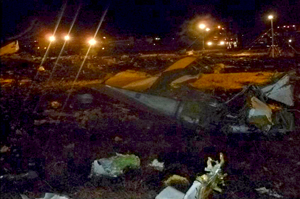
Boeing crashes in Russia, 50 killed

November 18, 2013

RUSSIA-CRASHMoscow, Nov 18: A Boeing 737-500 airliner crashed on landing in the Russian city of Kazan on Sunday, killing all 50 on board and highlighting the poor safety record of Russian airlines that ply internal routes across the world's largest nation.

The Tatarstan airlines flight from Moscow was trying to abort its landing in order to make a second approach, but it exploded on hitting the runway, killing all 44 passengers and six crew on board, emergency officials said.

The only picture shown from the scene on Russian television reports was a blurred still shot of the plane's fuselage with firefighters in the foreground, apparently after they had extinguished a fire at the scene.

Flight U363 took off from Moscow's Domodedovo airport at 6:25 pm (1425 GMT) and crashed just over an hour later, emergency officials said.

The plane was 23 years old.

According to eyewitness reports, the Boeing lost altitude quickly and its fuel tank exploded on impact. There were high winds and cloudy skies over the airport in central Russia.

Boeing officials at the Dubai Airshow declined to comment on the crash.

Kazan, which is 800 km east of Moscow, is capital of the largely-Muslim, oil-rich region of Tatarstan. A new runway was built at the airport ahead of the World Student Games, held in the city earlier this year.

Russia will host the Winter Olympics in the southern city of Sochi early next year.

Russia spans nine time zones, from the Baltic Sea to the Pacific across large areas of largely uninhabited land, making efficient air travel and train links especially important to the country's economy.

A spokesman for state aviation oversight agency Rosaviatsia said authorities woulds search for the flight recorders. "The plane touched the ground and burst into flame," Sergei Izvolsky said. "The cause of the crash as of now is unknown."

Russia and the former Soviet republics combined had one of the world's worst safety records in 2011, with a total accident rate almost three times the world average, according to the International Air Transport Association.

Comments

Add new comment

  • Coastaldigest.com reserves the right to delete or block any comments.
  • Coastaldigset.com is not responsible for its readers’ comments.
  • Comments that are abusive, incendiary or irrelevant are strictly prohibited.
  • Please use a genuine email ID and provide your name to avoid reject.
Agencies
July 8,2020

Washington, Jul 7: President Donald Trump on Tuesday formally started the withdrawal of the United States from the World Health Organization, making good on threats to deprive the UN body of its top funding source over its response to the coronavirus.

Public health advocates and Trump's political opponents voiced outrage at the departure from the Geneva-based body, which leads the global fight on maladies from polio to measles to mental health -- as well as Covid-19, at a time when cases have again been rising around the world.

After threatening to suspend the $400 million (Dh1.47 billion) in annual US contributions and then announcing a withdrawal, the Trump administration has formally sent a notice to UN Secretary-General Antonio Guterres, a State Department spokesperson said.

The withdrawal is effective in one year -- July 6, 2021 -- and Joe Biden, Trump's presumptive Democratic opponent, is virtually certain to stop it and stay in the WHO if he wins the November election.

A spokesman for Guterres and the global health body itself confirmed that the United States, a key founding WHO member, gave its notice.

In a speech earlier in the day, WHO chief Tedros Adhanom Ghebreyesus said of Covid-19, "National unity and global solidarity are more important than ever to defeat a common enemy."

In line with conditions set when the WHO was set up in 1948, the United States can leave within one year but must meet its remaining assessed financial obligations, the UN spokesman said.

'Total control'

In late May, Trump said that China exerted "total control" over the WHO and accused the UN body led by Tedros, an Ethiopian doctor and diplomat, of failing to implement reforms.

Blaming China for the coronavirus, Trump, a frequent critic of the UN, said the United States would redirect funding "to other worldwide and deserving, urgent, global public health needs."

Democratic lawmakers have accused Trump of seeking to deflect criticism from his handling of the pandemic in the United States, which has suffered by far the highest death toll of any nation despite the president's stated hope that the virus will disappear.

"To call Trump's response to Covid chaotic and incoherent doesn't do it justice," said Senator Robert Menendez, the top Democrat on the Foreign Relations Committee.

"This won't protect American lives or interests -- it leaves Americans sick and America alone," he wrote on Twitter.

Representative Ami Bera, himself a physician, said that the United States and World Health Organization had worked "hand in hand" to eradicate smallpox and nearly defeat polio.

"Our cases are increasing," Bera said of Covid-19. "If the WHO is to blame: why has the US been left behind while many countries from South Korea to New Zealand to Vietnam to Germany return to normal?"

Even some of Trump's Republican allies had voiced hope that he was exerting pressure rather than making a final decision to abandon the World Health Organization.

The investigative news outlet ProPublica reported last month that most of Trump's aides were blindsided by the WHO withdrawal announcement, which he made during an appearance about China. 

The Trump administration has said that the WHO ignored early signs of human-to-human transmission in China, including warnings from Taiwan -- which, due to Beijing's pressure, is not part of the UN body.

While many public health advocates share some criticism of the WHO, they question what other options the world body had other than to work with China, where Covid-19 was first detected late last year in the city of Wuhan.

The anti-poverty campaign ONE said the United States should work to reform, not abandon, the WHO.

"Withdrawing from the World Health Organization amidst an unprecedented global pandemic is an astounding action that puts the safety of all Americans the world at risk," it said.

Comments

Add new comment

  • Coastaldigest.com reserves the right to delete or block any comments.
  • Coastaldigset.com is not responsible for its readers’ comments.
  • Comments that are abusive, incendiary or irrelevant are strictly prohibited.
  • Please use a genuine email ID and provide your name to avoid reject.
News Network
May 20,2020

Kensington (United States), May 20: The world cut its daily carbon dioxide emissions by 17% at the peak of the pandemic shutdown last month, a new study found.

But with life and heat-trapping gas levels inching back toward normal, the brief pollution break will likely be “a drop in the ocean" when it comes to climate change, scientists said.

In their study of carbon dioxide emissions during the coronavirus pandemic, an international team of scientists calculated that pollution levels are heading back up — and for the year will end up between 4% and 7% lower than 2019 levels.

That's still the biggest annual drop in carbon emissions since World War II.

It'll be 7% if the strictest lockdown rules remain all year long across much of the globe, 4% if they are lifted soon.

For a week in April, the United States cut its carbon dioxide levels by about one-third.

China, the world's biggest emitter of heat-trapping gases, sliced its carbon pollution by nearly a quarter in February, according to a study Tuesday in the journal Nature Climate Change. India and Europe cut emissions by 26% and 27% respectively.

The biggest global drop was from April 4 through 9 when the world was spewing 18.7 million tons (17 million metric tons) of carbon pollution a day less than it was doing on New Year's Day.

Such low global emission levels haven't been recorded since 2006. But if the world returns to its slowly increasing pollution levels next year, the temporary reduction amounts to ''a drop in the ocean," said study lead author Corinne LeQuere, a climate scientist at the University of East Anglia.

“It's like you have a bath filled with water and you're turning off the tap for 10 seconds," she said.

By April 30, the world carbon pollution levels had grown by 3.3 million tons (3 million metric tons) a day from its low point earlier in the month. Carbon dioxide stays in the air for about a century.

Outside experts praised the study as the most comprehensive yet, saying it shows how much effort is needed to prevent dangerous levels of further global warming.

“That underscores a simple truth: Individual behavior alone ... won't get us there,” Pennsylvania State University climate scientist Michael Mann, who wasn't part of the study, said in an email.

“We need fundamental structural change.”

If the world could keep up annual emission cuts like this without a pandemic for a couple decades, there's a decent chance Earth can avoid warming another 1.8 degrees (1 degree Celsius) of warming from now, study authors said. But getting the type of yearly cuts to reach that international goal is unlikely, they said.

If next year returns to 2019 pollution levels, it means the world has only bought about a year's delay in hitting the extra 1.8 degrees (1 degree Celsius) of warming that leaders are trying to avoid, LeQuere said. That level could still occur anywhere from 2050 to 2070, the authors said.

The study was carried out by Global Carbon Project, a consortium of international scientists that produces the authoritative annual estimate of carbon dioxide emissions. They looked at 450 databases showing daily energy use and introduced a measurement scale for pandemic-related societal “confinement” in its estimates.

Nearly half the emission reductions came from less transportation pollution, mostly involving cars and trucks, the authors said. By contrast, the study found that drastic reductions in air travel only accounted for 10% of the overall pollution drop.

In the US, the biggest pollution declines were seen in California and Washington with plunges of more than 40%.

Comments

Add new comment

  • Coastaldigest.com reserves the right to delete or block any comments.
  • Coastaldigset.com is not responsible for its readers’ comments.
  • Comments that are abusive, incendiary or irrelevant are strictly prohibited.
  • Please use a genuine email ID and provide your name to avoid reject.
Agencies
June 7,2020

Moscow, Jun 7: OPEC, Russia and allies agreed on Saturday to extend record oil production cuts until the end of July, prolonging a deal that has helped crude prices double in the past two months by withdrawing almost 10% of global supplies from the market.

The group, known as OPEC+, also demanded countries such as Nigeria and Iraq, which exceeded production quotas in May and June, compensate with extra cuts in July to September.

OPEC+ had initially agreed in April that it would cut supply by 9.7 million barrels per day (bpd) during May-June to prop up prices that collapsed due to the coronavirus crisis. Those cuts were due to taper to 7.7 million bpd from July to December.

“Demand is returning as big oil-consuming economies emerge from pandemic lockdown. But we are not out of the woods yet and challenges ahead remain,” Saudi Energy Minister Prince Abdulaziz bin Salman told the video conference of OPEC+ ministers.

Benchmark Brent crude climbed to a three-month high on Friday above $42 a barrel, after diving below $20 in April. Prices still remain a third lower than at the end of 2019.

“Prices can be expected to be strong from Monday, keeping their $40 plus levels,” said Bjornar Tonhaugen from Rystad Energy.

Saudi Arabia, OPEC’s de facto leader, and Russia have to perform a balancing act of pushing up oil prices to meet their budget needs while not driving them much above $50 a barrel to avoid encouraging a resurgence of rival U.S. shale production.

It was not immediately clear whether Saudi Arabia, the United Arab Emirates and Kuwait would extend beyond June their additional, voluntary cuts of 1.18 million bpd, which are not part of the deal.

BULGING INVENTORIES

The April deal was agreed under pressure from U.S. President Donald Trump, who wants to avoid U.S. oil industry bankruptcies.

Trump, who previously threatened to pull U.S. troops out of Saudi Arabia if Riyadh did not act, spoke to the Russian and Saudi leaders before Saturday’s talks, saying he was happy with the price recovery.

While oil prices have partially recovered, they are still well below the costs of most U.S. shale producers. Shutdowns, layoffs and cost cutting continue across the United States.

“I applaud OPEC-plus for reaching an important agreement today which comes at a pivotal time as oil demand continues to recover and economies reopen around the world,” U.S. Energy Secretary Dan Brouillette wrote on Twitter after the extension.

As global lockdowns ease, oil demand is expected to exceed supply sometime in July but OPEC has yet to clear 1 billion barrels of excess oil inventories accumulated since March.

Rystad’s Tonhaugen said Saturday’s decisions would help OPEC reduce inventories at a rate of 3 million to 4 million bpd in July-August. “The quicker stocks fall, the higher prices will get,” he said.

Nigeria’s petroleum ministry said Abuja backed the idea of compensating for its excessive output in May and June.

Iraq, with one of the worst compliance rates in May, agreed to extra cuts although it was not clear how Baghdad would reach agreement with oil majors on curbing Iraqi output.

Iraq produced 520,000 bpd above its quota in May, while overproduction by Nigeria was 120,000 bpd, Angola’s was 130,000 bpd, Kazakhstan’s was 180,000 bpd and Russia’s was 100,000 bpd, OPEC+ data showed.

OPEC+’s joint ministerial monitoring committee, known as the JMMC, will meet monthly until December to review the market, compliance and recommend levels of cuts. JMMC’s next meeting is scheduled for June 18.

OPEC and OPEC+ will hold their next scheduled meetings on Nov. 30-Dec. 1.

Comments

Add new comment

  • Coastaldigest.com reserves the right to delete or block any comments.
  • Coastaldigset.com is not responsible for its readers’ comments.
  • Comments that are abusive, incendiary or irrelevant are strictly prohibited.
  • Please use a genuine email ID and provide your name to avoid reject.