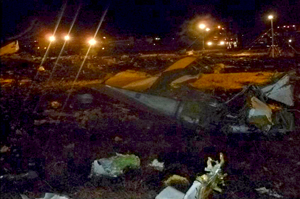
Boeing crashes in Russia, 50 killed

November 18, 2013

RUSSIA-CRASHMoscow, Nov 18: A Boeing 737-500 airliner crashed on landing in the Russian city of Kazan on Sunday, killing all 50 on board and highlighting the poor safety record of Russian airlines that ply internal routes across the world's largest nation.

The Tatarstan airlines flight from Moscow was trying to abort its landing in order to make a second approach, but it exploded on hitting the runway, killing all 44 passengers and six crew on board, emergency officials said.

The only picture shown from the scene on Russian television reports was a blurred still shot of the plane's fuselage with firefighters in the foreground, apparently after they had extinguished a fire at the scene.

Flight U363 took off from Moscow's Domodedovo airport at 6:25 pm (1425 GMT) and crashed just over an hour later, emergency officials said.

The plane was 23 years old.

According to eyewitness reports, the Boeing lost altitude quickly and its fuel tank exploded on impact. There were high winds and cloudy skies over the airport in central Russia.

Boeing officials at the Dubai Airshow declined to comment on the crash.

Kazan, which is 800 km east of Moscow, is capital of the largely-Muslim, oil-rich region of Tatarstan. A new runway was built at the airport ahead of the World Student Games, held in the city earlier this year.

Russia will host the Winter Olympics in the southern city of Sochi early next year.

Russia spans nine time zones, from the Baltic Sea to the Pacific across large areas of largely uninhabited land, making efficient air travel and train links especially important to the country's economy.

A spokesman for state aviation oversight agency Rosaviatsia said authorities woulds search for the flight recorders. "The plane touched the ground and burst into flame," Sergei Izvolsky said. "The cause of the crash as of now is unknown."

Russia and the former Soviet republics combined had one of the world's worst safety records in 2011, with a total accident rate almost three times the world average, according to the International Air Transport Association.

Comments

Add new comment

  • Coastaldigest.com reserves the right to delete or block any comments.
  • Coastaldigset.com is not responsible for its readers’ comments.
  • Comments that are abusive, incendiary or irrelevant are strictly prohibited.
  • Please use a genuine email ID and provide your name to avoid reject.
News Network
March 25,2020

Beijing, Mar 25: Around 5,000 people have signed up for the phase I clinical trial of recombinant novel coronavirus vaccine in Chinese city Wuhan where the virus first emerged late last year.

The recruitment for participants ended this week with nearly 5,000 volunteers signing up for the trial, state-run Beijing News reported on Wednesday.

A single-centre, open and dose-escalation phase I clinical trial for recombinant novel coronavirus vaccine (adenoviral vector) will be tested in healthy adults aged between 18 and 60 years, according to the ChiCTR (China Clinical Trial Register).

The trial, led by experts from the Academy of Military Medical Sciences, gained its approval on March 16 and the research is expected to last half a year.

Requiring at least 108 participants, the trial will be conducted in Wuhan, capital of Hubei province, the region worst-affected by the virus in the country, state-run China Daily reported.

Participants will experience 14-day quarantine restrictions after being vaccinated and their health condition will be recorded every day.

Chinese scientists are hastening the development of COVID-19 vaccines through five approaches --- inactivated vaccines, genetic engineering subunit vaccines, adenovirus vector vaccines, nucleic acid vaccines and vaccines using attenuated influenza virus as vectors.

So far, most teams are expected to complete preclinical research in April and some are moving forward faster, Wang Junzhi, an academician with the Chinese Academy of Engineering said.

Wang noted that research and development of COVID-19 vaccines in China is not slower than foreign counterparts and has been carried out in a scientific, standardised and orderly way.

China has stepped up the process to finalise vaccines to counter COVID-19 after Kaiser Permanente research facility in Seattle and Washington stole the march and began human trials.

China lifted tough restrictions on the Hubei province on Wednesday after a months-long lockdown as the country reported no new domestic cases.

But there were another 47 imported infections from overseas, the National Health Commission said. In total, 474 imported infections have been diagnosed in China -- mostly Chinese nationals returning home.

Comments

Y UDAYA CHANDAR
 - 
Monday, 13 Apr 2020

Dear Sir,


I am 77 but a very healthy person with remarkable immunity. I contracted Malaria fever in 1994 because of mosquito biting and I have not been sick anytime there after, not even for ordinary fever in the last 26 years.


I am sure you would like to conduct the trials on persons of varying criteria. I am sure you don't want to carry out the trials on perfectly healthy young individuals only. 


I am certain that  you want to try the vaccine on a 'common man' from 'general public.' I am ready for the trial and you can take me. I will be delighted. 


If you are not handling this matter kindly forward this mail to the correct agency.


I look forward to hearing from you.


Best regards.


If you are not moving forward, you are really moving backward.

Y Udaya Chandar


Add new comment

  • Coastaldigest.com reserves the right to delete or block any comments.
  • Coastaldigset.com is not responsible for its readers’ comments.
  • Comments that are abusive, incendiary or irrelevant are strictly prohibited.
  • Please use a genuine email ID and provide your name to avoid reject.
News Network
June 26,2020

Washington, Jun 26: The US is reviewing its global deployment of forces to ensure it is postured appropriately to counter the People's Liberation Army, given the increasing threat posed by China to Asian countries like India, Malaysia, Indonesia, and the Philippines, Secretary of State Mike Pompeo said on Thursday.

Mr Pompeo made those remarks in response to a question during the virtual Brussels Forum 2020 of the German Marshall Fund.

"We're going to make sure we're postured appropriately to counter the PLA. We think that the challenge of our times, and we're going to make sure we have resources in place to do that," Mr Pompeo said.
 
The force posture review is being done at the direction of President Donald Trump, as part of which the US is reducing the number of its troops in Germany from about 52,000 to 25,000, he said.

Mike Pompeo said that the force posture would be dictated by the ground realities.

"In certain places there will be fewer American resources. There'll be other places - I just talked about the threat from the Chinese Communist Party, so now threats to India, threats to Vietnam, threats to Malaysia, Indonesia, South China Sea challenges, the Philippines," he said.

"To the extent that that changed, the difference in what the US decided to do impacts adversely a threat some place, it may be that other nations need to step up and take responsibility for their own defense in ways that they hadn't done previously. So, we want to do this in full consultation with all of our partners all around the world, and certainly our friends in Europe," Mr Pompeo said.

President Trump is being criticised for reducing troops from Germany. His critics say that this will increase the threat from Russia to Europe.

Mike Pompeo, however, did not agree with that argument.

It has been a long time since there has been a strategic review of our force posture all across the world. The US undertook that starting about 2.5 years ago, whether that was our forces in Africa, our forces in Asia, the force we have in the Middle East and in Europe, he said.

"We began to say these are often decisions that were made in a different time. Should we reallocate those a different way? Should we have a different composition of those forces? Everyone always wants to talk about ground troops. I get it. I was a young tank officer. You described that. There's nothing I like as much as a good M1 tank.

"But it's often the case that the capacity to deter Russia or other adversaries isn''t determined any longer by just having a bunch of folks garrisoned someplace. So, we really went to back fundamentally relook, what is the nature of the conflict, what''s the nature of the threat, and how should we allocate our resources, whether that''s our resources in the intelligence community, our resources from the Air Force or the Marines and Army," Mr Pompeo said.

Last week, Mike Pompeo criticised the Chinese Army for "escalating" the border tension with India and militarising the strategic South China Sea. He also described the ruling Communist Party of China (CPC) as a "rogue actor".

"Our broad set of allocation of security apparatus, our ability to counter cyber threats, how do we allocate them? What''s the best way to do this? And the decision that you see the president made with respect to Germany is an outcome from a collective set of decisions about how we''re going to posture our resources around the world," said the top American diplomat on Thursday.

Changes in force posture is being taken in consultations with allies and friends, Mr Pompeo said.

"President Trump has spoken to this. (Defense) Secretary (Mark) Esper will be in London today and in Brussels tomorrow. We''ll talk about our plan and how we''re thinking about delivering it," he said.

"But you should understand this, and I hope our European partners will understand this as well. When you see what we ultimately conclude, how we ultimately deliver on the statements of the president made, that they''re aimed squarely at what we believe to be democracies'' fundamental interest and certainly America's most fundamental interest," Mr Pompeo said.

Earlier this month, Mike Pompeo had said that China's actions, be it on the India border, or in Hong Kong or in the South China Sea, were part of the behaviour of the ruling Communist Party in Beijing in the recent past.

China has been fast expanding military and economic influence in the Indo-Pacific region, triggering concern in various countries of the region and beyond.

China is engaged in hotly contested territorial disputes in both the South China Sea and the East China Sea. Beijing has built up and militarised many of the islands and reefs it controls in the region. Both areas are stated to be rich in minerals, oil and other natural resources and are vital to global trade.


Comments

Add new comment

  • Coastaldigest.com reserves the right to delete or block any comments.
  • Coastaldigset.com is not responsible for its readers’ comments.
  • Comments that are abusive, incendiary or irrelevant are strictly prohibited.
  • Please use a genuine email ID and provide your name to avoid reject.
Agencies
June 12,2020

Kabul, Jun 12: A blast in a mosque during Friday prayers in the western part of capital Kabul has killed at least four people and wounded many more, Afghanistan's interior ministry said.

"Explosives placed inside the Sher Shah Suri Mosque exploded during Friday prayers," said a statement issued by the ministry, which added that the mosque's prayer leader Mofleh Frotan was among those killed.

Interior ministry spokesman Tariq Arian said police have cordoned off the area and helped move the wounded to ambulances and nearby hospitals.

No group immediately claimed responsibility for the attack but a mosque attack earlier this month was claimed by an ISIL (or ISIS) group affiliate, headquartered in eastern Afghanistan's Nangarhar province.

"Interestingly, every time you have the peace process gaining some momentum and pace, you have these kinds of attacks in the country," Habib Wardak, a national security analyst based in Kabul, told Al Jazeera.

"The Islamic State group claimed responsibility for the attack that happened last week on a mosque in Kabul, so despite the fact that you have these news and press conference from the government that they have eliminated ISIL, how can they conduct such sophisticated operations?"

Friday's blast had parallels to one earlier this month, when an explosion tore apart a famous Kabul mosque and led to the death of renowned Afghan cleric Maulvi Ayaz Niazi.

"In this attack, the imam seems to be the target, not the rest of the crowd. These are the imams who have supported the peace process with the Taliban movement," Wardak said.

"The other political aspect for these kinds of attacks is that there are peace spoilers trying to convey a message that peace with the Taliban will not eradicate violence in the country because you have ISIL."

Violence has spiked in recent weeks in Afghanistan with most of the attacks claimed by the ISIL affiliate.

The United States blamed the armed group for a horrific attack last month on a maternity hospital in the capital that killed 24 people, including two infants and several new mothers.

The ISIL affiliate also took responsibility for an attack on a bus carrying journalists in Kabul on May 30, killing two.

It also claimed credit for an attack on the funeral of a strongman loyal to the government last month that killed 35 people.

Meanwhile, the US is attempting to broker peace talks between the Afghan government and the Taliban to end 18 years of war.

Washington's peace envoy Zalmay Khalilzad was in the region earlier this week trying to resuscitate a US peace deal with the Taliban.

The peace deal signed in February calls for the withdrawal of the US and NATO troops from Afghanistan in return for a commitment by the Taliban to not launch attacks on the US or its allies.

Comments

Add new comment

  • Coastaldigest.com reserves the right to delete or block any comments.
  • Coastaldigset.com is not responsible for its readers’ comments.
  • Comments that are abusive, incendiary or irrelevant are strictly prohibited.
  • Please use a genuine email ID and provide your name to avoid reject.