


World's most expensive burger sold in Dubai for Dh37,000

March 15, 2017

Dubai, Mar 15: Fancy eating the most expensive burger? Bite into this - the most expensive burger in the world was sold yesterday for approximately Dh36,700 ($10,000) in Dubai.
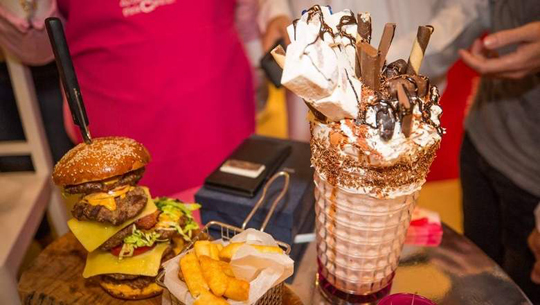
burger

The sale was part of the initiative, Pink Bite - Pink Caravan's breast cancer charity auction event - by Sheikh Mohammed bin Abdullah Al Thani, Chairman of the Department of Statistics and Community Development, Sharjah, and Co-founder of Musafir.com, in support of their mission of raising awareness about the importance of early detection of breast cancer and offering free screenings.

The UAE's prominent government officials, public figures, all got together at Galeries Lafayette, Le Gourmet - The Dubai Mall, to celebrate their shared spirit of giving at this popular culinary fundraiser.

The higher organising committee of the Pink Caravan announced that the charity auction raised Dh108,755. Seven of Dubai's top chefs got together with Pink Caravan ambassadors, and their support teams, who were paired up in a random draw of chits, who then went on to put together innovative pink-themed creations inspired by Emirati cuisine at their live stations.

Chef Russell Impiazzi along with Sheikh Mohammed bin Abdullah Al Thani, and his team made what they called the 'Seven Emirates Burgerstack'; Chef Robbie Stokes and social media influencer, Ali al Saloum did a 'Yasa Caviar with hot smoked sturgeon and Al jabab blinis'; Chef Tom Reger and Khawla Al Serkal, Director General, Sharjah Ladies Club cooked up 'Braised short ribs with desert truffles'; Chef Reif Othman and Reem BinKaram put together a 'Pita surprise and steam buns.

Chef Izu and social media influencer Mohannad Al Hasouni tossed up a 'Seafood risotto with pistachio and dried cherry tomatoes'; Chef Colin Clague and life coach Zina Habi did a 'Lobster kibbe with avocado labneh' and Chef Mohammad Orfali teamed up with Olympia Tabash, Partner at Anfasic Dokhoon to present a kebab dish they called 'Roots of my backyard forest'.

During the hour-long auction, all ambassadors tried to sell their dishes at the highest price. Sheikh Al Thani sold four of his signature burgers, one of which was bought by the owner of the luxury lifestyle magazine in the UAE, Villa 88 Magazine, for Dh36,700.

"I have been an ambassador of Pink Caravan since the very beginning, and I am extremely honoured to be here today. Two years ago we broke the world record by selling one burger for $7,000, and this year we wanted to top that. Of course, all proceeds will go to breast cancer awareness and free detection at an earlier stage," said Sheikh Al Thani.

"I am so proud of the charitable spirit of the people here in the UAE. We may be celebrating 2017 as the 'UAE Year of Giving', but for the people of this nation every year is. It is the personal responsibility of every individual to participate in initiatives like the Pink Caravan, for it is one of the best ways to give back to the community," he added.

The delicious Burgerstack was prepared with 7 Al Jassiri with aged cheddar and veal bacon in a saffron brioche burger bun with 7 spices & Harrisa burger sauce. The dish was served with a delicious milkshake.

"One burger bought for $10,000! This was an incredible feat for not just the Pink Caravan and its supporters, but for everyone who supports a good cause in the world. I am proud of Pink Caravan ambassadors who have provided their unfailing support to us to be able to realise our goals. I am happy so many people got together and had such a good time, raising a significant amount of money, which will fuel Pink Caravan's efforts to raise awareness about early detection of breast cancer," said Reem BinKaram, Chairperson of Higher Organising Committee at Pink Caravan Ride.

"The Chefs and Pink Caravan ambassadors really came together! They were all excellent and embraced the spirit of this charitable event night. Not forgetting a big thank you to all our generous customers who managed to raise an incredible sum of money for such a worthy cause," said Russell Impiazzi, Culinary Director of Galeries Lafayette Le Gourmet, The Dubai Mall, thanking everyone for being part of a hugely successful fundraiser.

The Pink Caravan will continue its nationwide tour, ending with a closing ceremony in Abu Dhabi on Friday, 17 March.

Comments

Add new comment

  • Coastaldigest.com reserves the right to delete or block any comments.
  • Coastaldigset.com is not responsible for its readers’ comments.
  • Comments that are abusive, incendiary or irrelevant are strictly prohibited.
  • Please use a genuine email ID and provide your name to avoid reject.
Agencies
June 22,2020

New delhi, Jun 22: As consumer sentiment runs high amid growing chorus for boycotting Chinese goods in the country, the fluid market situation offers new opportunities for various smartphone makers, especially the non-Chinese ones like Samsung, Apple, Nokia, Asus and others, to realign their strategies and regain the lost market share in the face of fierce Chinese competition.

The challenge here would be not to look "opportunistic" and leverage the current explosive situation on just riding on the anti-Chinese sentiment but to offer real challenges in the form of top-end devices with solid internals at affordable price points, feel industry experts.

"The current market conditions in India are fluid and open up new opportunities for smartphone original equipment manufacturers (OEMs) to focus and leverage," Prabhu Ram, Head-Industry Intelligence Group, CyberMedia Research (CMR), told IANS.

In the first quarter (January-March) this year, Samsung's shipments were driven by its upgraded A and M series (A51, A20s, A30s, and M30s).

According to Counterpoint Research, Samsung managed to hold third position in Q1 2020 due to launches across several price tiers, especially in the affordable premium segment (S10 Lite, Note 10 Lite).

The South Korean smartphone maker last week announced a Rs 4,000 price drop on its popular Galaxy Note10 Lite smartphone that will now cost Rs 37,999 (6GB variant).

Earlier this month, Samsung launched two new smartphones, Galaxy M11 and Galaxy M01, with powerful batteries under Rs 15,000 in India.

Galaxy M11 comes in two variants. The 3GB+32GB will be priced at Rs 10,999 while the higher 4GB+64GB variant will be available for Rs 12,999.

Samsung has also launched an affordable Galaxy A21s smartphone with quad-camera system and 5,000mAh battery at a starting price of Rs 16,499.

Also read: Boycott China? OnePlus 8 Pro sold out within minutes of going on sale

On the other hand, Apple grew a strong 78 per cent YoY driven by strong shipments of iPhone 11 and multiple discounts on platforms like Flipkart and Amazon in Q1, according to Counterpoint.

Apple has also brought its cheapest yet powerful new iPhone SE that costs Rs 38,900 (64GB) in India with a special offer from HDFC Bank. The new iPhone SE is powered by the Apple-designed A13 Bionic, the fastest chip in a smartphone and features the best single-camera system ever in an iPhone.

According to Tarun Pathak, Associate Director, Counterpoint Research, consumer sentiments are running high and a section of users will look for alternatives, benefitting global and Indian brands.

"However, we do not think non-Chinese brands will run aggressive campaigns based on the situation as it might look like being opportunistic," Pathak told media.

It may actually let brands of Chinese origin try to run aggressive campaigns on their presence and scale.

"Some of these Chinese brands have been active in scaling up local value addition, creating jobs and investing in research and development," Pathak noted.

On Saturday, market leader Xiaomi said that it is "more Indian" than any other smartphone brand.

The company's India head Manu Kumar Jain said that the company's mobile phone R&D centre and product team is in India, it employs 50,000 people in the country, the entire leadership team is Indian and that the company pays its taxes in India.

Earlier, Realme India CEO Madhav Sheth who is also very active on social media said that Realme is an Indian startup.

In his latest episode of Ask Madhav' series on YouTube, Sheth said: "I can proudly say Realme is an Indian startup, which is now a global MNC (multinational corporation)".

Comments

Add new comment

  • Coastaldigest.com reserves the right to delete or block any comments.
  • Coastaldigset.com is not responsible for its readers’ comments.
  • Comments that are abusive, incendiary or irrelevant are strictly prohibited.
  • Please use a genuine email ID and provide your name to avoid reject.
Agencies
June 8,2020

Washington DC, Jun 8: Astronomers acting on a hunch have likely resolved a mystery about young, still-forming stars and regions rich in organic molecules closely surrounding some of them.

They used the National Science Foundation's Karl G Jansky Very Large Array (VLA) to reveal one such region that previously had eluded detection and that revelation answered a longstanding question.

The regions around the young protostars contain complex organic molecules which can further combine into prebiotic molecules that are the first steps on the road to life.

The regions, dubbed "hot corinos" by astronomers, are typically about the size of our solar system and are much warmer than their surroundings, though still quite cold by terrestrial standards.

The first hot corino was discovered in 2003 and only about a dozen have been found so far. Most of these are in binary systems, with two protostars forming simultaneously.

Astronomers have been puzzled by the fact that, in some of these binary systems, they found evidence for a hot corino around one of the protostars but not the other.

"Since the two stars are forming from the same molecular cloud and at the same time, it seemed strange that one would be surrounded by a dense region of complex organic molecules and the other wouldn't," said Cecilia Ceccarelli, of the Institute for Planetary Sciences and Astrophysics at the University of Grenoble (IPAG) in France.

The complex organic molecules were found by detecting specific radio frequencies, called spectral lines, emitted by the molecules. Those characteristic radio frequencies serve as "fingerprints" to identify the chemicals.

The astronomers noted that all the chemicals found in hot corinos had been found by detecting these "fingerprints" at radio frequencies corresponding to wavelengths of only a few millimetres.

"We know that dust blocks those wavelengths, so we decided to look for evidence of these chemicals at longer wavelengths that can easily pass through dust," said Claire Chandler of the National Radio Astronomy Observatory, and principal investigator on the project.

"It struck us that dust might be what was preventing us from detecting the molecules in one of the twin protostars," added Chandler.

The astronomers used the VLA to observe a pair of protostars called IRAS 4A, in a star-forming region about 1,000 light-years from Earth. They observed the pair at wavelengths of centimetres.

At those wavelengths, they sought radio emissions from methanol, CH3OH (wood alcohol, not for drinking). This was a pair in which one protostar clearly had a hot corino and the other did not, as seen using the much shorter wavelengths.

The result confirmed their hunch. "With the VLA, both protostars showed strong evidence of methanol surrounding them. This means that both protostars have hot corinos. The reason we did not see the one at shorter wavelengths was because of dust," said Marta de Simone, a graduate student at IPAG who led the data analysis for this object.

The astronomers cautioned that while both hot corinos now are known to contain methanol, there still may be some chemical differences between them. That, they said, can be settled by looking for other molecules at wavelengths not obscured by dust.

"This result tells us that using centimetre radio wavelengths is necessary to properly study hot corinos," Claudio Codella of Arcetri Astrophysical Observatory in Florence, Italy, said.

"In the future, planned new telescopes such as the next-generation VLA and SKA, will be very important to understanding these objects," added Codella.

Comments

Add new comment

  • Coastaldigest.com reserves the right to delete or block any comments.
  • Coastaldigset.com is not responsible for its readers’ comments.
  • Comments that are abusive, incendiary or irrelevant are strictly prohibited.
  • Please use a genuine email ID and provide your name to avoid reject.
News Network
April 28,2020

Los Angeles, Apr 28: People who experience loss of smell as one of the COVID-19 symptoms are likely to have a mild to moderate clinical course of the disease, according to a study which may help health care providers determine which patients require hospitalisation.

The findings, published in the journal International Forum of Allergy & Rhinology, follows an earlier study that validated the loss of smell and taste as indicators of infection with the novel coronavirus, SARS-CoV-2.

According to the scientists from the University of California (UC) San Diego Health in the US, patients who reported loss of smell were 10 times less likely to be hospitalised for COVID-19 compared to those without the symptom.

"One of the immediate challenges for health care providers is to determine how to best treat persons infected by the novel coronavirus," said Carol Yan, first author of the current study and rhinologist from the UC San Diego Health.

"If they display no or mild symptoms, can they return home to self-quarantine or will they likely require hospitalisation? These are crucial questions for hospitals trying to efficiently and effectively allocate finite medical resources," Yan said.

The findings, according to the researchers, suggest that loss of smell may be predictive of a milder clinical course of COVID-19.

"What's notable in the new findings is that it appears that loss of smell may be a predictor that a SARS-CoV-2 infection will not be as severe, and less likely to require hospitalisation," Yan said.

"If an infected person loses that sense, it seems more likely they will experience milder symptoms, barring other underlying risk factors," she added.

Risk factors for COVID-19 previously reported by other studies include age, and underlying medical conditions, such as chronic lung disease, serious heart conditions, diabetes, and obesity.

In the current study, the scientists made a retrospective analysis between March 3 and April 8 including 169 patients who tested positive for COVID-19 at UC San Diego Health.

They assessed olfactory and gustatory data for 128 of the 169 patients, 26 of whom required hospitalisation.

According to the researchers, patients who were hospitalised for COVID-19 treatment were significantly less likely to report anosmia or loss of smell -- 26.9 per cent compared to 66.7 per cent for COVID-19-infected persons treated as outpatients.

Similar percentages were found for loss of taste, known as dysgeusia, they said.

"Patients who reported loss of smell were 10 times less likely to be admitted for COVID-19 compared to those without loss of smell," said study co-author Adam S. DeConde.

"Moreover, anosmia was not associated with any other measures typically related to the decision to admit, suggesting that it's truly an independent factor and may serve as a marker for milder manifestations of Covid-19," DeConde said.

The researchers suspect that the findings hint at some of the physiological characteristics of the infection.

"The site and dosage of the initial viral burden, along with the effectiveness of the host immune response, are all potentially important variables in determining the spread of the virus within a person and, ultimately, the clinical course of the infection," DeConde said.

If the SARS-CoV-2 virus initially concentrates in the nose and upper airway, where it impacts olfactory function, that may result in an infection that is less severe and sudden in onset, decreasing the risk of overwhelming the host immune response, respiratory failure, and hospitalisation, the scientists added.

"This is a hypothesis, but it's also similar to the concept underlying live vaccinations," DeConde explained.

"At low dosage and at a distant site of inoculation, the host can generate an immune response without severe infection," he added.

Loss of smell, according to the study, might also indicate a robust immune response which has been localised to the nasal passages, limiting effects elsewhere in the body.

Citing the limitations of the study, the scientists said they relied upon self-reporting of anosmia from participants, which posed a greater chance of recall bias among patients once they had been diagnosed with COVID-19.

They added that patients with more severe respiratory disease requiring hospitalisation may not be as likely to recognise or recall the loss of smell.

So the researchers said more expansive studies are needed for validating the results.

Comments

Add new comment

  • Coastaldigest.com reserves the right to delete or block any comments.
  • Coastaldigset.com is not responsible for its readers’ comments.
  • Comments that are abusive, incendiary or irrelevant are strictly prohibited.
  • Please use a genuine email ID and provide your name to avoid reject.