World's oldest man of 145 years wants to die, says it's patience that has kept him going

August 29, 2016

New Delhi, Aug 29: An Indonesian man who claims to be an incredible 145 years old may be the oldest person in the world ever.

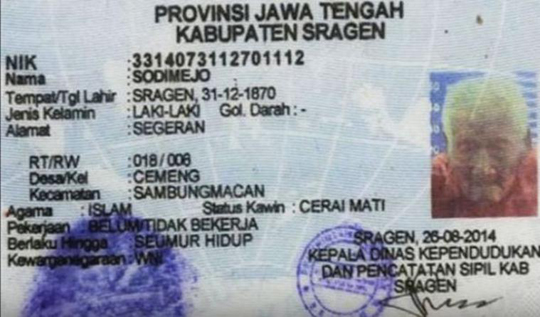
According to the documents recognised by Indonesian officials, Mbah Gotho from Sragen in central Java was born on December 31, 1870.

oldestman2 2

If the documents are true, that would make him much older than the verified oldest person in the world ever - a title that currently belongs to Jeanne Calment from France who lived to the age of 122.

Gotho has outlived all 10 of his siblings, his four wives, as well as all his children, and is now survived by his grandchildren, great grandchildren, and great-great grandchildren, 'The Sun' reported.

However, the super senior citizen now 'just wants to die' and even bought his gravestone 20 years ago.

"What I want is to die. My grandchildren are all independent," he said.

Whether or not he will be listed as the world's oldest man however is uncertain, as the paperwork has till now not been independently verified.

For the past three months, Gotho has had to be spoon-fed and bathed as he has become weaker.

According to Gotho's grandchildren, he mostly sits and listens to the radio, and his secret to longevity is 'patience.

oldestman2

Comments

Add new comment

  • Coastaldigest.com reserves the right to delete or block any comments.
  • Coastaldigset.com is not responsible for its readers’ comments.
  • Comments that are abusive, incendiary or irrelevant are strictly prohibited.
  • Please use a genuine email ID and provide your name to avoid reject.
Agencies
June 22,2020

New delhi, Jun 22: As consumer sentiment runs high amid growing chorus for boycotting Chinese goods in the country, the fluid market situation offers new opportunities for various smartphone makers, especially the non-Chinese ones like Samsung, Apple, Nokia, Asus and others, to realign their strategies and regain the lost market share in the face of fierce Chinese competition.

The challenge here would be not to look "opportunistic" and leverage the current explosive situation on just riding on the anti-Chinese sentiment but to offer real challenges in the form of top-end devices with solid internals at affordable price points, feel industry experts.

"The current market conditions in India are fluid and open up new opportunities for smartphone original equipment manufacturers (OEMs) to focus and leverage," Prabhu Ram, Head-Industry Intelligence Group, CyberMedia Research (CMR), told IANS.

In the first quarter (January-March) this year, Samsung's shipments were driven by its upgraded A and M series (A51, A20s, A30s, and M30s).

According to Counterpoint Research, Samsung managed to hold third position in Q1 2020 due to launches across several price tiers, especially in the affordable premium segment (S10 Lite, Note 10 Lite).

The South Korean smartphone maker last week announced a Rs 4,000 price drop on its popular Galaxy Note10 Lite smartphone that will now cost Rs 37,999 (6GB variant).

Earlier this month, Samsung launched two new smartphones, Galaxy M11 and Galaxy M01, with powerful batteries under Rs 15,000 in India.

Galaxy M11 comes in two variants. The 3GB+32GB will be priced at Rs 10,999 while the higher 4GB+64GB variant will be available for Rs 12,999.

Samsung has also launched an affordable Galaxy A21s smartphone with quad-camera system and 5,000mAh battery at a starting price of Rs 16,499.

Also read: Boycott China? OnePlus 8 Pro sold out within minutes of going on sale

On the other hand, Apple grew a strong 78 per cent YoY driven by strong shipments of iPhone 11 and multiple discounts on platforms like Flipkart and Amazon in Q1, according to Counterpoint.

Apple has also brought its cheapest yet powerful new iPhone SE that costs Rs 38,900 (64GB) in India with a special offer from HDFC Bank. The new iPhone SE is powered by the Apple-designed A13 Bionic, the fastest chip in a smartphone and features the best single-camera system ever in an iPhone.

According to Tarun Pathak, Associate Director, Counterpoint Research, consumer sentiments are running high and a section of users will look for alternatives, benefitting global and Indian brands.

"However, we do not think non-Chinese brands will run aggressive campaigns based on the situation as it might look like being opportunistic," Pathak told media.

It may actually let brands of Chinese origin try to run aggressive campaigns on their presence and scale.

"Some of these Chinese brands have been active in scaling up local value addition, creating jobs and investing in research and development," Pathak noted.

On Saturday, market leader Xiaomi said that it is "more Indian" than any other smartphone brand.

The company's India head Manu Kumar Jain said that the company's mobile phone R&D centre and product team is in India, it employs 50,000 people in the country, the entire leadership team is Indian and that the company pays its taxes in India.

Earlier, Realme India CEO Madhav Sheth who is also very active on social media said that Realme is an Indian startup.

In his latest episode of Ask Madhav' series on YouTube, Sheth said: "I can proudly say Realme is an Indian startup, which is now a global MNC (multinational corporation)".

Comments

Add new comment

  • Coastaldigest.com reserves the right to delete or block any comments.
  • Coastaldigset.com is not responsible for its readers’ comments.
  • Comments that are abusive, incendiary or irrelevant are strictly prohibited.
  • Please use a genuine email ID and provide your name to avoid reject.
Agencies
May 17,2020

As millions of people get hooked to online dating platforms, their proliferation has led to online romance scams becoming a modern form of fraud that have spread in several societies along with the development of social media like Facebook Dating, warn researchers.

For example, extra-marital dating app Gleeden has crossed 10 lakh users in India in COVID-19 times while dating apps like Tinder and Bumble have gained immense popularity.

According to researchers from University of Siena and Scotte University Hospital led by Dr Andrea Pozza, via a fictitious Internet profile, the scammer develops a romantic relationship with the victim for 6-8 months, building a deep emotional bond to extort economic resources in a manipulative dynamic.

"There are two notable features: on the one hand, the double trauma of losing money and a relationship, on the other, the victim's shame upon discovery of the scam, an aspect that might lead to underestimation of the number of cases," the authors wrote in a paper published in the journal Clinical Practice & Epidemiology in Mental Health.

Around 1,400 dating sites/chats have been created over the last decade in North America alone. In the UK, 23 per cent of Internet users have met someone online with whom they had a romantic relationship for a certain period and even 6 per cent of married couples met through the web.

"The online dating industry has given rise to new forms of pathologies and crime, said the authors.

The results showed that 63 per cent of social media users and 3 per cent of the general population reported having been a victim at least once.

Women, middle-aged people, and individuals with higher tendencies to anxiety, romantic idealization of affective relations, impulsiveness and susceptibility to relational addiction are at higher risk of being victims of the scam.

Online romance scams are, in other words, relationships constructed through websites for the purpose of deceiving unsuspecting victims in order to extort money from them.

The scammer always acts empathetically and attempts to create the impression in the victim that the two are perfectly synced in their shared view of life.

"The declarations of the scammer become increasingly affectionate and according to some authors, a declaration of love is made within two weeks from initial contact," the study elaborated.

After this hookup phase, the scammer starts talking about the possibility of actually meeting up, which will be postponed several times due to apparently urgent problems or desperate situations such as accidents, deaths, surgeries or sudden hospitalizations for which the unwitting victim will be manipulated into sending money to cover the momentary emergency.

Using the strategy of "testing-the-water", the scammer asks the victim for small gifts, usually to ensure the continuance of the relationship, such as a webcam, which, if successful, leads to increasingly expensive gifts up to large sums of money.

When the money arrives from the victim, the scammer proposes a new encounter.

The request for money can also be made to cover the travel costs involved in the illusory meeting. In this phase, the victim may start having second thoughts or showing doubt about the intentions of the partner and gradually decide to break off the relationship.

"In other cases, the fraudulent relationship continues or even reinforces itself as the victim, under the influence of ambivalent emotions of ardor and fear of abandonment and deception, denies or rationalizes doubts to manage their feelings," said the study.

In some cases, the scammer may ask the victim to send intimate body photos that will be used as a sort of implicit blackmail to further bind the victim to the scammer.

Once the scam is discovered, the emotional reaction of the victim may go through various phases: feelings of shock, anger or shame, the perception of having been emotionally violated (a kind of emotional rape), loss of trust in people, a sensation of disgust towards oneself or the perpetrator of the crime and a feeling of mourning.

"Understanding the psychological characteristics of victims and scammers will allow at-risk personality profiles to be identified and prevention strategies to be developed," the authors suggested.


Comments

Add new comment

  • Coastaldigest.com reserves the right to delete or block any comments.
  • Coastaldigset.com is not responsible for its readers’ comments.
  • Comments that are abusive, incendiary or irrelevant are strictly prohibited.
  • Please use a genuine email ID and provide your name to avoid reject.
News Network
February 21,2020

London, Feb 21: Scientists have discovered a new species of land snail, and have named it Craspedotropis Greta Thunberg in honour of the Swedish activist Greta Thunberg for her efforts to raise awareness about climate change.

According to the study, published in the Biodiversity Data Journal, the newly discovered species belongs to the so-called caenogastropods -- a group of land snails known to be sensitive to drought, temperature extremes, and forest degradation.

The scientists, including evolutionary ecologist Menno Schilthuizen from Naturalis Biodiversity Center in the Netherlands, said the snails were found very close to the research field station at Kuala Belalong Field Studies Centre in Brunei.

They added that the snails were discovered at the foot of a steep hill-slope, next to a river bank, foraging at night on the green leaves of understorey plants.

The effort aided by amateur scientist J.P. Lim, who found the first individual of the snail said, "Naming this snail after Greta Thunberg is our way of acknowledging that her generation will be responsible for fixing problems that they did not create."

"And it's a promise that people from all generations will join her to help," Lim said.

The researchers said they approached Thunberg who said that she would be "delighted" to have this species named after her.

The study work including, fieldwork, morphological study, and classification of identified specimen was carried out in a field centre with basic equipment and no internet access, the scientists said.

According to the study, the work was done by untrained ‘citizen scientists’ guided by experts, on a 10-day taxon expedition.

"While we are aware that this way of working has its limitations in terms of the quality of the output (for example, we were unable to perform dissections or to do extensive literature searches), the benefits include rapid species discovery and on-site processing of materials," the researchers wrote in the study.

Comments

Add new comment

  • Coastaldigest.com reserves the right to delete or block any comments.
  • Coastaldigset.com is not responsible for its readers’ comments.
  • Comments that are abusive, incendiary or irrelevant are strictly prohibited.
  • Please use a genuine email ID and provide your name to avoid reject.