World's oldest man of 145 years wants to die, says it's patience that has kept him going

August 29, 2016

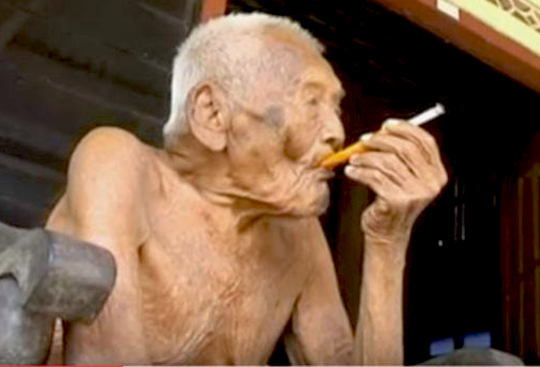
New Delhi, Aug 29: An Indonesian man who claims to be an incredible 145 years old may be the oldest person in the world ever.

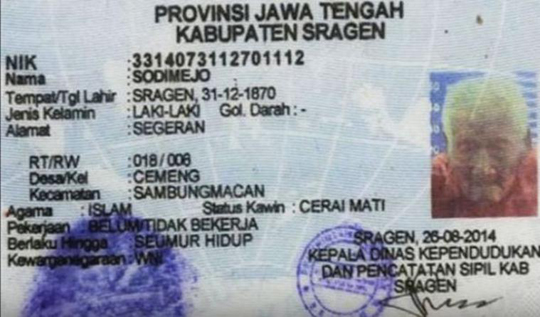
According to the documents recognised by Indonesian officials, Mbah Gotho from Sragen in central Java was born on December 31, 1870.

oldestman2 2

If the documents are true, that would make him much older than the verified oldest person in the world ever - a title that currently belongs to Jeanne Calment from France who lived to the age of 122.

Gotho has outlived all 10 of his siblings, his four wives, as well as all his children, and is now survived by his grandchildren, great grandchildren, and great-great grandchildren, 'The Sun' reported.

However, the super senior citizen now 'just wants to die' and even bought his gravestone 20 years ago.

"What I want is to die. My grandchildren are all independent," he said.

Whether or not he will be listed as the world's oldest man however is uncertain, as the paperwork has till now not been independently verified.

For the past three months, Gotho has had to be spoon-fed and bathed as he has become weaker.

According to Gotho's grandchildren, he mostly sits and listens to the radio, and his secret to longevity is 'patience.

oldestman2

Comments

Add new comment

  • Coastaldigest.com reserves the right to delete or block any comments.
  • Coastaldigset.com is not responsible for its readers’ comments.
  • Comments that are abusive, incendiary or irrelevant are strictly prohibited.
  • Please use a genuine email ID and provide your name to avoid reject.
Agencies
July 15,2020

New Delhi, Jul 15: The employees union of state-run telecom operator BSNL will stage protests across the country on Thursday on a host of issues including the cancellation of its 4G tender and non-payment of salaries.

All major unions are organising ‘lunch-hour black-flag' demonstrations throughout the country under the banner of All Unions and Association of BSNL (AUAB), said a statement by AUAB. These demonstrations will be organised, by maintaining social distancing and by taking other precautions, like wearing of masks. The BSNL employees will also wear black-badges the whole day on July 16.

The employees body would demand that BSNL should immediately be allowed to roll out its 4G services and the tender should be issued immediately. Further, they want that in the matter of procuring new equipment and upgradation, there should not be any discrimination between BSNL and other private telecom service providers.

Recently, the Centre cancelled the 4G upgradation tender for BSNL as it had decided to come up with fresh specifications for the upgrade process, in a move to keep Chinese technology companies at bay as the border tussle escalated with the northern neighbour.

The Department of Telecommunications (DoT) would issue a fresh tender for the same, and people in the know said that Chinese companies may not be allowed to participate.

"The agitational programme is being organised to express the deep anguish and resentment of the employees against cancellation of BSNL's 4G tender, cancellation of BSNL's proposal for upgradation of its 49,300 BTSs to 4G, abnormal delay in issuing ‘Add on Order' for 4G equipments, inordinate delay in the implementation of BSNL's Revival Package and against the non-settlement of the burning problems of the employees," said the statement.

The umbrella body of BSNL's employees' unions noted that rolling out of 4G services is the backbone for the revival of this telecom PSU, but the recent cancellation of the tender floated by BSNL for procuring 4G equipment at a cost of Rs 9,300 crore, has brought the company back to square one.

It said that BSNL is already having 49,300 base transceiver stations (BTS), which are 4G compatible and through minor upgradation, all these equipment can be converted into 4G BTSs with an investment of about Rs 1,500 crore.

In addition to this, BSNL could have added another 15,000 BTSs, by placing an Add on Order to the existing mobile tender, it added.

Noting that in October 2019, the PSU could have rolled out pan-India 4G services, AUAB said: "Being the sole owner of the company, the Government of India also cannot shirk its responsibility in this matter."

"Adding insult to injury, the tender floated by BSNL to procure 4G equipment, has been cancelled by the government, based on a complaint from the Telecom Equipments and Services Promotional Council (TEPC)," it said.

AUAB said that BSNL is already lagging four years behind the private operators, in terms of 4G and the cancellation of the tender is going to inordinately delay the company's 4G launch.

Saying that TEPC's contention has been to bar foreign companies from participating in BSNL's tender, AUAB statement pointed out that when private operators are procuring equipment from multinationals, "why BSNL alone should be compelled to procure 4G equipments from domestic vendors, whose 4G technology is not tested or proven so far."

It alleged a conspiracy to destabilise BSNL by disrupting its rolling out of 4G services.

AUAB further said that even after the lapse of nine months, the implementation of the much publicised BSNL's Revival Package is moving at a snail's pace.

"Except the swift retrenchment of 79,000 BSNL employees under VRS, all other assurances given in BSNL's Revival Package have been put in cold storage."

The management should ensure that the salary payment of the employees is made on the last working day of every month. Deductions made from employees' salary, on account of "society dues", should immediately be remitted, it said.

Regarding the monetisation of the company's assets under the revival package, the organisation said that the land asset should not be handed over to corporates, at "throwaway" prices.

"These lands should be sold in a transparent manner and at the prevailing market rates. They should not be sold at book value or at circle rates. The AUAB will strictly monitor these dealings," it said.


Comments

Add new comment

  • Coastaldigest.com reserves the right to delete or block any comments.
  • Coastaldigset.com is not responsible for its readers’ comments.
  • Comments that are abusive, incendiary or irrelevant are strictly prohibited.
  • Please use a genuine email ID and provide your name to avoid reject.
Agencies
June 19,2020

Denser places, assumed by many to be more conducive to the spread of the coronavirus that causes COVID-19, are not linked to higher infection rates, say researchers.

The study, led by Johns Hopkins University, published in the Journal of the American Planning Association, also found that dense areas were associated with lower COVID-19 death rates.

"These findings suggest that urban planners should continue to practice and advocate for compact places rather than sprawling ones, due to the myriad well-established benefits of the former, including health benefits," says study lead author Shima Hamidi from Johns Hopkins Bloomberg School of Public Health in the US.

For their analysis, the researchers examined SARS-CoV-2 infection rates and COVID-19 death rates in 913 metropolitan counties in the US.

When other factors such as race and education were taken into account, the authors found that county density was not significantly associated with county infection rate.

The findings also showed that denser counties, as compared to more sprawling ones, tended to have lower death rates--possibly because they enjoyed a higher level of development including better health care systems.

On the other hand, the research found that higher coronavirus infection and COVID-19 mortality rates in counties are more related to the larger context of metropolitan size in which counties are located.

Large metropolitan areas with a higher number of counties tightly linked together through economic, social, and commuting relationships are the most vulnerable to the pandemic outbreaks.

According to the researchers, recent polls suggest that many US citizens now consider an exodus from big cities likely, possibly due to the belief that more density equals more infection risk.

Some government officials have posited that urban density is linked to the transmissibility of the virus.

"The fact that density is unrelated to confirmed virus infection rates and inversely related to confirmed COVID-19 death rates is important, unexpected, and profound," said Hamidi.

"It counters a narrative that, absent data and analysis, would challenge the foundation of modern cities and could lead to a population shift from urban centres to suburban and exurban areas," Hamidi added.

The analysis found that after controlling for factors such as metropolitan size, education, race, and age, doubling the activity density was associated with an 11.3 per cent lower death rate.

The authors said that this is possibly due to faster and more widespread adoption of social distancing practices and better quality of health care in areas of denser population.

The researchers concluded that a higher county population, a higher proportion of people age 60 and up, a lower proportion of college-educated people, and a higher proportion of African Americans were all associated with a greater infection rate and mortality rate.

Comments

Add new comment

  • Coastaldigest.com reserves the right to delete or block any comments.
  • Coastaldigset.com is not responsible for its readers’ comments.
  • Comments that are abusive, incendiary or irrelevant are strictly prohibited.
  • Please use a genuine email ID and provide your name to avoid reject.
News Network
July 24,2020

Melbourne, Jul 24: Home-made cloth face masks may need a minimum of two layers, and preferably three, to prevent the dispersal of viral droplets associated with Covid-19, according to a study.

Researchers, including those from the University of New South Wales in Australia, noted that viral droplets are generated by those infected with the novel coronavirus when they cough, sneeze, or speak.

As face masks have been proven to protect healthy people from inhaling infectious droplets as well as reducing the spread from those who are already infected, several types of material have been suggested for these, but based on little or no evidence of how well they work, the scientists said.

In the current study, published in the journal Thorax, the researchers compared the effectiveness of single and double-layer cloth face coverings with a surgical face mask (Bao Thach) at reducing droplet spread.

They said the single layer covering was made from a folded piece of cotton T shirt and hair ties, and the double layer covering was made using the sew method described by the US Centers for Disease Control and Prevention (CDC).

The scientists used a tailored LED lighting system and a high-speed camera to film the dispersal of airborne droplets produced by a healthy person with no respiratory infection, during speaking, coughing, and sneezing while wearing each type of mask.

Their analysis showed that the surgical face mask was the most effective at reducing airborne droplet dispersal, although even a single layer cloth face covering reduced the droplet spread from speaking.

But the study noted that a double layer covering was better than a single layer in reducing the droplet spread from coughing and sneezing.

According to the researchers, the effectiveness of cloth face masks is dependent on the number of layers of the covering, the type of material used, design, fit as well as the frequency of washing.

Based on their observations, they said a home made cloth mask with at least two layers is preferable to a single layer mask.

"Guidelines on home-made cloth masks should stipulate multiple layers," the scientists said, adding that there is a need for more research to inform safer cloth mask design.

Comments

Add new comment

  • Coastaldigest.com reserves the right to delete or block any comments.
  • Coastaldigset.com is not responsible for its readers’ comments.
  • Comments that are abusive, incendiary or irrelevant are strictly prohibited.
  • Please use a genuine email ID and provide your name to avoid reject.