



Yemenis applaud king’s gesture of extending visit visa

December 18, 2016

Jeddah, Dec 18: The Yemeni government and expatriates living in the Kingdom have thanked Custodian of the Two Holy Mosques King Salman for taking measures to correct the status of Yemeni expatriates holding visitor IDs in the Kingdom.
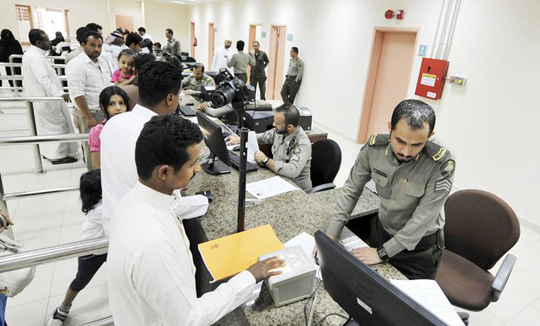
Yemenis

The General Directorate of Passports announced an extension of the visitor identity cards of Yemeni expatriates for another six months starting Sunday in line with directives of Crown Prince Mohammed bin Naif, deputy premier and minister of interior.

The current visit visas expire on Monday.

In a statement to Saudi Press Agency, the Passport Department stressed that all arrangements have been completed for online extension of the cards.

The directorate said that there is no need for Yemenis to visit the passport offices personally to extend their ID cards. Instead, they can do it via the Absher service of the Interior Ministry’s portal (www.moi.gov.sa) after making an online payment of SR100 through their bank accounts.

The user must log in to their personal account on Absher on www.moi.gov.sa and type “visitor identity.” The card will be printed and delivered to the user through the Wasel service of Saudi Post.

In case of those who have no postal address, or have not registered their address on Wasel, a link will appear for them to register their address on Absher to receive the card, and for any further details they can connect on gdp.gov.sa@992, the directorate said.

In a statement, Yemeni Vice President Lt. Gen. Ali Mohsen Al-Ahmar appreciated the directives of the king to extend the visitor identity cards to Yemenis as a kind gesture of the Kingdom’s continued support to Yemeni people.

Al-Ahmar said he valued the order and pointed out the attention paid by the Kingdom under the leadership of King Salman to Yemenis who live in the Kingdom.

He praised the efforts of the chief of the Immigration Department and Saudi Arabia to offer the necessary facilities at the branches of the correction centers in the Kingdom, in addition to the new branches in the liberated cities and a number of embassies of Yemen abroad.

Ahmed Saleh, a Yemeni national, thanked the king for the continued support to Yemen and Yemeni nationals, and for the order of extending the visas of Yemeni visitors to the Kingdom, as the situation is not fit for them to return home.

Another Yemeni national, Ali Nidam bin Abdat, thanked and appreciated the support of Saudi Arabia and the king’s order to extend visit visas. “I was worried I would have to go back to my country, but after this announcement I am relieved that I can stay here legally. The Kingdom adopted Yemenis and provided them with a comfortable and dignified life. This royal order shows that the Kingdom cares about their Yemeni brothers.

Thanks to everyone ... the king, the royal family, and the people of the Kingdom,” he said.

Thousands of Yemeni expats are living in the Kingdom on visit visas due to the ongoing war in their homeland.

Comments

Add new comment

  • Coastaldigest.com reserves the right to delete or block any comments.
  • Coastaldigset.com is not responsible for its readers’ comments.
  • Comments that are abusive, incendiary or irrelevant are strictly prohibited.
  • Please use a genuine email ID and provide your name to avoid reject.
Agencies
August 2,2020

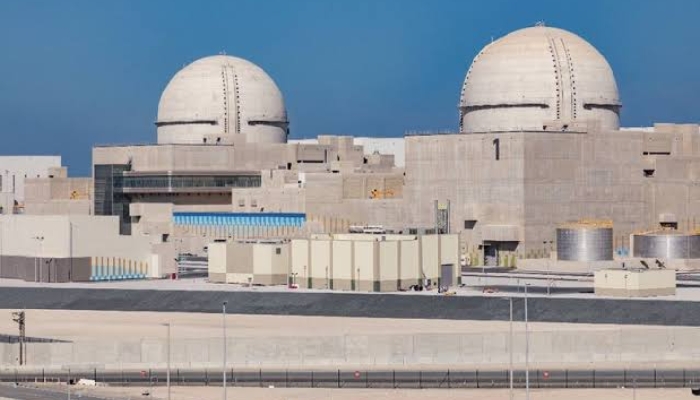
Dubai, Aug 2: The United Arab Emirates (UAE) announced on Saturday that it has started operations in the first of four reactors at the Barakah nuclear power station - the first nuclear power plant in the Arab world.

Emirates Nuclear Energy Corporation (ENEC), which is building and operating the plant with Korea Electric Power Corporation (KEPCO) said in a press release that its subsidiary Nawah Energy Company "has successfully started up Unit 1 of the Barakah Nuclear Energy Plant, located in the Al Dhafrah Region of Abu Dhabi".

That signals that Unit 1, which had fuel rods loaded in March, has achieved "criticality" - a sustained fission chain reaction.

"The start-up of Unit 1 marks the first time that the reactor safely produces heat, which is used to create steam, turning a turbine to generate electricity," said ENEC.

Barakah, which was originally scheduled to open in 2017, has been dogged by delays and is billions of dollars over budget. It has also raised myriad concerns among nuclear energy veterans who are concerned about the potential risks Barakah could visit upon the Arabian Peninsula, from an environmental catastrophe to a nuclear arms race.

Paul Dorfman, an honorary senior research fellow at the Energy Institute, University College London and founder and chair of the Nuclear Consulting Group, has criticised the Barakah reactors' "cheap and cheerful" design that he says cuts corners on safety.

Dorfman authored a report (PDF) last year detailing key safety features Barakah's reactors lack, such as a "core catcher" to literally stop the core of a reactor from breaching the containment building in the event of a meltdown. The reactors are also missing so-called Generation III Defence-In-Depth reinforcements to the containment building to shield against a radiological release resulting from a missile or fighter jet attack.

Both of these engineering features are standard on new reactors built in Europe, says Dorfman.

There have been at least 13 aerial attacks on nuclear facilities in the Middle East - more than any other region on earth.

The vulnerability of critical infrastructure in the Arabian Peninsula was further laid bare last year after Saudi Arabia's oil facilities at Abqaiq and Khurais were attacked by 18 drones and seven cruise missiles - an assault that temporarily knocked out more than half of the kingdom's oil production.

On Saturday, Dorfman reiterated his concern that there is no regional protocol in place to determine liability should an accident or incident at Barakah result in radioactive contamination spreading from the UAE to its neighbours. 

"Given Barakah has started up, because of all the well-rehearsed nuclear safety and security problems, it may be critically important that the Gulf states collectively evolve a Nuclear Accident Liability Convention, so that if anything does go wrong, victim states may have some sort of redress," Dorfman told Al Jazeera. 

The UAE has substantial oil and gas reserves, but it has made huge investments in developing alternative energy sources, including nuclear and solar.

Experts though have questioned why the UAE - which is bathed in sunlight and wind - has pushed ahead with nuclear energy - a far more expensive and riskier option than renewable energy sources.

When the UAE first announced Barakah in 2009, nuclear power was cheaper than solar and wind. But by 2012 - when the Emirates started breaking ground to build the reactors - solar and wind costs had plummeted dramatically.

Between 2009 and 2019, utility-scale average solar photovoltaic costs fell 89 percent and wind fell 43 percent, while nuclear jumped 26 percent, according to an analysis by the financial advisory and asset manager Lazard.

There are also concerns about the potential for Barakah to foment nuclear proliferation in the Middle East - a region rife with geopolitical fault lines and well-documented history of nuclear secrecy.

The UAE has sought to distance itself from the region's bad behaviour by agreeing not to enrich its own uranium or reprocess spent fuel. It has also signed up to the United Nation's nuclear watchdog's Additional Protocol, significantly enhancing inspection capabilities, and secured a 123 Agreement with the United States that allows bilateral civilian nuclear cooperation.

Comments

Add new comment

  • Coastaldigest.com reserves the right to delete or block any comments.
  • Coastaldigset.com is not responsible for its readers’ comments.
  • Comments that are abusive, incendiary or irrelevant are strictly prohibited.
  • Please use a genuine email ID and provide your name to avoid reject.
News Network
March 24,2020

Riyadh, Mar 24: General Directorate of Passports (Jawazat) on Tuesday asked all expatriates in the Kingdom, who have a final exit visa or an exit and reentry visa, to quickly cancel them before their expiry. This is to avoid the prescribed fines for not availing of these visas before their expiry date, the Saudi Press Agency reported.

The new measure was taken following the Saudi government’s suspension of international flights as part of the preventive and precautionary measures to stem the spread of new coronavirus. The Jawazat asked expatriates to verify the validity of such visas and cancel them through Ministry of Interior’s electronic service portals of Absher or Muqeem.

It underlined the need to adhere to the regulations and instructions in order to avoid fines prescribed by law against the violators.

Comments

KAJOOR MOHAMME…
 - 
Tuesday, 24 Mar 2020

My reentry expair date 26-03-2020 plz help me

Add new comment

  • Coastaldigest.com reserves the right to delete or block any comments.
  • Coastaldigset.com is not responsible for its readers’ comments.
  • Comments that are abusive, incendiary or irrelevant are strictly prohibited.
  • Please use a genuine email ID and provide your name to avoid reject.
News Network
May 3,2020

Jeddah, May 3: Saudis and expats who spread rumors on social media could be jailed for up to five years and fined SR3 million ($800,000) under measures to counter false information regarding the coronavirus pandemic.

The move follows warnings by Saudi Arabia’s Ministry of Health, Ministry of Interior, General Presidency of the Two Holy Mosques and other government entities that people should rely on trusted news sources and not third parties for information on the Kingdom’s handling of the COVID-19 outbreak.

The Saudi Public Prosecutor warned that legal action will be taken against individuals who spread misinformation and rumors.

On Saturday, media spokesman for the Riyadh region police, Col. Shakir Al-Tuwaijri, highlighted a video circulating on social media in which a person spreads rumors about steps taken to curb the spread of the coronavirus.

Other false claims include a planned change in curfew hours, warnings of food shortages, and a suggestion that health authorities are deliberately concealing the number of cases in the Kingdom.

In a recent case, a Riyadh resident claimed to know when worshippers will be allowed to return to the Grand Mosque.

All suspects have been arrested and face legal action, police said.

Dimah Al-Sharif, a Saudi legal counsel and member of the International Association of Lawyers, urged people to be responsible regarding content they access on social media.

“Receivers should not save such content or share it with others, and should delete it if possible since they, too, will be liable,” she said.

“Under Saudi laws to counter cyber-crime, we are not allowed to produce, prepare, send or save any unauthorized content or rumors.”

Individuals who breach regulations can be jailed for up to five years and face fines of SR3 million, as well as confiscation of the device(s) used in the crime, she said.

In addition, the judicial ruling will be published in newspapers at the offender’s expense.

The Kingdom’s Public Prosecution Office took to social media to warn users about the consequences of spreading rumors and misinformation.

@bip_ksa tweeted: “Receiving information from its official sources is a moral obligation and commitment, and legal responsibility. Do not fall victim to malicious rumors and news from anonymous sources that violate the procedures and effort, and cause terror regarding the Coronavirus, in order to avoid strict criminal accountability in this regard.”

Comments

Add new comment

  • Coastaldigest.com reserves the right to delete or block any comments.
  • Coastaldigset.com is not responsible for its readers’ comments.
  • Comments that are abusive, incendiary or irrelevant are strictly prohibited.
  • Please use a genuine email ID and provide your name to avoid reject.