


Young Saudis: We value responsibility, hard work, tolerance and justice

News Network
December 29, 2019

Jeddah/Dubai, Dec 29: The recent Saudi Youth Development Survey revealed that 67.02 percent of the Saudi population is between the age of 0 and 34.

The survey, which was performed during the second quarter of 2019 and was published by the General Authority for Statistics (GASTAT), aimed to provide many important indicators about the life of young people.

This included social, demographic and economic aspects, as well as the obstacles and challenges that face the younger generation.

Researchers compiled the figures in visits to 5,000 families in 13 regions and results showed that Saudis aged between 15 and 34 years formed 36.7 percent of the total population, 51.03 percent of them males, and 48.97 percent females.

The GASTAT survey also focused on education among youth in the Kingdom, reporting that 31.75 percent believe they have faced learning difficulties during their educational years, of which 31.86 percent were males and 31.64 percent were females.

Amongst these challenges, difficulty in accessing a school or university proved to be significantly low, with only 4.55 percent of males and 5.88 percent of females saying they have struggled to have an education. However, close to 14 percent said they have “difficulty studying.”

Commenting on these difficulties, Dr. Asma Siddiki, a Saudi education management leader with a degree in cognitive psychology from the University of Oxford said: “What’s interesting about this percentage is that it is self-reported. If we were to look at the recently published PISA (Program for International Student Assessment) results, we find that the majority of our 15-year-olds do very poorly with their problem-solving skills in tests on reading, mathematics and science. So it’s no surprise that a third of our 15 to 34 year-olds are aware of their challenges with learning difficulties,” said Dr. Siddiki.

“This is both unfortunate, given the efforts being made in the education sector, and an opportunity, if we are bold enough to recognize that the fix must be in tackling the earlier years and in ensuring that foundations are better laid so that children can be inspired to learn to learn — and not learn to rote learn,” she added.

However, despite a third of respondents facing learning difficulties, the report showed that more than half (58 percent) said they have participated in extracurricular activities, of which 59.67 percent were male and 56.26 percent were females.

In addition, the results showed that the percentage of young people fully satisfied in their work was 23.54 percent — 23.9 percent of males, and 21.85 of females. The percentage of working young people who have faced work difficulties, whether past or present, was estimated at 45.88 percent, 45.33 percent of males and 48.53 percent of females.

Wedjan Al-Ghamdi, a 31-year-old BIS graduate from Cardiff Metropolitan University in the UK, returned to the Kingdom and had difficulty finding a job in her field due to her family commitments and her husband’s job, which requires him to move from one city to another every few years.

To ensure that she made use of her degree, which she obtained through the Ministry of Higher Education, she had to settle for jobs that are far from her field and only provided her with one disappointment after another.

“I have changed jobs several times in the past six years,” said Al-Ghamdi. “I had to work in international schools as a supervisor, a teacher and at times an activities supervisor. It was difficult as I moved from one small city to the next due to my husband’s job, but I believe what would have been best for people like me is to find a company that would allow workers to work from home. There weren’t many in my field that provide that and there are many who have returned from abroad who are still finding it difficult to find jobs in their respective fields.”

Al-Ghamdi said that she has recently found a job that she is content with.

The Saudi government has a series of reform plans, including the ambitious Vision 2030, for the country to invest in education for its people to prepare them to participate in the workforce. Additionally, the Kingdom has proposed strict quotas in the private sector to encourage enterprises to prioritize hiring Saudi nationals and ensure economic and social growth.

The percentage of hired young people who considered that their salary was sufficient to meet their financial obligations was 68.91 percent, 69.59 percent of males, and 70.48 percent of females, while the percentage of young people who said that they can save part of their monthly income, was 44.71 percent, 43.62 percent of males, and 50.19 percent of females.

John Sfakianakis, chief economist at the Gulf Research Center and associate fellow at Chatham House in London, said that the tendency to save more money could be a result of higher income.

“There are a lot of young people that we classify as youth who are engaged in the economy far more today than a few years back and there are more women in the workforce, which is very positive. Saudi Arabia had a low female labor participation rate in the wider region and that has been improving.”

“At one point, youth unemployment rates were higher than they were in Egypt and Greece,” said Sfakianakis. “This was challenging for many years and now we see the overall youth unemployment rates falling, which is proof that many government programs to bolster the economy are working.”

In a recent survey also published by GASTAT, the labor market bulletin for the third quarter of 2019 showed that unemployment rates decreased to 5.5 percent, compared to 5.6 percent for the second quarter of this year. It’s a significant drop in comparison to the fourth quarter of 2018, where it was at 12.7 percent.

Meanwhile, social media proved to play a major role in the lives of Saudi youth.

The GASTAT survey showed that around 98 percent of youth use social media platforms, with 35.83 percent of respondents saying their social relationships have been affected by social media. This included 36.81 percent of males and 34.8 percent of females.

When it comes to societal norms, the report showed that youth believe that social values are strong in their communities. Among these values are an individual sense of responsibility (98.55 percent), hard work (98.12 percent), tolerance (98.26 percent), efficiency (97.46 percent), rational spending (89.22 percent), compliance with regulations (94.64 percent), justice (97.95 percent), moderation (97.42 percent), determination and perseverance (98.41 percent), and transparency (92.64 percent).

“In the unprecedented development that the Kingdom is witnessing, such reported high numbers in the social values that young Saudis share reflect a great sense of patriotism and nationalism,” said Razan Alaquil, Saudi Youth Delegate to the 2018 UN ECOSOC Youth Forum. “Our Saudi identity is being structured and defined on important factors that we as young Saudis not only share, but keep one another accountable for.

“Because this is a time for us to tell the story of our Kingdom through our actions by being responsible citizens who actively contribute. Those actions develop our Kingdom and make the Saudi identity what it is — an identity based upon our sense of contribution and responsibility for our country’s development, hard work, tolerance, efficiency, and so much more. As young Saudis, we keep one another accountable for those civic values because we all look at each other as one.”

Comments

Add new comment

  • Coastaldigest.com reserves the right to delete or block any comments.
  • Coastaldigset.com is not responsible for its readers’ comments.
  • Comments that are abusive, incendiary or irrelevant are strictly prohibited.
  • Please use a genuine email ID and provide your name to avoid reject.
Agencies
July 22,2020

Dubai, Jul 22: Saudi Arabia's Minister of Haj and Umrah, Dr Muhammad Saleh Benten, has inspected the facilities and arrangement made for the Haj pilgrims in Makkah and the holy sites.

Speaking to the Saudi Press Agency after the tour, the minister said that the Saudi government has worked out unprecedented plans for the running of this year's Haj, enabling pilgrims to perform their rituals in ease and comfort.
 
This year's Haj, which has been scaled back dramatically to include only around 1,000 Muslim pilgrims as Saudi Arabia battles a coronavirus surge, will begin on July 29, authorities said Monday.

"The comprehensive, foolproof plans will be implemented by the security, health and service agencies. The plans include the provision of the best health services, and the most appropriate crowd control, strictly in line with the precautionary measures and preventive protocols, formulated by the Ministry of Health to ensure full safety of pilgrims from the coronavirus pandemic," Dr Benten said.

According to the Saudi Gazette, Benten emphasised the eagerness of the government of the Custodian of the Two Holy Mosques, King Salman bin Abdulaziz of Saudi Arabia and Saudi Crown Prince Mohammed bin Salman bin Abdulaziz Al Saud to implement the Haj operation by following the highest health standards and precautionary measures in order to ensure the safety of the pilgrims.

Earlier, the minister inspected the arrangements and facilities for the reception and accommodation of pilgrims at Four Point Hotel in Makkah.

He was briefed by ministry officials with regard to receiving and accommodating pilgrims during the period from 4 to 8 of Dhul Hijjah before leaving for Mina.

Benten also visited the tents in Arafat and the facilities in Muzdalifah.

After that, his inspection tour visited the tent city of Mina, where he viewed one of the towers designated for the housing of pilgrims. 

According to the Saudi Gazette, he was impressed with the services and facilities being arranged for the accommodation and serving of food for the pilgrims.

To complete his visit, the minister watched a visual presentation of the mechanism for providing logistical services for the pilgrims during their travel from accommodation to Jamarat to undertake the stoning ritual.

Meanwhile, Maj. Gen. Mohammed Bin Wasl Al Ahmadi, assistant commander of the Haj security forces for the Grand Mosque and its premises, said on Tuesday that the security plan for this year's pilgrimage prioritises on organisational, security, humanitarian and health aspects.

He said the Haj security forces have installed entry and exit mechanisms from the Grand Mosque during Haj, with passages for pilgrims extending from the southern and western premises of venue as well as special passages around the circumambulation and Saey areas.

Comments

Add new comment

  • Coastaldigest.com reserves the right to delete or block any comments.
  • Coastaldigset.com is not responsible for its readers’ comments.
  • Comments that are abusive, incendiary or irrelevant are strictly prohibited.
  • Please use a genuine email ID and provide your name to avoid reject.
Agencies
July 31,2020

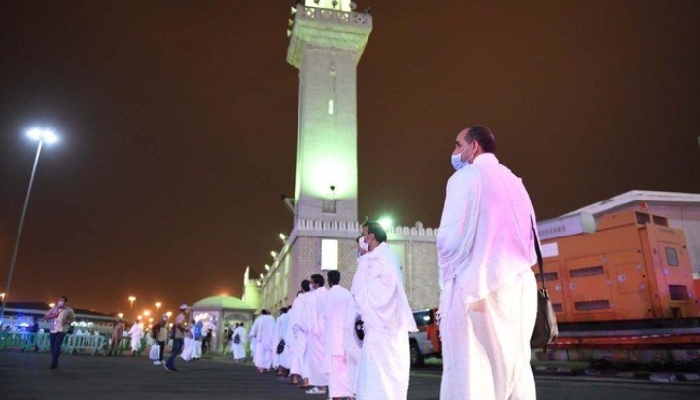
Jeddah, Jul 31: Hajj 2020 pilgrims arrived in Muzdalifah Thursday night to rest after spending the day in Arafat.

Earlier, the pilgrims scaled Mount Arafat to pray and repent, as a highly unusual Hajj approached its climax. They listened to a sermon delivered by Sheikh Abdullah Al-Manea and prayed Dhuhr and Asr prayers together at the Al-Namirah Mosque in Arafat.

This year’s pilgrimage is the smallest in modern times, after the number of participants was greatly restricted to prevent the spread of the coronavirus. 

Tight security was in place around the foot of the rocky hill outside Makkah, also known as Jabal Al-Rahma or Mount of Mercy, in preparation for the high point of the annual ritual.

Video footage shown on state television showed the pilgrims setting off on their climb to the summit. They wore face masks and observed strict social-distancing rules imposed by Saudi authorities.As sprinklers sprayed water on them to provide relief from the summer desert heat, the pilgrims raised their palms as they climbed the slopes of the hill — the site of Prophet Muhammad’s last sermon. When they reached the top they recited holy verses and prayed for forgiveness for their sins.

Earlier, the pilgrims were taken in buses from Mina to Mount Arafat. Strict precautionary measures were in place, with each group accompanied by security teams, ambulances and civil defense vehicles. 

When they arrived, their temperatures were checked before they entered Namirah Mosque to hear a sermon that was translated into 10 languages.

“The camps were set up for pilgrims in Arafat early on,” said Minister of Hajj and Umrah Muhammad Salih Bentin. The sermon at Namirah Mosque was delivered by Sheikh Abdullah Al-Manea, who led the pilgrims in noon and afternoon prayers.

“During Hajj this year, we reiterate that it is essential for pilgrims, as well as everyone assisting them, to adhere to the precautionary regulations that have been implemented,” Al-Manea, a member of the Council of Senior Scholars, said during his sermon. “This is to be done for their own safety.

“Precautions have been put in place to protect lives against the damage that the pandemic can cause, and also to actualize Islam’s teachings pertaining to safeguarding human life by Allah’s permission.”

The stay in Arafat is described as the pinnacle of Hajj and Muslims around the world reflect the actions of pilgrims by asking for forgiveness and praying for their deepest desires.
Pilgrims left Arafat in coaches for Muzdalifah after sunset and will pray the Maghrib and Isha prayers there.

After sunset prayers, the pilgrims made their way down Mount Arafat to Muzdalifah, where they will spend the night before the final Hajj ritual, the symbolic stoning of the devil. 

This year, each pilgrim received sanitized pebbles in advance of the event on Friday, which is the first day of Eid Al-Adha.
This year the Kingdom faced the unprecedented challenge of ensuring pilgrims attending Hajj were protected as much as possible from the risks of the coronavirus.

They will then sleep, pray the Fajr prayer there tomorrow and then leave for Mina.

Comments

Add new comment

  • Coastaldigest.com reserves the right to delete or block any comments.
  • Coastaldigset.com is not responsible for its readers’ comments.
  • Comments that are abusive, incendiary or irrelevant are strictly prohibited.
  • Please use a genuine email ID and provide your name to avoid reject.
Agencies
January 11,2020

Muscat, Jan 11: Oman's Sultan Qaboos bin Said has died, Aljazeera reported citing state television on Friday.

Qaboos was 79-year-old and was ill for a long time. He has served as the ruler of Oman since 1970 when he ousted his father in a bloodless coup.

Qaboos had no children and has not publicly named his successor.

Sultan Qaboos travelled to Belgium for a week in December for what was described then as "medical checks." He returned to Oman but speculations of his deteriorating health were rife.

Comments

Add new comment

  • Coastaldigest.com reserves the right to delete or block any comments.
  • Coastaldigset.com is not responsible for its readers’ comments.
  • Comments that are abusive, incendiary or irrelevant are strictly prohibited.
  • Please use a genuine email ID and provide your name to avoid reject.