



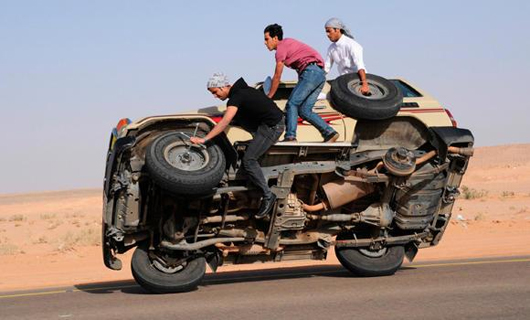
Youngster dies in drifting stunt

May 28, 2014

Dies in drifting stunt

Jeddah, May 28: A young Saudi national has died in Qassim after falling from a pickup truck when the driver performed a drifting stunt, according to local media.

This was the first death recorded from drifting since the final examinations started on Sunday, according to the report.

Young Saudis engage in drifting maneuvers during examination periods. “The dead man was traveling in a Hilux pickup vehicle with friends and fell from the vehicle during the drifting stunt and died on the spot,” a source reportedly said.

In a related development, police in Bisha arrested 10 drifters and their accomplices in the city, after receiving a tipoff, while the Jeddah police arrested 60 students for the same offense.

Brig. Gen. Zaid Al-Hamzi, spokesman for the Jeddah traffic department, told Arab News that most were intermediary and secondary level students.

The students were released but had to sign statements that they would have to face legal action after writing their final examinations.

Penalties include having the vehicle confiscated for 15 days and a fine of SR1,000.

For repeat offenders, the punishment could mean imprisonment, the seizure of the vehicle for a month, and a fine of SR1,500.

If a student is caught drifting a third time, the court would definitely imprison him, confiscate the vehicle and fine him SR2,000.

Al-Hamzi said the department is cracking down on the practice.

Traffic patrols have been positioned close to schools to ensure order, including helping students get to their examinations on time.

He said many traffic patrols have been deployed on the city’s roads to ease traffic flow and assist students. “Sometimes students’ vehicles break down on their way to school, and the patrols help them get there quickly,” he said.

Many undercover policemen are operating close to schools, he said.

The department has coordinated its efforts with the education department in Jeddah to prevent students from leaving the school grounds during breaks, said Al-Hamzi.

He said traffic light systems are updated on a regular basis to keep pace with the number of cars on the road at any given time, particularly on main roads.

“Trucks are strictly forbidden from entering cities, traveling on highways and the Al-Khair overpass during peak times because this causes traffic congestion.” Drivers would be punished for failing to comply, he said.

Comments

Add new comment

  • Coastaldigest.com reserves the right to delete or block any comments.
  • Coastaldigset.com is not responsible for its readers’ comments.
  • Comments that are abusive, incendiary or irrelevant are strictly prohibited.
  • Please use a genuine email ID and provide your name to avoid reject.
News Network
May 20,2020

Cairo, May 20: A senior Kuwaiti lawmaker has called for imposing a tax on expatriates’ remittances to shore up the country’s finances.

MP Khalil Al Saleh, the head of the parliament’s Human Resources Committee, has presented a draft law on the proposed tax to the legislature.

“Imposing fees on expatriates’ transfers will have a role in improving the state's revenues and diversify sources of income,” he told Al Rai newspaper.

Migrant workers transfer about 4.2 billion dinars annually from Kuwait, he added, citing figures from Kuwait’s Central Bank.

“This system is in effect in most countries of the world and in more than one Gulf country. Expats there have not objected to it. Allowing this money to exit the country is very dangerous and has a direct effect on economy,” MP Al Saleh said.

“We do not target brotherly expats because imposing symbolic fees on financial transfers will not affect their money, but will have a positive effect on the state’s sources,” he said. “This has become a necessity after the money transferred outside Kuwait has reached 4.2 billion dinars annually without the state [Kuwait] making any benefit from this.”

Foreign workers make up 3.3 million of Kuwait’s 4.6 million population.

Several Kuwaiti public figures have recently pushed for redrawing the demographic imbalance in the country, accusing expatriates of straining health facilities and increasing the Covid-19 threat.

Comments

Add new comment

  • Coastaldigest.com reserves the right to delete or block any comments.
  • Coastaldigset.com is not responsible for its readers’ comments.
  • Comments that are abusive, incendiary or irrelevant are strictly prohibited.
  • Please use a genuine email ID and provide your name to avoid reject.
News Network
April 15,2020

Dubai, Apr 15: Saudi Arabia reported 493 new cases of coronavirus, bringing the total number of infections in the country to 5869, the Ministry of Health announced on Wednesday.

According to the ministry of health, the number of recoveries today are 42 cases, making total of recoveries in the kingdom 931. And 71 critical cases in intensive care.

The ministry also confirmed 6 deaths bringing the total number of deaths in the kingdom to 79.

Saudi Arabia imposed a 24-hour curfew and lockdown on the cities of Riyadh, Tabuk, Dammam, Dhahran and Hofuf and throughout the governorates of Jeddah, Taif, Qatif and Khobar. This week the curfew was extended until further notice.

Overall, Saudi Arabia has reported one of the lowest rates of infection in the region, with around 5,000 cases in a population of over 30 million. Mecca was one of the first Saudi cities to be placed under a full-day curfew, and authorities took unprecedented precautions, suspending religious tourism in February and closing mosques across the country in March.

Comments

Add new comment

  • Coastaldigest.com reserves the right to delete or block any comments.
  • Coastaldigset.com is not responsible for its readers’ comments.
  • Comments that are abusive, incendiary or irrelevant are strictly prohibited.
  • Please use a genuine email ID and provide your name to avoid reject.
News Network
May 11,2020

May 11: Saudi Arabia will triple its value-added tax rate and suspend a cost of living allowance for state workers, it said on Monday, seeking to shield finances hit by low oil prices and a slump in demand for its lifeline export worsened by the new coronavirus.

Historic oil output cuts agreed by Riyadh and other major producers have given only limited support to prices after they sank on oversupply caused by a war for petroleum market share between the kingdom and its fellow oil titan Russia.

Saudi Arabia, the world's largest oil exporter, is also being hit hard by measures to fight the new coronavirus, which are likely to curb the pace and scale of economic reforms launched by Crown Prince Mohammed bin Salman.

"The cost of living allowance will be suspended as of June 1, and the value added tax will be increased to 15% from 5% as of July 1," Finance Minister Mohammed al-Jadaan said in a statement reported by the state news agency. "These measures are painful but necessary to maintain financial and economic stability over the medium to long term...and to overcome the unprecedented coronavirus crisis with the least damage possible."

The austerity measures come after the kingdom posted a $9 billion budget deficit in the first quarter.

The minister said non-oil revenues were affected by the suspension and decline in economic activity, while spending had risen due to unplanned strains on the healthcare sector and the initiatives taken to support the economy.

"All these challenges have cut state revenues, pressured public finances to a level that is hard to deal with going forward without affecting the overall economy in the medium to long term, which requires more spending cuts and measures to support non-oil revenues stability," he added.

The government has cancelled and put on hold some operating and capital expenditures for some government agencies, and cut allocations for some reform initiatives and projects worth a total 100 billion riyals ($26.6 billion), the statement said.

Central bank foreign reserves fell in March at their fastest rate in at least 20 years and to their lowest since 2011, while oil revenues in the first three months of the year fell 24% from a year earlier to $34 billion, pulling total revenues down 22%.

"The reforms are positive from a fiscal side as greater adjustment is essential. However, the tripling of VAT is unlikely to help that much in 2020 revenue wise with the expected fall in consumption," said Monica Malik, chief economist at Abu Dhabi Commercial Bank.

She said she kept unchanged her deficit forecast of 16.3% of GDP for this year, which already factors in a greater than previously announced spending cut.

About 1.5 million Saudis are employed in the government sector, according to official figures released in December.

In 2018, Saudi Arabia's King Salman ordered a monthly payment of 1,000 riyals ($267) to every state employee to compensate them for the rising living costs after the government hiked domestic gas prices and introduced value-added tax.

DIFFICULT TIMES

A committee has been formed to study all financial benefits paid to public sector employees and contractors, and will submit recommendations within 30 days, the statement said.

In late 2015, when oil prices fell from record highs, the kingdom slashed lavish bonuses, overtime payments and other benefits once considered routine perks in the public sector.

In a country without elections and with political legitimacy resting partly on distribution of oil revenue, the ability of citizens to adapt to such reforms is crucial for stability.

"Tripling the VAT will test the limits of the balance between revenues and consumption as the economy dives into a deep recession. The move will impact consumption and could also lower the expected revenues," said John Sfakianakis, a Gulf expert at the University of Cambridge.

"These are pro-austerity and pro-revenue moves rather than pro-growth ones," he said.

Hasnain Malik, head of equity strategy at Tellimer, said the VAT rise could bring about $24-$26.5 billion in additional non-oil fiscal revenue. The rise would hit consumer spending further but was a needed step towards fiscal sustainability, he said.

Comments

Add new comment

  • Coastaldigest.com reserves the right to delete or block any comments.
  • Coastaldigset.com is not responsible for its readers’ comments.
  • Comments that are abusive, incendiary or irrelevant are strictly prohibited.
  • Please use a genuine email ID and provide your name to avoid reject.