


1% transaction fee: Petrol bunks to stop accepting cards from tonight

January 8, 2017

Jan 8: The petrol bunks across the country will stop accepting debit cards and credit cards for filling fuel from midnight on Sunday as banks will now debit a Merchant Discount Rate of 1 per cent from petroleum dealers, said President of All India Petroleum Dealers Association Ajay Bansal.
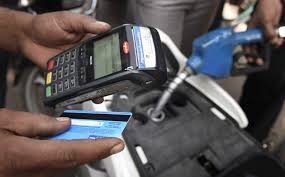
cardTalking to reporters after a two-day State-level convention of petroleum dealers here on Sunday, Mr. Bansal said each petroleum dealer was operating with a profit margin of 2 per cent.

On Saturday, banks referred to the Reserve Bank of India notification dated December 16 and said an MDR ranging between between 0.25 and 1 per cent will be deducted for each debit card transaction. An MDR of 1 per cent will be deducted for each credit card transaction.

“We are operating on a very thin margin. We cannot afford this deduction. Hence we have no other go than stop accepting debit and credit cards,” Mr. Bansal said. When pointed that the dealers are going against government directions, Mr. Bansal said they have no other option. Mr. Bansal said the decision to stop accepting debit and credit cards had been conveyed to Petroleum Ministry and Finance Ministry officials, he said.

Paytm and BHIM

Mr. Bansal said petroleum dealers will however accept payments through Paytm and Bhim apps. “But we have to stop accepting Paytm if they impose charge for each transaction,” he said. There are as many as 28,000 petrol bunks where Paytm was being accepted.

Mr. Bansal said the petroleum dealers are in favour of Central Government's move towards cashless transactions. “But we cannot afford to pay from our margin. We want our profit margin (of 2 per cent) intact,” he said.

Comments

Wonder Kotian
 - 
Monday, 9 Jan 2017

Wa master mind success, Fantastic \ cash less is not better than card less\" our great Anna!!!!!
\"While two fighting opponent fall down even he says my noose upside\" like all our great annaas say !!!!!!!
\" Now not wait and see, now wait and watch\""

Althaf
 - 
Sunday, 8 Jan 2017

Fenku ki tho Aisi ki taisi

Add new comment

  • Coastaldigest.com reserves the right to delete or block any comments.
  • Coastaldigset.com is not responsible for its readers’ comments.
  • Comments that are abusive, incendiary or irrelevant are strictly prohibited.
  • Please use a genuine email ID and provide your name to avoid reject.
News Network
May 29,2020

New Delhi, May 29: The Reserve Bank of India (RBI) has imposed a monetary penalty of Rs 1.2 crore on Karnataka Bank Limited for non-compliance of asset classification, divergence and provisioning norms.

"The penalty has been imposed in exercise of powers vested in RBI under the provisions of Section 47 A (1) (c) read with Section 46 (4) (i) of the Banking Regulation Act, 1949. 

This action is based on the deficiencies in regulatory compliance and is not intended to pronounce upon the validity of any transaction or agreement entered into by the bank with its customers," the central bank said in a statement on Thursday.

According to the central bank, the statutory inspection of the bank with reference to its financial position as on March 31, 2017, and as on March 31, 2018, and the Risk Assessment Reports (RAR) pertaining thereto revealed, inter-alia, non-compliance with the directions issued by RBI.

Earlier, a notice was issued to the bank advising it to show cause as to why penalty should not be imposed on it for non-compliance with the directions.

After considering the bank's reply to the notice, oral submissions made in the personal hearing and examination of additional submissions, RBI concluded that the charges of non-compliance with RBI directions warranted imposition of monetary penalty, according to a release.

This action is based on the deficiencies in regulatory compliance and is not intended to pronounce upon the validity of any transaction or agreement entered into by the bank with its customers.

Comments

Add new comment

  • Coastaldigest.com reserves the right to delete or block any comments.
  • Coastaldigset.com is not responsible for its readers’ comments.
  • Comments that are abusive, incendiary or irrelevant are strictly prohibited.
  • Please use a genuine email ID and provide your name to avoid reject.
News Network
February 11,2020

Bengaluru, Feb 11: Onion price dropped to Rs 25-30 per kg on Monday, down from the dizzying Rs 200/kg in December and January. The price had spiked because of excess rain, which ruined the crop in several parts of the country.

With supply stabilising, especially from Maharashtra and northern Karnataka, and exports banned, the rate is now easing, officials said.

Consumers may be smiling but farmers are worried as they are not able to make more than Rs 17/kg as against the expected Rs 40.

"We get onions from Nasik and Sholapur in Maharashtra. Nasik onions used to be exported but since that is currently banned, they are landing in Bengaluru, leaving the market here with a surplus," said K Lokesh, president, Karnataka State Onion Merchants Association.

A farmer from Sholapur wh o was part of a onion growers' delegation which met traders in Bengaluru, said, "The cost of everything has gone up. Labour charges and fuel prices are draining us. How can we survive? How can I pay for my children's education?"

Another Sholapur farmer rued: "My daughter's wedding is in March. How am I going to meet all the expenses? I have to pay for labour, transportation, gunny bags and when everything adds up, I don't get to save more than Rs 30,000 in a month."

Comments

Add new comment

  • Coastaldigest.com reserves the right to delete or block any comments.
  • Coastaldigset.com is not responsible for its readers’ comments.
  • Comments that are abusive, incendiary or irrelevant are strictly prohibited.
  • Please use a genuine email ID and provide your name to avoid reject.
News Network
January 25,2020

New Delhi, Jan 25: The latest edition of the Oxford Advanced Learner's Dictionary features 26 new Indian English words, including Aadhaar, chawl, dabba, hartal and shaadi.

The 10th edition of the dictionary, which was launched on Friday, has 384 Indian English words and incorporates over 1,000 new words such as chatbot, fake news and microplastic.

The dictionary focuses on language change and its evolution through the years, and has ensured that the language and examples used in the new edition are relevant and up to date with the times, Oxford University Press (OUP) said.

The new edition comes with interactive online support through the Oxford Learner's Dictionaries website and an app. The website includes advanced features such as audio-video tutorials, video walkthroughs, self-study activities and enhanced iWriter and iSpeaker tools.

"This edition has 26 new Indian English words of which 22 figure in the printed dictionary. The other four are in the digital version," said Fathima Dada, Managing Director (Education Division) at OUP.

Some of other new Indian words in the dictionary are auntie (while aunty already figures in the English dictionary, auntie is an Indianism), bus stand, deemed university, FIR, non-veg, redressal, tempo, tube light, veg and videograph.

The four new Indian English words in the online version of the dictionary are current (for electricity), looter, looting and upazila (one of the areas that a district is divided into for administration purposes).

According to OUP, the new edition provides better, more accurate and understandable definitions with examples, usage notes and additional resources to help the learner use the right word in the right context.

"Prevalence and common usage are the main criteria for enlisting new words. We scan the globe for words which are often used by people while speaking English. Then these words go through a rigorous testing process," Dada said.

"As OUP is the custodian of English language globally, these words have to go through its processes," she told PTI.

The Oxford Advanced Learner's Dictionary, she said, has been reinventing itself for nearly eight decades, anticipating the growing learning requirements of learners.

"The 10th edition also is equipped with a strong digital support system, including an app," she said.

It is equipped with several digital tools. With iSpeaker, learners can get help preparing for speaking exams and presentations. With iWriter, learners can plan, write and review their written work. Text Checker allows the teacher to check any text against the Oxford 3000, 5000, and OPAL (Oxford Phrasal Academic Lexicon) written word list.

Resources accessible through online premium access include lesson plans, worksheets, video walkthroughs, and classroom and self-study activities. With the OALD app one can find 86,000 words, 95,000 phrases, 112,000 meanings and 237,000 examples.

The dictionary, which spans 77 years, was originally published in Japan in 1942 and was first brought out by OUP in 1948. The learner's dictionary is based on the original values of its creator, Albert Sydney Hornby, whose aim was to help language learners worldwide understand the meaning of English words.

Comments

Add new comment

  • Coastaldigest.com reserves the right to delete or block any comments.
  • Coastaldigset.com is not responsible for its readers’ comments.
  • Comments that are abusive, incendiary or irrelevant are strictly prohibited.
  • Please use a genuine email ID and provide your name to avoid reject.