10 more venues cleaned under Swacch Mangaluru drive

[email protected] (CD Network)
October 31, 2016

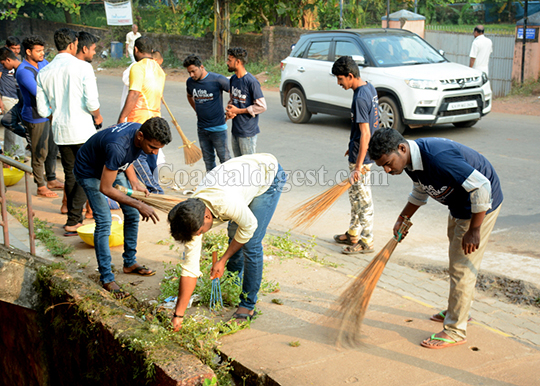
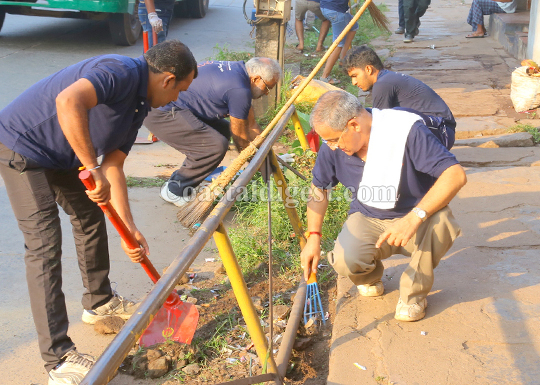
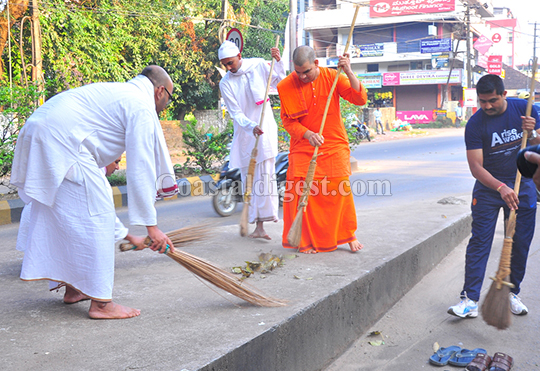
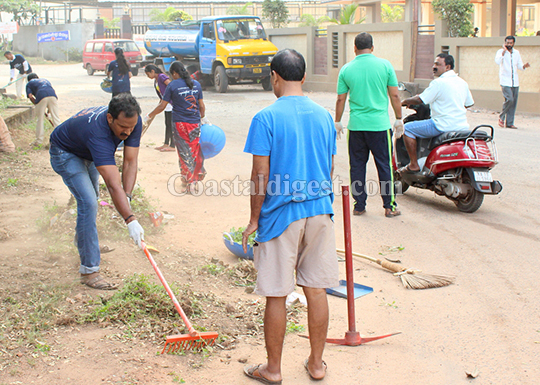
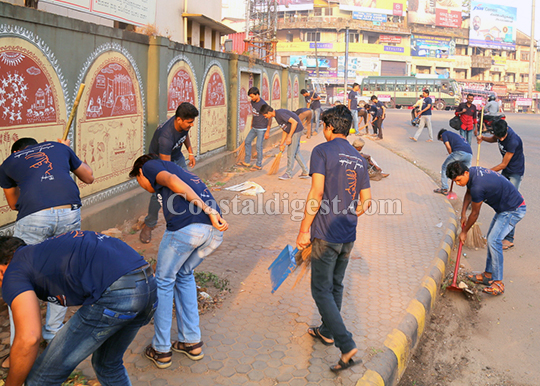
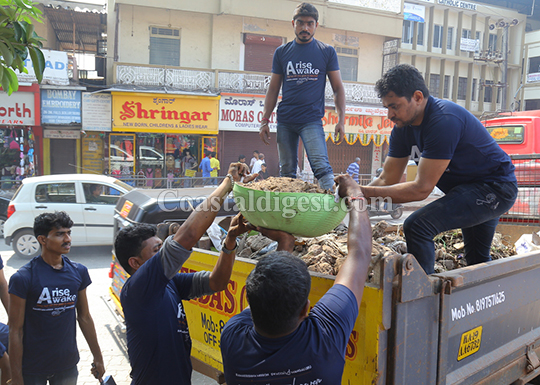
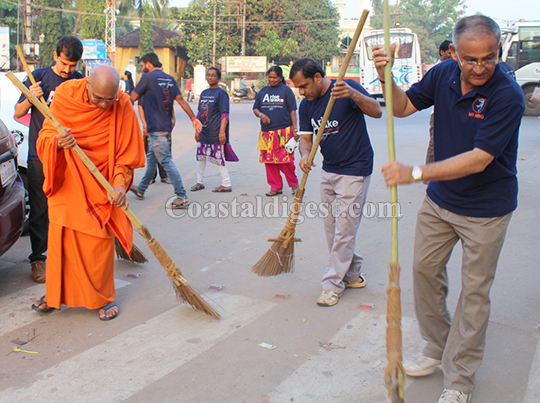
Mangaluru, Oct 31: The fourth week of 10 cleanliness drives of the 400 Abhiyans being organized by Ramakrishna Mission, Mangaluru took off on Sunday, the 30th October at 10 different venues in Mangalore.
Rkmm 1

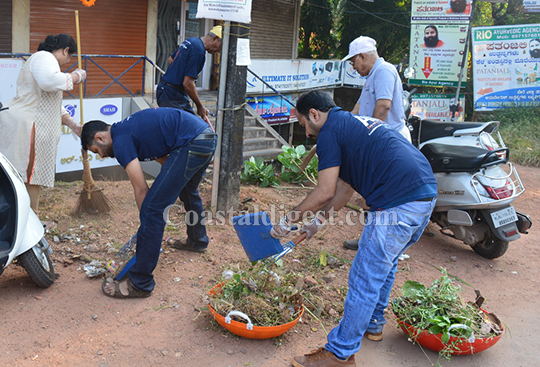
33 A B Shetty Circle – Employees of Sri Ram Transport Finance Co. Ltd. Took up the cleanliness drive surrounding AB Shetty Circle. Swami Jitakamanandaji, President, Ramakrishna Math, Mangalore and Capt. Ganesh Karnik, MLC jointly flagged off the drive. Sri Sathyanarayana K V, DGM & Sri Sharatchandra, DGM of Sriram Transport Finance guided the team members in cleaning the surroundings of RTO office.
34 Marnamikatta – Members of Lions Club under the leadership of Sri Sadashiva Rai & Sri Prashanth Rao cleaned the Marnamikatta area for about 2 hours. The team was coordinated by Sri Suresh Shetty. Swami Jitakamanandaji & Sri Harshakumar Kedige jointly flagged off the drive.
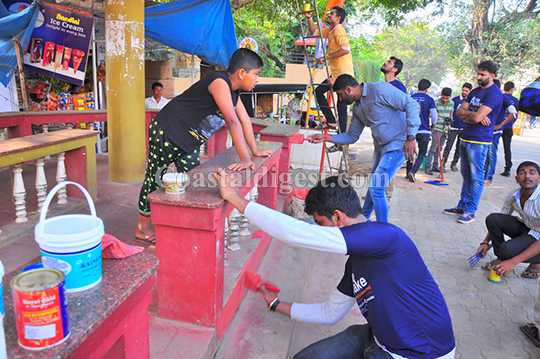
35 Milagres Circle – The members of Hindu warriors WhatsApp Group took up the 35th cleanliness drive near Milagres circle. Swami Dharmavratanandaji flagged off the drive. The volunteers cleaned the road dividers removing the mud and stones accumulated under the guidance of Sri Prashanth Ubarangala. The area around Light House Hill road was also cleared off the construction debris and the medians were painted. Sri Shivu Puttur & Sri Yogish Karyathadka coordinated the team.
36 Pandeshwara – The surroundings of Rosario church & school were cleaned. Mr. Latif, Corporator, MCC & Br Nishchay jointly flagged off the cleanliness drive. Sri Kumble Gopalakrishna Coordinated the team.
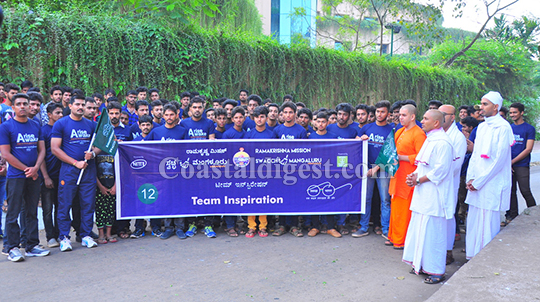
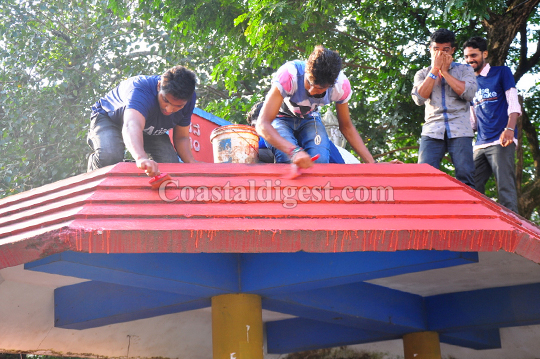
37 Kottara – Team Inspiration carried out the cleanliness drive around Infosys in Kottara. Swami Ekagamyanandaji of Ramakrishna Math, Mangalore & Sri Madan, SI, Bunder jointly flagged off the drive. Brahmacharis of the Ramakrishna math too joined hands with several volunteers in cleaning the area. Both sides of the road were cleaned and bus shelter was painted. Prof Sheshappa Amin, GFGC, car Street guided the volunteers.
38 Jeppu – The team of Swacch Jeppu carried out the cleanliness drive in the Jeppu area. Swami Jitakamanandaji & Sri Praveen Kumar jointly flagged off the drive. Cleanliness was carried out for two hours.
39 Bunts Hostel – Silver Fox Youth team cleaned the surroundings of Bunts Hostel area for about 2 hours. Swami Dharmavratanandaji of Ramakrishna Math & Capt. Ganesh Karnik jointly flagged off the drive. Sri Dhanush & Sri Nihal guided the team in the cleanliness drive.
40 Attavara – The devotees of Sri Chakrapani temple joined in the Swacch Mangaluru Abhiyan by cleaning the temple premises, KMC & surrounding areas. Br Shivakumar of Ramakrishna Math flagged off the drive. JCB & tipper was used to clear the dirt and mud accumulated in the area. Sri Akshith guided the team.
41 Monkey Stand – Crazy Guys team of Monkey Stand carried out the cleanliness drive in Monkey stand and Amar Alva road. Swami Chidambaranandaji of Ramakrishna Math flagged off the drive. Sri Dilraj Alva guided the team in the drive.
42 Morgan's gate - The members of Bhagini Samaj & Nivedita Balaga carried out the 38th cleanliness drive in Morgans gate & Bhagini Samaj area. It was a sight to see the old and young join the cleanliness drive alike.
Rkmm 2

Rkmm 3

Rkmm 4

Rkmm 5

Rkmm 6

Rkmm 7

Rkmm 8

Rkmm 9

Rkmm 10

Rkmm 11

Comments

anti corruption
 - 
Wednesday, 2 Nov 2016

Before cleaning the streets, the central govt should clean their minds & hearts for Bharat to be swachh.

naren kotian
 - 
Tuesday, 1 Nov 2016

hahaha all thief sorry althaf ... i cannot see single burqa clad women or low grade athar special affect otte topi doing swach bharath program.... yesterday did u see swatch bharath initiative in madya pradesh , 8 parasites were cleared by spraying bullets ... adu onthara swacha bharath kanappa ... hahaha ... we are doing swatch bharath in kashmir also ... hats off to ramakrishna mission ...

Shaima umar farooq
 - 
Tuesday, 1 Nov 2016

Well done keep it up. Gud work by team. Masha allah.

Ahmed
 - 
Tuesday, 1 Nov 2016

Does MCC have paid staff for cleaning the areas? if so, where are they? only taking salary from tax money and sleeping at home.
Then, general public has to clean the filth?

Althaf
 - 
Monday, 31 Oct 2016

Until We clear our dirty politicians and terrorists organisations like RSS,BD,Rama sene, Shivasene etc india will not be a clean country. All indians should join together to clean this Organisations.

Peace
 - 
Monday, 31 Oct 2016

No need to make politics by taking some photographs & advertising. I appreciate this work but not as one particular task to promote someone.
Being humans its our duty to keep clean & hygeine environment around all time. but above images shows clearly about particular xxx advertisement. It will not promote awareness, coz here this work is done only for taking for photographs & particular situation.
Hope it will continue regularly in village area where really need awareness....

Add new comment

  • Coastaldigest.com reserves the right to delete or block any comments.
  • Coastaldigset.com is not responsible for its readers’ comments.
  • Comments that are abusive, incendiary or irrelevant are strictly prohibited.
  • Please use a genuine email ID and provide your name to avoid reject.
Ram Puniyani
January 14,2020

In the beginning of January 2020 two very disturbing events were reported from Pakistan. One was the attack on Nankana Sahib, the holy shrine where Sant Guru Nanak was born. While one report said that the place has been desecrated, the other stated that it was a fight between two Muslim groups. Prime Minister of Pakistan Imran Khan condemned the incident and the main accused Imran Chisti was arrested. The matter related to abduction and conversion of a Sikh girl Jagjit Kaur, daughter of Pathi (One who reads Holy Guru Granth Sahib in Gurudwara) of the Gurudwara. In another incident one Sikh youth Ravinder Singh, who was out on shopping for his marriage, was shot dead in Peshawar.

While these condemnable attacks took place on the Sikh minority in Pakistan, BJP was quick enough to jump to state that it is events like this which justify the Citizenship Amendment Act (CAA). Incidentally CAA is the Act which is discriminatory and relates to citizenship with Religion, which is not as per the norms of Indian constitution. There are constant debates and propaganda that population of Hindus has come down drastically in Pakistan and Bangla Desh. Amit Shah, the Home minister stated that in Pakistan the population of Hindus has come down from 23% at the time of partition to 3.7% at present. And in Bangla Desh it has come down from 22% to present 8%.

While not denying the fact that the religious minorities are getting a rough deal in both these countries, the figures which are presented are totally off the mark. These figures don’t take into consideration the painful migrations, which took place at the time of partition and formation of Bangla Desh later. Pakistan census figures tell a different tale. Their first census was held in 1951. As per this census the overall percentage of Non Muslim in Pakistan (East and West together) was 14.2%, of this in West Pakistan (Now Pakistan) it was 3.44 and in Eat Pakistan it was 23.2. In the census held in Pakistan 1998 it became 3.72%. As far as Bangla Desh is concerned the share of Non Muslims has gone down from 23.2 (1951) to 9.6% in 2011.

The largest minority of Pakistan is Ahmadis, (https://minorityrights.org/country/pakistan/) who are close to 4 Million and are not recognised as Muslims in Pakistan. In Bangla Desh the major migrations of Hindus from Bangla Desh took place in the backdrop of Pakistan army’s atrocities in the then East Pakistan.

As far as UN data on refugees in India it went up by 17% between 2016-2019 and largest numbers were from Tibet and Sri Lanka.  (https://www.un.org/en/development/desa/population/migration/publication…)

The state of minorities is in a way the index of strength of democracy. Most South Asian Countries have not been able to sustain democratic values properly. In Pakistan, the Republic began with Jinnah’s classic speech where secularism was to be central credo of Pakistan. This 11th August speech was in a way what the state policy should be, as per which people of all faiths are free to practice their religion. Soon enough the logic of ‘Two Nation theory” and formation of Pakistan, a separate state for Muslim took over. Army stepped in and dictatorship was to reign there intermittently. Democratic elements were suppressed and the worst came when Zia Ul Haq Islamized the state in collusion with Maulanas. The army was already a strong presence in Pakistan. The popular formulation for Pakistan was that it is ruled by three A’s, Army, America and Allah (Mullah).

Bangla Desh had a different trajectory. Its very formation was a nail in the coffin of ‘two nation theory’; that religion can be the basis of a state. Bangla Desh did begin as a secular republic but communal forces and secular forces kept struggling for their dominance and in 1988 it also became Islamic republic. At another level Myanmar, in the grip of military dictatorship, with democratic elements trying to retain their presence is also seeing a hard battle. Democracy or not, the army and Sanghas (Buddhist Sang has) are strong, in Myanmar as well. The most visible result is persecution of Rohingya Muslims.

Similar phenomenon is dominating in Sri Lanka also where Budhhist Sanghas and army have strong say in the political affairs, irrespective of which Government is ruling. Muslim and Christian minorities are a big victim there, while Tamils (Hindus, Christians etc.) suffered the biggest damage as ethnic and religious minorities. India had the best prospect of democracy, pluralism and secularism flourishing here. The secular constitution, the outcome of India’s freedom struggle, the leadership of Gandhi and Nehru did ensure the rooting of democracy and secularism in a strong way.

India so far had best democratic credentials amongst all the south Asian countries. Despite that though the population of minorities rose mainly due to poverty and illiteracy, their overall marginalisation was order of the day, it went on worsening with the rise of communal forces, with communal forces resorting to identity issues, and indulging in propaganda against minorities.

While other South Asian countries should had followed India to focus more on infrastructure and political culture of liberalism, today India is following the footsteps of Pakistan. The retrograde march of India is most visible in the issues which have dominated the political space during last few years. Issues like Ram Temple, Ghar Wapasi, Love Jihad, Beef-Cow are now finding their peak in CAA.

India’s reversal towards a polity with religion’s identity dominating the political scene was nicely presented by the late Pakistani poetess Fahmida Riaz in her poem, Tum bhi Hum Jaise Nikle (You also turned out to be like us). While trying to resist communal forces has been an arduous task, it is becoming more difficult by the day. This phenomenon has been variously called, Fundamentalism, Communalism or religious nationalism among others. Surely it has nothing to do with the religion as practiced by the great Saint and Sufi traditions of India; it resorts mainly to political mobilization by using religion as a tool.

Comments

Ashi
 - 
Tuesday, 14 Jan 2020

If Malaysia implement similar NRC/CAA, India and China are the loser.

Add new comment

  • Coastaldigest.com reserves the right to delete or block any comments.
  • Coastaldigset.com is not responsible for its readers’ comments.
  • Comments that are abusive, incendiary or irrelevant are strictly prohibited.
  • Please use a genuine email ID and provide your name to avoid reject.
News Network
May 9,2020

Bengaluru, May 9: Karnataka government in its latest order has allowed restaurants, pubs and bars to sell liquor at retail prices from May 9 till May 17. The third phase of coronavirus lockdown is slated to end on May 17.

"Karnataka government has allowed restaurants, pubs and bars to sell liquor at retail prices from tomorrow till May 17. However, they can be sold only in take away form," read an order issued by the state government.

Earlier, the government had allowed the opening of liquor shops in order to mobilise revenue. However, bars, pubs, restaurants were ordered to remain close amid the COVID-19 lockdown.

As per the latest update by the State Health Department, the total number of coronavirus cases in the state is 753. "Of 753 cases, 346 are active cases. 376 persons were discharged after treatment while 30 people have succumbed to the coronavirus," the Health Department said in a release. 

Comments

Add new comment

  • Coastaldigest.com reserves the right to delete or block any comments.
  • Coastaldigset.com is not responsible for its readers’ comments.
  • Comments that are abusive, incendiary or irrelevant are strictly prohibited.
  • Please use a genuine email ID and provide your name to avoid reject.
coastaldigest.com web desk
June 9,2020

With the steep hike in excise duty in the past couple of months, an average consumer of petrol now pays over 275% in taxes to centre and states on a litre of the fuel.  The base price of petrol is just about Rs 18. The taxes are close to Rs 50 and the pump price is over Rs 72.

India imports 85% of all its crude oil demand.  After a steep hike in excise duty in the past two months despite a hold on daily price revisions by the oil public sector undertakings (PSUs), Indian consumers now pay 275% collectively in excise duty to state and centre. 

The central government hiked excise on petrol and diesel by Rs 10 and Rs 13 respectively last month. The excise duty on petrol is taxed around Rs 33-a-litre while the same on diesel it is Rs 32.

The Value-Added Tax (VAT) on both petrol and diesel is Rs 16.44 and Rs 16.26 respectively. Both the taxes together are around Rs 49 while it is sold at petrol pumps at 73-per-litre.

These two taxes cumulatively account for 69% of tax which is higher than anywhere else in the world. The same is taxed at 19% in the US, 47% in Japan, UK 62% and 63% in France. The government does not pass on the benefit of lower crude oil prices to the customer.

It is to be noted that Indian consumers continued to pay Rs 70-a-litre even when crude oil prices hit a paltry US $ 20-a-barrel on April 12.

Former finance minister and Congress leader recently took a jab at the Centre over rising prices stating, “Fuel selling prices raised twice in two days, following tax hikes two weeks ago. This time to benefit oil companies. Government is poor, it needs more taxes. Oil companies are poor, they need better prices. Only the poor and middle class are not poor, so they will pay”.

Comments

Lovely indian
 - 
Wednesday, 10 Jun 2020

Acche din for modi bakth....lets enjoy


you need only ram mandir and NRC

Add new comment

  • Coastaldigest.com reserves the right to delete or block any comments.
  • Coastaldigset.com is not responsible for its readers’ comments.
  • Comments that are abusive, incendiary or irrelevant are strictly prohibited.
  • Please use a genuine email ID and provide your name to avoid reject.