



3 militant attacks in 24 hours injure over 13 jawans along LoC; army on high alert

Agencies
June 14, 2017

Srinagar, Jun 14: In a span of just over four hours, militants carried out series of attacks on Tuesday evening in Kashmir, injuring 13 security personnel. According to an media report, there have been five attacks in south Kashmir and one in north Kashmir in the last 24 hours.army5
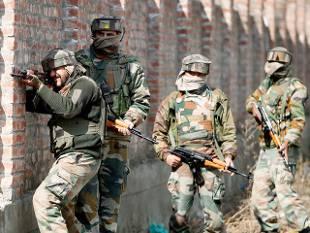
In south Kashmir's Pulwama district's Tral, terrorists threw a grenade at a Central Reserve Police Force (CRPF) camp, injuring nine jawans, a police official was quoted as saying by news agency.

"Nine CRPF jawans were injured in the explosion and were shifted to the (army's) 92nd Base Hospital in Srinagar," said a police official, adding, "The area has been surrounded for searches."

In the second attack, militants opened firing on security personnel guarding the residence of a retired high court judge at Anchidora in Anantnag district, resulting in injuries to two policemen, the official said. He said the ultras also snatched four service weapons from the police posted there.

The third attack took place on a CRPF camp at Padgampora in Pulwama, but no one was hurt, as the grenade hurled by the militants exploded mid-air. The ultras also threw a grenade on Pulwama police station, resulting in minor injuries to one cop.

On Monday evening, two soldiers were injured when terrorists attacked a CRPF camp in Pulwama. Police said they had inputs about a possible terrorist attack on Tuesday, and the information was shared with all security agencies.

Last week, a civilian was injured after terrorists attacked a police convoy on the Srinagar-Jammu National Highway, near Kashmir's Qazigund area. Terrorists fired at least 10 rounds of bullets, one of which hit a civilian.

On Monday, soldiers deployed along the Line of Control in Poonch detected suspicious movement at around 03:30 am and engaged "Pakistan-backed terrorists", a defence spokesman said.

As Indian troops fired back, the terrorists returned fire and ran back across the LoC, he said. An intense combing operation was conducted, which resulted in eight rucksacks (one combat jacket each), one Underbarrel Grenade Launchers (UBGL), one binocular, one radio set with antenna, seven shawls medicines, seven ready-to-eat meals, a mobile phone, cells, personal clothing and eatables being recovered, the spokesperson said.

The army had earlier claimed to have thwarted an Uri-style attack (that left 19 soldiers dead last year) by killing five militants on the LoC on Friday in north Kashmir. These militants, according to the army, were wearing "unique body-fitted IEDs", which had been earlier used by militants to carry out suicide attacks along the LoC.

Although the army has been able to keep a tight lid on the infiltration attempts, Firstpost reported, one miscalculation could see another Uri-style attack in the coming days in Kashmir. "We are prepared for any eventuality. We will not allow a repeat of the Uri attack," the army officer told Firstpost.

Comments

Add new comment

  • Coastaldigest.com reserves the right to delete or block any comments.
  • Coastaldigset.com is not responsible for its readers’ comments.
  • Comments that are abusive, incendiary or irrelevant are strictly prohibited.
  • Please use a genuine email ID and provide your name to avoid reject.
News Network
May 26,2020

New Delhi, May 26: With India now in the bracket of top 10 nations worst hit by the novel coronavirus, experts have attributed the surge in cases to easing of travel restrictions and movement of migrants besides enhanced testing capacity.

According to AIIMS Director, Randeep Guleria, the present rise in cases has been reported predominantly from hotspot areas but there is a possibility of further rise in the number of COVID-19 cases in the coming few days due to increased travel.

"Those who are asymptomatic or are in presymptomatic stage will pass through screening mechanisms and may reach areas where there have been minimal or less cases," Guleria said.

He said there was a need for more intense surveillance and monitoring in areas where migrants have returned to contain the spread of the disease.

If proper social distancing and hand hygiene is not maintained at a time when people are out on roads, the coronavirus infection will transmit much faster, he said.

Guleria also noted that testing capacity has been significantly ramped up which is reflecting in the increasing number of cases being detected.

Commenting on the partial resumption of rail and road transport services and migrants returning to their native places, Dr Chandrakant S Pandav, former president of the Indian Public Health Association and Indian Association of Preventive and social medicine, said the floodgates have been opened.

"This is a classic case of creating an enabling environment for coronavirus to spread like wildfire. In the coming few days, the number will rise dramatically. While it is true that lockdown cannot go on forever, the opening up should have been in a measured, calibrated and informed manner," he said.

"Travelling leads to spread of the infection. Now, the government will have to ensure even stronger surveillance to curb the infection but if that will be done is something to be observed," he said.

The death toll due to COVID-19 rose to 4,167 and the number of cases climbed to 1, 45,380 in the country, registering an increase of 146 deaths and 6,535 cases since Monday 8 am, according to the Union Health Ministry.

Dr K K Aggarwal, President of the Confederation of Medical Association of Asia and Oceania (CMAAO), and former IMA President, said there will be a further surge in cases in the coming days if migration continues without any proper social distancing.

"Within the next ten days, the cases will cross two lakh. The very fact that number of cases was rising before the end of the third lockdown and continuing during the fourth lockdown means that people are not following physical distancing as required," he said.

"Even in the last week of May when the temperature is very high, the rising number of cases would mean that human-to-human transmission is more important than surface-to-human transmission. Normally in heat the surface-to-human transmission should have reduced the new cases by half which has not happened," Aggarwal said.

However, Professor K Srinath Reddy, president of the Public Health Foundation of India, said an increase in the number of cases reflects both an increase in testing rates and an increase in spread.

"What we need to see is the number of new tests performed per day and the number of new cases that were identified from them. That gives a better idea of the rate of spread than the total number of new cases alone.

"We also have to see if the testing criteria has remained the same between the two periods of comparison.We may open up gradually but will have to continue case detection, contact tracing and follow personal protection measures as vigorously as possible," he added.

A total of 31,26,119 samples have been tested as on May 26, 9 am and 92,528 samples have been tested in the last 24 hours, ICMR officials said.

India is the tenth most affected nation by the pandemic after the US, Russia, UK, Spain, Italy, Brazil, Germany, Turkey and France, as per the John Hopkins University data.

The country has recorded 6,088, 6,654, 6,767 and 6977 cases on May 22, 23, 24 and 25 respectively. Also, the number of RT-PCR tests for detection of COVID-19 in the country crossed the 30-lakh mark on Monday.

The first two phases of the lockdown led to 14-29 lakh COVID-19 cases being averted, while the number of lives saved in that period was between 37,000 and 78,000, the government said last Friday, citing various studies, and asserted that the unprecedented shutdown has paid "rich dividends" in the fight against the pandemic.

Comments

Add new comment

  • Coastaldigest.com reserves the right to delete or block any comments.
  • Coastaldigset.com is not responsible for its readers’ comments.
  • Comments that are abusive, incendiary or irrelevant are strictly prohibited.
  • Please use a genuine email ID and provide your name to avoid reject.
Agencies
July 6,2020

New Delhi, Jul 6: The Indian Academy of Sciences, a Bengaluru-based body of scientists, has said the Indian Council for Medical Research's (ICMR) target to launch a coronavirus vaccine by August 15 is "unfeasible" and "unrealistic".

The IASc said while there is an unquestioned urgent need, vaccine development for use in humans requires scientifically executed clinical trials in a phased manner.

While administrative approvals can be expedited, the "scientific processes of experimentation and data collection have a natural time span that cannot be hastened without compromising standards of scientific rigour", the IASc said in a statement.

In its statement, the IASc referred to the ICMR's letter which states that "it is envisaged to launch the vaccine for public health use latest by 15th August 2020 after completion of all clinical trials".

The ICMR and Bharat Biotech India Limited, a private pharmaceutical company, are jointly developing the vaccine against the novel coronavirus -- SARS-CoV-2.

The IASc welcomes the exciting development of a candidate vaccine and wishes that the vaccine is quickly made available for public use, the statement said.

"However, as a body of scientists including many who are engaged in vaccine development IASc strongly believes that the announced timeline is unfeasible. This timeline has raised unrealistic hope and expectations in the minds of our citizens," it said.

Aiming to launch an indigenous COVID-19 vaccine by August 15, the ICMR had written to select medical institutions and hospitals to fast-track clinical trial approvals for the vaccine candidate, COVAXIN.

Experts have also cautioned against rushing the process for developing a COVID-19 vaccine and stressed that it is not in accordance with the globally accepted norms to fast-track vaccine development for diseases of pandemic potential.

The IASc said trials for a vaccine involve evaluation of safety (Phase 1 trial), efficacy and side effects at different dose levels (Phase 2 trial), and confirmation of safety and efficacy in thousands of healthy people (Phase 3 trial) before its release for public use.

Clinical trials for a candidate vaccine require participation of healthy human volunteers. Therefore, many ethical and regulatory approvals need to be obtained prior to the initiation of the trials, it added.

The IASc said the immune responses usually take several weeks to develop and relevant data should not be collected earlier.

"Moreover, data collected in one phase must be adequately analysed before the next phase can be initiated. If the data of any phase are unacceptable then the clinical trial is required to be immediately aborted," it said.

For example, if the data collected from Phase 1 of the clinical trial show that the vaccine is not adequately safe, then Phase 2 cannot be initiated and the candidate vaccine must be discarded.

For these reasons, the Indian Academy of Sciences believes that the announced timeline is "unreasonable and without precedent", the statement said.

"The Academy strongly believes that any hasty solution that may compromise rigorous scientific processes and standards will likely have long-term adverse impacts of unforeseen magnitude on citizens of India," it said.

Comments

Add new comment

  • Coastaldigest.com reserves the right to delete or block any comments.
  • Coastaldigset.com is not responsible for its readers’ comments.
  • Comments that are abusive, incendiary or irrelevant are strictly prohibited.
  • Please use a genuine email ID and provide your name to avoid reject.
News Network
February 16,2020

Varanasi, Feb 16: Amidst continuing protests against the amended citizenship law, Prime Minister Narendra Modi on Sunday said his government stood by the decision despite all pressure.

"Be it the decision on Article 370 or the Citizenship Amendment Act, it was necessary in the interest of the country. Despite pressure, we stand by our decision and will remain so," he said.

Modi was addressing a public meeting in his Lok Sabha constituency.

Prime Minister Narendra Modi also asserted that the trust set up for construction of the Ram temple in Ayodhya will work "rapidly".

"A trust has been formed for construction of a grand Ram temple in Ayodhya. This trust will work rapidly," he said at a public meeting during his day-long visit to his Lok Sabha constituency.

The government had recently set up the Shri Ram Janmabhoomi Teerth Kshetra on the Supreme Court's directive to the Union government to form a trust that can look into the construction and management of the temple.

Comments

Add new comment

  • Coastaldigest.com reserves the right to delete or block any comments.
  • Coastaldigset.com is not responsible for its readers’ comments.
  • Comments that are abusive, incendiary or irrelevant are strictly prohibited.
  • Please use a genuine email ID and provide your name to avoid reject.