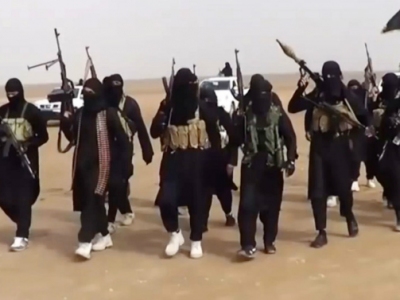
5 from Kerala killed while fighting for ISIS in Syria, says report

Agencies
July 2, 2017

Kozhikode, Jul 2: The Kerala Intelligence has received reports of death of five persons from Malabar while fighting for Islamic State in Syria, but the news cannot be authenticated as the information was first received by the victims' family, an official has said.
is

"Such news is not authenticated, it is only information. But the reports could be true as they were received by family circles," a senior officer in the intelligence wing said.

He said relatives of one Sibi from Kanjikode in Palakkad district, had received the news of his death a few days ago. Sibi was working in Bahrain before joining the Islamic State in Syria. "Further details could not be known," the official said.

Similar is the case of one Muhadis, reportedly killed in Aleppo in Syria in military operations.

His brother who works in Bahrain broke the news of Muhadis' death to family members at Vaniyambalam in Mallapuram district when he came home about a month ago, the officer said.

Abu Tahir from Palakkad district was reportedly killed in US military strikes in Syria in April this year. The intelligence official, however, did not give details of the other two persons reportedly killed in Syria.

The official said the earlier deaths of four others from Kasaragod and Kozhikode districts of Kerala at Nangahar in Afghanistan have been confirmed.

"But it will be difficult for us to confirm the present deaths of five persons reportedly killed in Syria," he added.

Comments

Dr.Prakash Shetty
 - 
Thursday, 6 Jul 2017

Congratulations on your new appointment and wish you every success in your new duties.

Yuvraj
 - 
Thursday, 6 Jul 2017

Respected sir/ madam
I am a student Karnataka
Studying in Maharashtra
Have any scholarship scheme?

Add new comment

  • Coastaldigest.com reserves the right to delete or block any comments.
  • Coastaldigset.com is not responsible for its readers’ comments.
  • Comments that are abusive, incendiary or irrelevant are strictly prohibited.
  • Please use a genuine email ID and provide your name to avoid reject.
News Network
March 28,2020

Thiruvananthapuram, Mar 28: A man from Kerala was among the terrorists affiliated to Islamic State (IS) who allegedly attacked a Gurdwara in Kabul earlier this week in which 27 people were killed.

The IS has claimed that one of the suicide bombers was Abu Khalid al-Hindi.

According to sources, investigation agencies on Friday have identified him as 29-year-old Mohammed Sajid Kuthirummal of Padne in Kasargod. He was among the 14 persons, who left from Kerala to join IS in Nangarhar province of Afghanistan.

"IS had released the name Abu Khalid al-Hindi through its media agency soon after the attack. The photograph of him holding a rifle was also published by IS in their propaganda magazine Al Naba. From that, we have identified the person as Mohammed Sajid Kuthirummal. We are investigating the matter and in touch with the investigating agencies in Afghanistan for tracking his trail," sources told ANI.

The National Investigation Agency (NIA) probe had earlier revealed that Mohammed Sajid was recruited by Abdul Rashid Abdulla of Chandera, who was killed in Afghanistan last year.

Sajid worked as a shop keeper in a gulf country and returned to Kerala. Based on a complaint by Sajid's father Mahamood, the FIR was registered at Chendara Police Station, Kasaragod in 2016 regarding Sajid joining IS and leaving for Afghanistan.

He was among the 14 member team that left from Kerala to join IS in Khorasan Province' in Nangarhar.

ANI had earlier reported that two of these members Ayesha alias Sonia Sebastian and Fathima alias Nimisha who were in IS had expressed their interest in returning to Kerala. Out of 14, seven including Sajid is dead.

Comments

Abdul Gaffar Bolar
 - 
Saturday, 28 Mar 2020

First, investigate truly who is behind this? Then hang all of them. 


Add new comment

  • Coastaldigest.com reserves the right to delete or block any comments.
  • Coastaldigset.com is not responsible for its readers’ comments.
  • Comments that are abusive, incendiary or irrelevant are strictly prohibited.
  • Please use a genuine email ID and provide your name to avoid reject.
Ram Puniyani
June 29,2020

In Minneapolis, US an African American, George Floyd lost his life as the white policeman, Derek Chauvin, caught hold of him and put his knee on his neck. This is a technique developed by Israel police. For nine long minutes the knee of the while policeman was on the neck of George, who kept shouting, I can’t breathe.

Following this gruesome murder America erupted with protests, ‘Black lives matter’. The protestors were not just African Americans but also a large section of whites. Within US one police Chief apologized for the act of this. In a touching gesture of apology the police force came on its knees. This had reverberations in different parts of the World.

The act was the outcome of the remnants of the racial hatred against blacks by the whites. It is the hatred and the perceptions which are the roots of such acts of violence. What was also touching that the state of democracy in US is so deep that even the police apologized, the nation, whites and blacks, stood up as a sensitive collective against this violence.

US is not the only country where the brutal acts of violence torment the marginalized sections of society. In India there is a list of dalits, minorities and adivasis who are regularly subjected to such acts. But the reaction is very different. We have witnessed the case of Tabrez Ansari, who was tied to the pole by the mob and beaten ruthlessly. When he was taken to police station, police took enough time to take him to hospital and Tabrez died.

Mohsin Sheikh, a Pune techie was murdered by Hindu Rashtra Sena mob, the day Modi came to power in 2014. Afrazul was killed by Shambhulal Regar, videotaped the act released on social media. Regar believed that Muslims are indulging in love Jihad, so deserve such a fate. Mohammad Akhlaq is one among many names who were mob lynched on the issue of beef cow. The list can fill pages after pages.

Recently a young dalit boy was shot dead for the crime of entering a temple. In Una four dalits were stripped above waste and beaten mercilessly. Commenting on this act the Union Minister Ramvilas Paswan commented that it is a minor incident. Again the list of atrocities against dalits is long enough. The question is what Paswan is saying is the typical response to such gruesome murders and tortures. In US loss of one black life, created the democratic and humane response. In India there is a general silence in response to these atrocities. Some times after a good lapse of time, the Prime Minister will utter, ‘Mother Bharati has lost a son’. Most of the time victim is blamed. Some social groups raise their voice in some fora but by and large the deafening silence from the country is the norm.

India is regarded as the largest democracy. Democracy is the rule of law, and the ground on which the injustices are opposed. In America though the present President is insensitive person, but its institutions and processes of democratic articulations are strong. The institutions have deepened their roots and though prejudices may be guiding the actions of some of the officers like the killer of George, there are also police officers who can tell their President to shut up if he has nothing meaningful to say on the issue. The prejudices against Blacks may be prevalent and deep in character, still there are large average sections of society, who on the principles of ‘Black lives matter’. There are large sections of vocal population who can protest the violation of basic norms of democracy and humanism.

In India by contrast there are multiple reasons as to why the lives of Tabrez Ansari, Mohammad Akhlaq, Una dalit victims and their likes don’t matter. Though we claim that we are a democracy, insensitivity to injustices is on the rise. The strong propaganda against the people from margins has become so vicious during last few decades that any violence against them has become sort of a new normal. The large populace, though disturbed by such brutalities, is also fed the strong dose of biases against the victims. The communal forces have a great command over effective section of media and large section of social media, which generates Hate against these disadvantaged groups, thereby the response is muted, if at all.

As such also the process of deepening of our democracy has been weak. Democracy is a dynamic process; it’s not a fixed entity. Decades ago workers and dalits could protest for their rights. Now even if peasants make strong protests, dominant media presents it as blocking of traffic! How the roots of democracy are eroded and are visible in the form where the criticism of the ruling dispensation is labelled as anti National..

Our institutions have been eroded over a period of time, and these institutions coming to the rescue of the marginalized sections have been now become unthinkable. The outreach of communal, divisive ideology, the ideology which looks down on minorities, dalits and Adivasis has risen by leaps and bounds.

The democracy in India is gradually being turned in to a hollow shell, the rule of law being converted in to rule of an ideology, which does not have faith in Indian Constitution, which looks down upon pluralism and diversity of this country, which is more concerned for the privileges of the upper caste, rich and affluent. The crux of the matter is the weak nature of democracy, which was on way to become strong, but from decades of 1980s, as emotive issues took over, the strength of democracy started dwindling, and that’s when the murders of the types of George Floyd, become passé. One does complement the deeper roots of American democracy and its ability to protect the democratic institutions, which is not the case in India, where protests of the type, which were witnessed after George Floyd’s murder may be unthinkable, at least in the present times. 

Comments

Add new comment

  • Coastaldigest.com reserves the right to delete or block any comments.
  • Coastaldigset.com is not responsible for its readers’ comments.
  • Comments that are abusive, incendiary or irrelevant are strictly prohibited.
  • Please use a genuine email ID and provide your name to avoid reject.
coastaldigest.com news network
June 24,2020

Riyadh, June 24: Thousands of expatriates who managed to return to their home countries from Saudi Arabia during covid-19 lockdown are now in a dilemma as the Kingdom has clarified that it will not allow their re-entry till the end of the corona crisis. 

The Directorate General of Passports (Jawazat) announced on Tuesday that the mechanism to resume extension of the exit and re-entry visas for expatriates who are outside the Kingdom will be announced only after the end of the pandemic crisis.

The Jawazat stated this on its Twitter account while responding to queries from a number of expatriates who are currently outside the Kingdom and whose exit and re-entry visas have expired.

They inquired about the possibility of returning to the Kingdom after the resumption of international flight service. 

The Jawazat reiterated that the return of expatriates who left Saudi Arabia will be only after the end of the pandemic and in accordance with the process to obtain a valid re-entry visa.

The directorate said that in the event of any new decisions or instructions in this regard, they will be announced through the official channels.

It is noteworthy that the Jawazat had previously confirmed that its electronic services are continuing through the Absher and Muqeem online portals of the Ministry of Interior and that the service for messages and requests is still available and continuing through Absher for all the beneficiaries of its services.

Comments

Add new comment

  • Coastaldigest.com reserves the right to delete or block any comments.
  • Coastaldigset.com is not responsible for its readers’ comments.
  • Comments that are abusive, incendiary or irrelevant are strictly prohibited.
  • Please use a genuine email ID and provide your name to avoid reject.