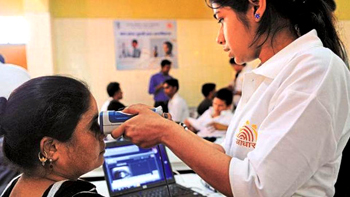
Aadhaar privacy issue: Supreme Court's 5-judge Constitution Bench to hear case on 18 July

Agencies
July 12, 2017

New Delhi, Jul 12: The Supreme Court today said that its five-judge Constitution Bench will sit on July 18 and 19 to hear matters relating to Aadhaar, including the aspect of right to privacy.aadhar

The matter was mentioned before a bench comprising Chief Justice J S Khehar and Justice D Y Chandrachud which said that its five-judge Constitution Bench will hear Aadhaar-related matters.  

Attorney General K K Venugopal and senior advocate Shyam Divan, appearing for petitioners who have challenged government's move to make Aadhaar mandatory for various public welfare schemes, jointly mentioned the matter before the bench and requested that there should be an early hearing by the Constitution Bench in the matter.

When Justice Khehar asked Venugopal and Divan as to whether the matter was to be heard by a seven-judge Constitution Bench, both the parties said that it has to be heard by a five-judge bench.    

The Attorney General and Divan mentioned the matter before the CJI as a three-judge bench had on July 7 said that all issues arising out of Aadhaar should finally be decided by a larger bench and the CJI would take a call on the need for setting up a Constitution Bench.

Comments

Add new comment

  • Coastaldigest.com reserves the right to delete or block any comments.
  • Coastaldigset.com is not responsible for its readers’ comments.
  • Comments that are abusive, incendiary or irrelevant are strictly prohibited.
  • Please use a genuine email ID and provide your name to avoid reject.
Agencies
August 6,2020

The Indian Defence Ministry, which had in its document that China intruded into the Indian territory in eastern Ladakh in early May, on August 6 took down the page which it had uploaded on its website.

According to a report by news channel NDTV, the ministry, in its document, had said the Chinese aggression has been "increasing along the Line of Actual Control (LAC) and more particularly in Galwan valley since May 5."

"The Chinese side has transgressed in the areas of Kungrang Nala, Gogra and north bank of Pangong Tso Lake on May 17-18," the document, titled 'Chinese Aggression on LAC' stated.

The document revealed that "... a violent face-off incident took place between the two sides on June 15, resulting in casualties on both sides."

After the clash, a second corps commander level meeting took place on June 22 to discuss the modalities of de-escalation. "While engagement and dialogue at military and diplomatic level is continuing to arrive at mutually acceptable consensus, the present standoff is likely to be prolonged," it said.

A defence ministry spokesperson told the news channel that the document "did not go through him".

The opposition Congress, meanwhile, asked the government why the report was taken down with party leader Rahul Gandhi alleging that removal of the document from websites would not change facts.

"Forget standing up to China, India's PM lacks the courage even to name them. Denying China is in our territory and removing documents from websites won't change the facts," Gandhi tweeted.

Comments

Add new comment

  • Coastaldigest.com reserves the right to delete or block any comments.
  • Coastaldigset.com is not responsible for its readers’ comments.
  • Comments that are abusive, incendiary or irrelevant are strictly prohibited.
  • Please use a genuine email ID and provide your name to avoid reject.
News Network
May 7,2020

Visakhapatnam, May 7: Unconscious children being carried by parents in their arms, people laying on roads, health workers scrambling to attend to those affected by the styrene vapour leak and residents fleeing were some of the scenes that played out near here on Thursday, bringing back grim memories of the 1984 Bhopal gas tragedy.

The leak of styrene, a chemical used to make synthetic rubber and resins, among others, occurred in the wee hours of Thursday while people were still fast asleep.

Women and children were seen lying on roads struggling to breath, reminiscent of the infamous Bhopal gas tragedy when a leak from the Union Carbide plant left around 3,500 dead and many maimed.

The worst-hit Gopalapatnam village reverberated with cries of people for help.

Many people fell unconscious during their sleep, a villager said.

Affected people, suffering writ large on their faces, were rushed to hospitals in autorickshaws and on two wheelers.

Visakhapatnam Collector Vinay Chand said 20 ambulances were pressed into service as soon information about the gas leak was received.

Exposure to styrene, also known as ethenylbenzene, vinylbenzene can affect the central nervous system (CNS), causing headache, fatigue, weakness, and depression.

It is primarily used in the production of polystyrene plastics and resins.

The gas leak took place at LG Polymers chemical plant.

LG Polymers was established in 1961 as "Hindustan Polymers" for manufacturing Polystyrene and its co-polymers at Visakhapatnam. It merged with McDowell & Co. Ltd of UB Group in 1978, according to the company's website.

Taken over by LG Chem (South Korea), Hindustan Polymers was renamed LG Polymers India Private Limited (LGPI) in July, 1997.

Comments

Add new comment

  • Coastaldigest.com reserves the right to delete or block any comments.
  • Coastaldigset.com is not responsible for its readers’ comments.
  • Comments that are abusive, incendiary or irrelevant are strictly prohibited.
  • Please use a genuine email ID and provide your name to avoid reject.
News Network
January 13,2020

Jan 13: For the first time in years, the government of India’s Prime Minister Narendra Modi is playing defense. Protests have sprung up across the country against an amendment to India’s laws — which came into effect on Friday — that makes it easier for members of some religions to become citizens of India. The government claims this is simply an attempt to protect religious minorities in the Muslim-majority countries that border India; but protesters see it as the first step toward a formal repudiation of India’s constitutionally guaranteed secularism — and one that must be resisted.

Modi was re-elected prime minister last year with an enhanced majority; his hold over the country’s politics is absolute. The formal opposition is weak, discredited and disorganized. Yet, somehow, the anti-Citizenship Act protests have taken hold. No political party is behind them; they are generally arranged by student unions, neighborhood associations and the like.

Yet this aspect of their character is precisely what will worry Modi and his right-hand man, Home Minister Amit Shah. They know how to mock and delegitimize opposition parties with ruthless efficiency. Yet creating a narrative that paints large, flag-waving crowds as traitors is not quite that easy.

For that is how these protests look: large groups of young people, many carrying witty signs and the national flag. They meet and read the preamble to India’s Constitution, into which the promise of secularism was written in the 1970’s.

They carry photographs of the Constitution’s drafter, the Columbia University-trained economist and lawyer B. R. Ambedkar. These are not the mobs the government wanted. They hoped for angry Muslims rampaging through the streets of India’s cities, whom they could point to and say: “See? We must protect you from them.” But, in spite of sometimes brutal repression, the protests have largely been nonviolent.

One, in Shaheen Bagh in a Muslim-dominated sector of New Delhi, began simply as a set of local women in a square, armed with hot tea and blankets against the chill Delhi winter. It has now become the focal point of a very different sort of resistance than what the government expected. Nothing could cure the delusions of India’s Hindu middle class, trained to see India’s Muslims as dangerous threats, as effectively as a group of otherwise clearly apolitical women sipping sweet tea and sharing their fears and food with anyone who will listen.

Modi was re-elected less than a year ago; what could have changed in India since then? Not much, I suspect, in most places that voted for him and his party — particularly the vast rural hinterland of northern India. But urban India was also possibly never quite as content as electoral results suggested. India’s growth dipped below 5% in recent quarters; demand has crashed, and uncertainty about the future is widespread. Worse, the government’s response to the protests was clearly ill-judged. University campuses were attacked, in one case by the police and later by masked men almost certainly connected to the ruling party.

Protesters were harassed and detained with little cause. The courts seemed uninterested. And, slowly, anger began to grow on social media — not just on Twitter, but also on Instagram, previously the preserve of pretty bowls of salad. Instagram is the one social medium over which Modi’s party does not have a stranglehold; and it is where these protests, with their photogenic signs and flags, have found a natural home. As a result, people across urban India who would never previously have gone to a demonstration or a political rally have been slowly politicized.

India is, in fact, becoming more like a normal democracy. “Normal,” that is, for the 2020’s. Liberal democracies across the world are politically divided, often between more liberal urban centers and coasts, and angrier, “left-behind” hinterlands. Modi’s political secret was that he was that rare populist who could unite both the hopeful cities and the resentful countryside. Yet this once magic formula seems to have become ineffective. Five of India’s six largest cities are not ruled by Modi’s Bharatiya Janata Party in any case — the financial hub of Mumbai changed hands recently. The BJP has set its sights on winning state elections in Delhi in a few weeks. Which way the capital’s voters will go is uncertain. But that itself is revealing — last year, Modi swept all seven parliamentary seats in Delhi.

In the end, the Citizenship Amendment Act is now law, the BJP might manage to win Delhi, and the protests might die down as the days get unmanageably hot and state repression increases. But urban India has put Modi on notice. His days of being India’s unifier are over: From now on, like all the other populists, he will have to keep one eye on the streets of his country’s cities.


Comments

Add new comment

  • Coastaldigest.com reserves the right to delete or block any comments.
  • Coastaldigset.com is not responsible for its readers’ comments.
  • Comments that are abusive, incendiary or irrelevant are strictly prohibited.
  • Please use a genuine email ID and provide your name to avoid reject.