AAP to expand network in Saudi Arabia, other Gulf countries

February 29, 2016

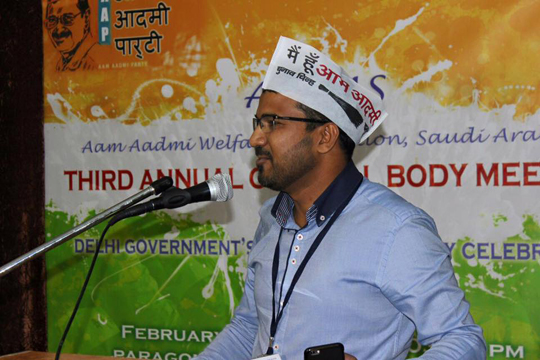
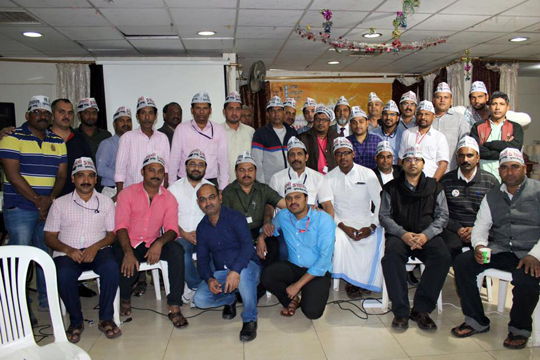
Riyadh, Feb 29: Indians here held a function to observe Aam Aadmi Party's (AAP) completion of one year in office in Riyadh.
aap 3

The event marked AAP's historic decision to expand its network globally including in the Gulf countries, where nearly seven million Indian expats are currently working.

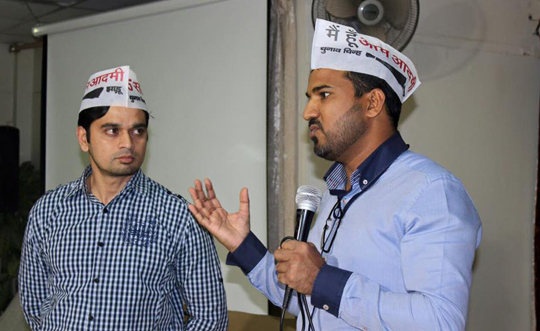
Speaking on the occasion, a legislator of Delhi's ruling party and the party's co-convener of its Overseas Chapter, Adarsh Shastri, said the party provides an alternative system of good governance.

“India's deep rooted corruption and dynastic political system will be transformed to non-corrupt, development- and issue-based governance by AAP,” he said and hailed Arvind Kejriwal's leadership.

The event, attended by a large number of expatriates, also provided an opportunity to take stock of the situation of India, which has been marred by several controversies and movements in recent times.

Shastri said the mood of the country toward the political system has changed after path-breaking initiatives taken by the AAP government after it came to power in Delhi in early 2014.
Social infrastructure like education, health, social welfare have been given top priority while free water, electricity, abolition of VIP status, completion of public projects were ensured to be completed within stipulated time.

Besides, citizens participation in administration through mohalla sabha, passing the janalokpaal bill, taking strict action against corrupt officials have restored people's confidence in government and party, he said.

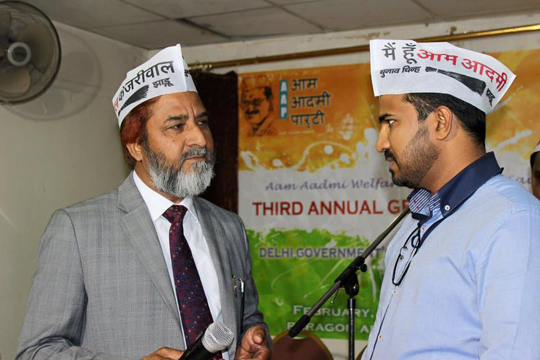
Kerala State Convener C. R. Neelakandan also spoke on the occasion, which was presided over by Basheer Aramboor. Mansoor welcomed the audience while Abdul Azees proposed the vote of thanks. Shameem conducted the program.

During the interactive session that followed, a number of questions about AAP including poor attention given to senior citizens in government hospitals, poor health infrastructure, corruption, unauthorized constructions, adulteration in food items, turning Yamuna shores into spots for tourist attraction, participation of public in decision-making process and other issues were discussed. AAP has developed a strong support base in India as well as among the Indian expatriates community across the globe. Party supporters and well-wishers from the different parts of the country participated in the event.
aap 1

aap 2

aap 5

Comments

Basheer Aramboor
 - 
Monday, 29 Feb 2016

Thank you for the wider coverage of the event and positive comments. AAP is expanding its support base drastically, common man looking for progressive political change. Hope AAP will deliver the peoples expectations n with their support.

- Basheer Aramboor, Convener AAP Riyadh

Hasan unun
 - 
Monday, 29 Feb 2016

Supply of free water, electrify, wifi, if it is true it will boost their image in other states also. Same way reduce house tax also. This is because it is being increase consistently. Sami irritations like paid Parking in cities if removed will make the citizens have a breath of relief. Politicians hardly understand this. Since Arvind may grasp the seriousness of the points raised, who will inform him or bring this to his attention. These are issues people are suffering worth attending to if u really care for the aam aadmi instead of tall claims. Difference will declare itself in th next general election .

Zubair Nandar Yanbu
 - 
Monday, 29 Feb 2016

Insha allah if allah wills we will open one AAP branch in Yanbu And Jubail soon.

Add new comment

  • Coastaldigest.com reserves the right to delete or block any comments.
  • Coastaldigset.com is not responsible for its readers’ comments.
  • Comments that are abusive, incendiary or irrelevant are strictly prohibited.
  • Please use a genuine email ID and provide your name to avoid reject.
News Network
May 6,2020

Bengaluru, May 6: The second day of liquor sales in Karnataka on Tuesday after easing of lockdown curbs saw a nearly five-fold jump in earnings, with Rs 197 crore worth spirits being sold.

According to top Excise Department officials, 4.21 lakh cases of Indian-made liquor, comprising 36.37 lakh litres, worth Rs 182 crore and 7.02 lakh litres of beer in 0.90 lakh cases worth Rs 15 crore was sold on Tuesday.

On Monday, when sales resumed in the state, Rs 45 crore worth liquor was sold.

"We had never expected such a record sale. It's unprecedented," an Excise official who did not wish to be named said.

Liquor sales had resumed in Karnataka on Monday after a 41 day gap following the lockdown due to the COVID-19 pandemic.

Comments

Add new comment

  • Coastaldigest.com reserves the right to delete or block any comments.
  • Coastaldigset.com is not responsible for its readers’ comments.
  • Comments that are abusive, incendiary or irrelevant are strictly prohibited.
  • Please use a genuine email ID and provide your name to avoid reject.
News Network
March 28,2020

Bengaluru, Mar 27: A software engineer has been arrested for giving a "call" to the people to sneeze in the open and spread coronavirus, police said on Friday.
The person identified as Mujeeb Mohammad had made this call in a Facebook post.
"Let's join hands, go out and sneeze with open mouth in public. Spread the virus," he wrote.

"The person who put this post saying people should go out and sneeze and spread the virus has been detained. His name is Mujeeb. He works in a software company," Bengaluru Joint Commissioner of Police Sandeep Patil said in a statement.

40 migrant labourers working in Mumbai caught while trying to flee to UP in truck, booked
Meanwhile, Infosys tweeted: "We are deeply concerned with an inappropriate post being attributed to an Infosys employee. We strongly reaffirm our commitment to responsible social-sharing.

The company also said, "Our preliminary enquiry, and discussions with our employees suggest that this could be a case of a mistaken identity."
"However, given the seriousness with which we take such matters, we are investigating this further and will also assist with any independent investigation. The company would take appropriate action based on its investigation," it added

Comments

Add new comment

  • Coastaldigest.com reserves the right to delete or block any comments.
  • Coastaldigset.com is not responsible for its readers’ comments.
  • Comments that are abusive, incendiary or irrelevant are strictly prohibited.
  • Please use a genuine email ID and provide your name to avoid reject.
Media Release
February 14,2020

Veteran journalist P. Sainath has said that the nation is in a crisis. And this crisis is not limited to just the rural area. It has become a national crisis at various areas such as agriculture, education, economy, job creation etc.

He was delivering the endowment lecture on the topic ‘Indian democracy at the post-liberalization and post-truth era’ at Media Manthan 2020 organized by the PG department of journalism and mass communication at St Aloysius College (Autonomous). 

Mr Sainath said that the many policies adopted in the 90s led to India becoming unusually unequal. Referring to the speech Ambedkar had made at the Constituent Assembly while handing over the draft of the Constitution, Mr Sainath said, “Ambedkar had warned about the weakness of Indian democracy that liberty without equality allows the supremacy of a few over the multitude. Liberty, equality and fraternity must be kept together as we cannot have one without the other.” 

Mr Sainath stated that the agrarian crisis was no longer about the loss of productivity, employment or about farmer suicide; it was a societal, civilizational crisis. Commenting on the lopsided policies such as cow-slaughter ban, he explained how cow slaughter ban had adversely affected many industries due to their interdependency. While Muslims who slaughtered cows were rendered helpless, the cattle traders who were mostly OBCs lost their earnings as the cattle prices crashed. An important industry like Kolhapur sandals industry in Maharashtra went bankrupt as a result of the cow slaughter ban in Maharashtra. He said the policymakers had no idea how the rural industries were interconnected. Demonetisation too devastated the rural economy as 98 percent of rural transactions happen through cash. 

Mr Sainath also spoke about the crisis of inequality which affects the Dalits and the Adivasis far more than anyone else as 90 percent of the rural households take home less than Rs 10,000/- per month. “Women are yet another group whose labour is never counted in the gross domestic product. Women and girls globally do unpaid work which amounts to about 12.5 billion working hours per year. Monetarily speaking, this is worth 10.8 trillion dollars,” Mr Sainath added. 

Speaking about the crisis of jobs Mr Sainath said that major companies were laying off employees just to create more profits for the investors and the adoption of artificial intelligence in the industry would further destroy millions of jobs.

Rector of St Aloysius College Institutions Fr Dionysius Vaz SJ, Principal Dr (Fr) Praveen Martis SJ, HOD of Journalism and Mass Communication department Dr (Fr) Melwyn Pinto SJ were present.

‘Veerappan and Vijay Mallya’s business models are interesting!’

Addressing the gathering during his endowment lecture on Friday, Mr Sainath made an interesting comment on the so called ‘revenue model’. “Whenever I visit IIMs and IITs for lectures on my PARI project, the students there ask me what my revenue model for my project is. I tell them that I do not have a revenue model. In fact, journalism does not begin with a revenue model. Gandhiji, Ambedkar, Bhagat Singh were all great journalists. But they did not have a revenue model,” Mr Sainath said.

On a lighter note, he said that the best revenue model that he liked was that of forest brigand Veerappan and liquor baron Vijay Mallya. “Veerappan ruled the forest for forty years and from the top ministers to the villagers he could dictate terms and liver royally. Similarly, Mallya’s revenue model was to steal the banks and run away abroad and live like a king,” Mr Sainath added.

Journalism is not and can never be a business. It is a calling, he opined. While newspaper can be a business, television can be a business, journalism per se cannot be reduced to a business. “Unfortunately today, journalists are recruited on a contract basis and they have no bargaining power; and there are no unions to fight for their cause. Hence, they are at the mercy of the corporate media houses for their survival and are made to write stories that cannot be called journalism,” Mr Sainath said.

Answering a question as to the pressures he faced as a journalist, he said that external pressures from the government or others could be very well handled. It is the internal pressures from once own media house that journalists find it difficult to manage.


Comments

Add new comment

  • Coastaldigest.com reserves the right to delete or block any comments.
  • Coastaldigset.com is not responsible for its readers’ comments.
  • Comments that are abusive, incendiary or irrelevant are strictly prohibited.
  • Please use a genuine email ID and provide your name to avoid reject.