AB Ibrahim cautions against withdrawal of cases against Pramod Muthalik

[email protected] (CD Network)
January 1, 2016

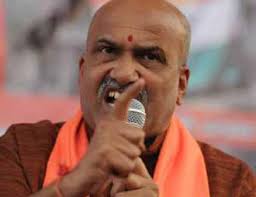
muthalikMangaluru, Jan 1: Dakshina Kannada Deputy Commissioner AB Ibrahim has expressed deep concern over the reports on possibility of withdrawal of more than a dozen cases against Sri Rama Sene leader Pramod Muthalik.

In a letter addressed to Additional Chief Secretary of the Home Department Mr Ibrahim cautioned against the proposal to drop 13 cases, including 12 hate-speech cases against Muthalik.

“Such a move would send wrong signals and demoralise the police force,” the deputy commissioner said.

It’s worth mentioning here that the Home Ministry had written to the Director of Prosecution to get the opinion of prosecutors on the proposal to drop the 13 cases, including the infamous 2009 pub attack case. Muthalik himself had expressed surprise and shock over the development.

Mr. Ibrahim, in his letter dated December 28, 2015 advised the government against giving freedom to those who indulge in immoral policing and spread communal hatred.

Withdrawal of cases against Muthalik could motivate other fringe elements to take law into their own hands, the DC said.

Comments

aharkul
 - 
Sunday, 3 Jan 2016

Very good decision taken by DC

A. Mangalore
 - 
Saturday, 2 Jan 2016

Excellent. It is the right decision of the District Commissioner.
Satyameva Jayathe. The honest officer never bent for any pressure. God bless you .

Add new comment

  • Coastaldigest.com reserves the right to delete or block any comments.
  • Coastaldigset.com is not responsible for its readers’ comments.
  • Comments that are abusive, incendiary or irrelevant are strictly prohibited.
  • Please use a genuine email ID and provide your name to avoid reject.
News Network
July 29,2020

Bengaluru, Jul 29: The Karnataka High Court’s division bench of Chief Justice Abhay Oka and Justice H P Sandesh today rejected an application that wanted Amulya Leona’s case to be transferred from Karnataka Police to the National Investigation Agency (NIA).

The bench, while observing that extraordinary jurisdiction can’t be exercised for transferring the case to the NIA, asked “What is so special that investigation should be transferred to NIA?”

The court, in its previous hearing, had questioned the maintainability of the petition seeking transfer of the sedition case against Leona to the NIA.

According to the petitioner, advocate Pavana Chandra Shetty, the case is a serious matter against national integration and unity and has not been investigated properly by the police. The state police also failed to file the chargesheet within 90 days, he said, and also asked for cancellation of her bail.

The bench asked the petitioner as to how a bail, already granted to a person, can be cancelled. “Is it not the indefeasible right of the accused to be released on bail if chargesheet is not filed within stipulated time? How can you make a prayer for cancellation of bail?”  the Court asked.

The counsel for the petitioner also stated that in cases of a cognizable offence, when the chargesheet is purposely not filed within the stipulated time, the matter will have to transferred to the appropriate authority.

The court responded to his contention by asking him how could the court override law and cancel the bail. “Where is the question of cancellation of bail? Can we override the law and say that bail should be cancelled?” said the bench.

Advocate Vishal Raghu had filed the petition for transfer of Leona’s case, who was accused of raising pro-Pakistan slogans at an anti-CAA rally on February 20 at Freedom Park. The advocate had blamed the probe team for not filing a chargesheet on time and has asked the state government to approach the higher court against bail granted to Leona.

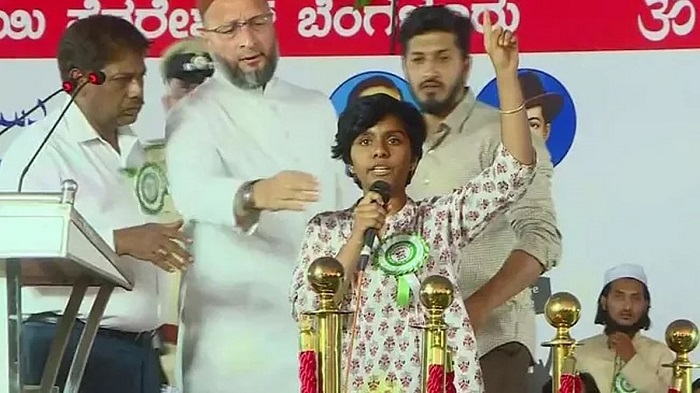
Bengaluru student Amulya Leona was charged with sedition for her actions in the presence of All India Majlis-e-Ittehad-ul-Muslimeen chief Asaduddin Owaisi. She was arrested by the Bengaluru police for allegedly shouting ‘Pakistan Zindabad’ slogans at an anti- CAA Protest in Bengaluru in February this year. On June 11, she was granted conditional bail by the Bengaluru civil court.

Her bail plea was earlier rejected by a Bengaluru court, after she had spent a three-month period in jail, stating that she may abscond if she is released. The sessions judge Vidhyadhar Shirahatti had also stated that if the petitioner is granted bail, she may abscond and may involve in similar offence which affects peace at large and hence her petition is liable to be rejected. The court had also noted that Amulya Leona is an influential person who may threaten and influence the witness and hamper the case in case of the prosecution and will abscond if released on bail.


Comments

Add new comment

  • Coastaldigest.com reserves the right to delete or block any comments.
  • Coastaldigset.com is not responsible for its readers’ comments.
  • Comments that are abusive, incendiary or irrelevant are strictly prohibited.
  • Please use a genuine email ID and provide your name to avoid reject.
Wafa Sultana
April 4,2020

Over the last couple of days when the world was occupied with unifying efforts to fight the deadly Covid19 pandemic, sections of Indian media provided viewers a familiar scapegoat – the Indian Muslims – who are often stereotyped as a community being constantly at loggerheads with the citizenry and the State. Biased media channels were quick to resort to blaming the entire Muslim community for the spread of the disease in the country, thanks to an ill-timed Tablighi Jamaat gathering at its international headquarters in Delhi’s Nizamuddin. Unsurprisingly, the opprobrium was also marked by a sudden spike in WhatsApp forwards of videos with people wearing skullcaps licking spoons and performing Sufi breathing rituals, suggesting some sort of wild conspiracy on the part of the community to spread the virus.  Some media channels were quick to formulate, hypothesize and provide loose definitions of a newly discovered form of Jihad i.e. ‘Corona Jihad ’ thereby vilifying the Islamic faith and its followers.

While the investigation on the culpability of the organizers of the Nizamuddin event is still ongoing, there is enough information to suggest that the meeting was held before any lockdown was in force, and the problem began when there was no way of getting people out once the curfew was announced. Be that as it may, there is little doubt that organizing a meet of such a scale when there is a global pandemic smacks of gross misjudgment, and definitely the organizers should be held accountable if laws or public orders were defied. Attendees who attempt to defy quarantine measures must be dealt with strictly. However, what is alarming is that the focus and narrative have now shifted from the unfortunate event at Nizamuddin to the Tablighi Jamaat itself.

For those not familiar with the Tablighi Jamaat, the organization was founded in 1926 in Mewat by scholar Maulana Mohammad Ilyas. The Jamaat’s main objective was to get Muslim youth to learn and practice pristine Islam shorn of external influences. This is achieved through individuals dedicating time for moral and spiritual upliftment secluded from the rest of the world for a brief period of time. There is no formal membership process. More senior and experienced participants typically travel from one mosque to other delivering talks on religious topics, inviting local youth to attend and then volunteer for a spiritual retreat for a fixed number of days to a mosque in a nearby town or village to present the message to their co-religionists. Contrary to ongoing Islamophobic rhetoric, the movement does not actively proselytize. The focus is rather on getting Muslims to learn the teachings and practices of Islam.  This grassroots India-based movement has now grown to almost all countries with substantial Muslim populations. Its annual meets, or ‘ijtemas’ are among the largest Islamic congregations in the world after the annual Haj. One of the reasons for its popularity and wide network in the subcontinent and wordwide is the fact that it has eschewed the need for scholarly intervention, focusing on peer learning of fundamental beliefs and practice rather than high-falutin ideological debates. The Tablighi Jamaat also distinguishes itself from other Islamic movements through its strictly apolitical nature, with a focus on individual self-improvement rather than political mobilization. Hardships and difficulty in the world are expected to be face through ‘sabr’ (patience) and ‘dua’ (supplication),  than through quest for political power or influence. In terms of ideology, it is very much based on mainstream Sunni Islamic principles derived from the Deobandi school.

So, why is all this background important in the current context? While biased media entities have expectedly brought out their Islamophobic paraphernalia out for full display, more neutral commentators have tried to paint the Tablighi Jamaat as a fringe group and have tried to distance it from 'mainstream Muslims'. While the intent is no doubt innocent, this is a trap we must not fall into. This narrative, unfortunately, is also gaining ground due to apathy some Muslims have for the group, accusing it of being “disconnected from the realities of the world”. Unlike other Muslim organizations and movements, the Tablighi Jamat, by virtue of its political indifference, does not boast of high-profile advocates and savvy spokespersons who can defend it in mainstream or social media.  The use of adjectives such as 'outdated' and 'orthodox' by liberal columnists to describe the Jamaat feeds into the malignant attempt to change the narrative from the control of the spread of the pandemic due to the Nizamuddin gathering to 'raison d'etre' of the organization itself.

A large mainstream religious group like the Tablighi Jamaat with nearly a hundred-year history, normally considered to be peaceful, apolitical and minding its own business is now suddenly being villainized owing to unfortunate circumstances. Biased media reactions filled with disgust and hate seem to feed the Indian public conscience with a danngerous misconception - to be a nominal Muslim is okay but being a practicing one is not.  For those committed to the truth and fighting the spread of Islamophobia, the temptation to throw the entire Tablighi Jamaat under the bus must be resisted.

The writer is a lawyer and research scholar at Qatar University. Her research interests include Islamic law and politics.

Comments

zahoorahmed
 - 
Saturday, 4 Apr 2020

great article! provides a great perspective on tableeg jamat

Add new comment

  • Coastaldigest.com reserves the right to delete or block any comments.
  • Coastaldigset.com is not responsible for its readers’ comments.
  • Comments that are abusive, incendiary or irrelevant are strictly prohibited.
  • Please use a genuine email ID and provide your name to avoid reject.
News Network
April 5,2020

New Delhi, April 5: Former Karnataka chief minister HD Kumaraswamy on Sunday challenged Prime Minister Narendra Modi to offer a "credible scientific and rational" explanation for his candle-lighting call and said he is giving "meaningless tasks" to an already exhausted population.

The JD(S) leader questioned if the Prime Minister asked the nation to observe a candle-light vigil on the eve of foundation day of BJP.

"Has the PM slyly asked the nation to observe a candle light vigil on the eve of foundation day of BJP? April 6 being its foundation day, what else can explain the choice of date & time for this event? I challenge the PM to offer a credible scientific and rational explanation," Kumaraswamy tweeted.

"The government is yet to provide PPEs for doctors and make test kits affordable for the common man. Without telling the nation what concrete steps are being taken to combat COVID-19 menace, the prime minister is giving meaningless tasks to an already exhausted population," he tweeted.

"It is shameful to convert the national crisis into an event of self aggrandizement & it is beyond shameful to push the hidden agenda of his party in the face of global calamity. May sense prevail upon the PM," the JDS leader said in another tweet.

Amid a nationwide COVID-19 lockdown, Prime Minister Modi on Friday appealed to countrymen to light diyas and candles on April 5 at 9 pm to fight the darkness spread by the pandemic. He asked the people to turn off all the lights in their homes and stand at doors or balconies and light candles or diyas, torches or mobile flashlights for 9 minutes on April 5.

Last month, PM Modi had asked the people to come out in their balconies and clap and beat utensils to show appreciation for doctors, nurses and others helping fight coronavirus on 'Janata Curfew'.

Comments

Add new comment

  • Coastaldigest.com reserves the right to delete or block any comments.
  • Coastaldigset.com is not responsible for its readers’ comments.
  • Comments that are abusive, incendiary or irrelevant are strictly prohibited.
  • Please use a genuine email ID and provide your name to avoid reject.