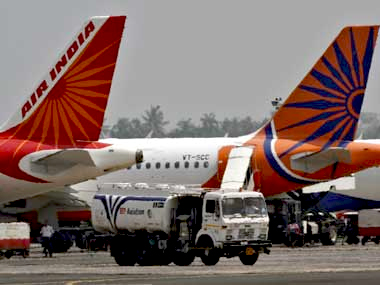
Air India plane suffers tyre burst, some passengers injured

March 16, 2016

airindiaMumbai, Mar 16: An Air India plane with 161 people suffered a tyre burst while landing at Mumbai airport on Tuesday, as per a media report.

AI630 arrived from Nagpur when one of the tyres burst during taxiing.

However, all the passengers on board the Airbus-A320 were said to be safe, though some received minor injures, Mid Day reported.

The report also said that the passengers took the emergency exit to de-board.

The incident reportedly happened at around 10 PM.

One of the passengers was quoted as saying, "Initially we all panicked but the effect was a minor one. However, some of us were hurt while trying to slide down the aircraft."

Comments

Rikaz
 - 
Wednesday, 16 Mar 2016

For that reason they are asking you to fasten seat belt until it stops completely. most of the passengers I have seen get up from the seat while taxing and landing too which is very much dangerous.

Edna
 - 
Wednesday, 16 Mar 2016

Hah Hah hah Hah hahhhhhhhhhhhhhhhhhhhhhhh it only happens in AirIndia

Add new comment

  • Coastaldigest.com reserves the right to delete or block any comments.
  • Coastaldigset.com is not responsible for its readers’ comments.
  • Comments that are abusive, incendiary or irrelevant are strictly prohibited.
  • Please use a genuine email ID and provide your name to avoid reject.
Agencies
January 1,2020

For many Indian tycoons, 2019 turned woeful as lenders -- empowered by the nation’s recent bankruptcy law and desperate to clean up soured debt from their books -- started seizing assets of delinquent firms or dragged them into insolvency.

Indian banks wrote off a record $39 billion of loans in the 18 months through September in a bid to repair their balance sheets as they battled the world’s worst bad debt pile. Making matters worse, a shadow banking crisis led to a funding squeeze, crushing debt-laden businesses that were critically dependent on rollover financing.

“Life has come a full circle for tycoons that had enjoyed debt-fueled growth,” said Nirmal Gangwal, founder of distress and debt restructuring advisory firm Brescon & Allied Partners LLP. “Many firms collapsed like a house of cards. The downfall was rather unprecedented.”
The government has also been cracking down on economic crime to assuage public anger over absconding businessmen. It’s even barred some from traveling overseas if they were deemed a flight risk.

Here are some of the country’s biggest and most-storied businessmen who saw their fortunes fade. Spokespersons for none of these tycoons, except Essar, immediately replied to emails and text messages seeking comments.

Anil Ambani

The chairman of Reliance Group, which makes movies to metro lines, had a close shave with jail time in March before his elder brother and Asia’s richest man, Mukesh Ambani, bailed him out at the last minute. The woes of the ex-billionaire came to the fore when India’s top court asked him to pay Ericsson AB’s India unit about $77 million of past dues or go to jail since Anil Ambani, 60, had given a personal guarantee. His telecom carrier slipped into insolvency this year, while unprofitable Reliance Naval & Engineering Ltd. faced a cash crunch. Reliance Capital Ltd. is selling assets to pare debt. Ambani is also fending off Chinese lenders in a London court.

Malvinder & Shivinder Singh

Karma caught up with ex-billionaires and brothers Malvinder Singh, 47, and Shivinder Singh, 44, and how. Scions of a prominent business family, they once helmed India’s top drug maker and second-largest hospital chain. In October, the two were arrested on charges of fraudulently diverting nearly $337 million from a lender they controlled. India’s market regulator found in 2018 that the brothers had defrauded their hospital company of about $56 million. The collapse of the $2 billion empire turned brother against brother, prompting their mother to broker a peace deal that was short-lived. In February, Malvinder accused Shivinder and their spiritual guru of fraud.

Shashikant & Ravikant Ruia

After a hard-fought battle to keep their flagship steel mill, the first-generation entrepreneurs finally saw the bankrupt Essar Steel India Ltd. pass on to ArcelorMittal last month. The $5.9 billion takeover was almost two years in the making with multiple legal wrangles. The group, controlled by Shashikant Ruia, 76, and Ravikant Ruia, 70, were also reprimanded by a U.K. judge in March this year for concealing documents. Started in 1969 as a construction firm, Essar Group diversified, investing about $18 billion between 2008 and 2012, and piled on debt. In 2017, the group had sold another prized asset, Essar Oil.

Selling an asset to pare a liability shouldn’t be seen as a “lost asset,” an Essar spokesman said, adding that the group remains a diversified conglomerate.

VG Siddhartha

Before jumping off a bridge into a river in July in an apparent suicide, the founder of India’s biggest coffee chain Cafe Coffee Day had penned a letter that spoke of pressure from lenders, a private equity firm and harassment by tax officials. He had spent much of the last two years pledging ever more of Coffee Day Enterprises Ltd. shares to refinance loans for ever shorter periods, at ever higher interest rates. “I would like to say I gave it my all,” V.G. Siddhartha, 60, wrote in the letter. “I fought for a long time but today I gave up.”

Naresh Goyal

The former ticketing agent who built India’s largest airline by value, stepped down as chairman of Jet Airways India Ltd. in March, caving in to pressure from banks who took over the company. Cut-throat price wars and surging costs pushed Jet deeper into loss. The airline stopped flying in April and went into bankruptcy two months later as lenders failed to find a buyer. In July, an Indian court barred Naresh Goyal from flying overseas after the government said it was investigating an alleged $2.6 billion fraud involving Jet Airways.

Rana Kapoor

The founder of Yes Bank Ltd., which became India’s fourth-largest non-state lender, tweeted in September 2018 that his shares were invaluable and requested his children never to sell them upon inheritance. But trouble was brewing. The nation’s banking regulator, which found the lender had repeatedly under-reported its bad loans, refused to extend his tenure as chief executive officer. This forced Rana Kapoor, 62, to step down by end-January. Kapoor, who has pledged some of his Yes Bank shares in July, sold almost his entire stake in the lender by October.

Subhash Chandra

The rice trader-turned-media mogul, 69, who brought cable television into Indian homes in the early 1990s with his ZEE TV, resigned as chairman of Zee Entertainment Enterprises Ltd. in November and lost control of his crown jewel. Subhash Chandra has been selling stake in Zee Entertainment in the past few months to repay group’s debt.

Gautam Thapar

A default by Gautam Thapar, founder of the paper mill-to-power transmission Avantha Group, on pledged shares made Yes Bank Ltd. the biggest shareholder in CG Power and Industrial Solutions Ltd. In August, the firm was hit by an accounting scandal forcing the board to remove Thapar, 59, from the chairman’s post. A month later, the market regulator ordered a forensic audit of the firm and barred Thapar from accessing securities market.


Comments

Add new comment

  • Coastaldigest.com reserves the right to delete or block any comments.
  • Coastaldigset.com is not responsible for its readers’ comments.
  • Comments that are abusive, incendiary or irrelevant are strictly prohibited.
  • Please use a genuine email ID and provide your name to avoid reject.
News Network
March 5,2020

Bengaluru, Mar 5: The Karnataka government has constituted a competent authority for I Monetary Advisory (IMA) cases under the KPIDFE (Karnataka Protection of Interest of Depositors in Financial Establishments) Act, 2004, which is required to call claims from erstwhile depositors of the IMA group of entities under the provisions of the Act, said Harsh Gupta, Special Officer and Competent Authority for IMA cases.

In order to ensure transparency and to avoid harassment to the claimants, an online application software has been developed for accepting claims from the depositors, Gupta stated.

"The claim application can be filed from any of Banglore-1, Karnataka-1 and Seva-Sindhu Kendras of the state government in person or through online. The required documents can be submitted using e-attestation along with claims or at a later date, but prior to the claim settlement. The details of authorities for e-attestation will be informed later," the official stated.

The claimants will have to provide Aadhaar authentication based identification or identification by the designated officer based on alternate documents; current mobile number and address among others.

The details of the draft claim filing process has been put for public feedback on website 'imaclaims.karnataka.gov.in'. The depositors can give their feedback on the website, WhatsApp number or email, Gupta stated.

Based on feedback received from the depositors, the claim process and the claim application software will be finalised, the official said and further informed that the start date for acceptance of claims will be informed through wide publicity at a later date.

"There will be a total time period of 30 days for submission of the claims from the start date of acceptance of claims," Gupta said.

An SIT was investigating the multi-crore IMA Jewels case, where the firm had allegedly cheated a large number of investors after promising them impressive returns on their deposits. The SIT has already arrested several government officials and questioned others including politicians in the matter.

The prime accused and Managing Director of IMA Mohammed Mansoor Khan, who had fled the country after several complaints were registered against him in connection with the scam, has also been arrested.

The state government had constituted an SIT to probe the scam when it first came to light in June earlier this year when more than 4,000 investors trooped outside the showroom after an audio clip purportedly recorded by Khan went viral.

Comments

Add new comment

  • Coastaldigest.com reserves the right to delete or block any comments.
  • Coastaldigset.com is not responsible for its readers’ comments.
  • Comments that are abusive, incendiary or irrelevant are strictly prohibited.
  • Please use a genuine email ID and provide your name to avoid reject.
News Network
March 12,2020

Bengaluru, Mar 12: Karnataka government on Wednesday issued a temporary regulation -- Karnataka Epidemic Diseases, COVID-19 Regulations, 2020 -- which aims to prevent the spread of the disease.

According to the regulation, all government and private hospitals should have flu corners for the screening of suspected cases of COVID-19.

All hospitals during the screening of such cases shall record the history of travel of the person if he or she has travelled to any country or area where COVID-19 has been reported in addition to the history of coming in contact with a suspected or confirmed case of COVID-19 shall be recorded.

Any person with a history of travel in the last 14 days to a country or area from where COVID-19 has been reported must report to the nearest government hospital or call at toll-free helpline number 104 so that necessary measures if required, may be initiated by the Department of Health and Family Welfare.

If a suspected case of COVID-19 refuses admission or isolation, the offices authorised under Section 3 of the regulation shall have powers to forcefully admit and isolate such case of a period of 14 days from the onset of symptoms or till the reports of lab tests are received, or such period as may be necessary.

No person, institution or organisation shall use print or electronic media to spread misinformation on COVID19. If a person is found indulging in any such activity, they will be punished.

If the cases of COVID-19 are reported from a defined geographic area, the district administration of the concerned district shall have the right to implement the following containment measures but not limited to these in order to prevent the spread of diseases:

* Sealing of geographic

* Barring of entry and exit of the population from the containment area

* Closure of schools, offices and banning public gathering

* Banning vehicular movement in the area

* Designating any government or private building as a containment unit for the isolation of cases

* The staff of all govt departments shall be at the disposal of the concerned district administration of the concerned area for discharging the duty of containment measures

Any person, institution or organisation found violating any of these regulations, shall be deemed to have committed an offence punishable under section 188 of the Indian Penal Code (IPC).

Comments

Add new comment

  • Coastaldigest.com reserves the right to delete or block any comments.
  • Coastaldigset.com is not responsible for its readers’ comments.
  • Comments that are abusive, incendiary or irrelevant are strictly prohibited.
  • Please use a genuine email ID and provide your name to avoid reject.