



Amidst demand for his release, fever kills Dadri lynching accused

[email protected] (News Network)
October 5, 2016

Noida, Oct 5: One of the 15 accused jailed for Dadri beef lynching case, wherein Mohammad Akhlaq was bludgeoned to death in September last year, died of fever at a hospital in Delhi.
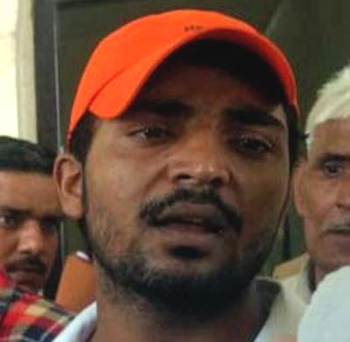
debriJail officials said it was likely that Ravin, a 22-year-old Bisada resident, was suffering from dengue or chikungunya. But the youth's mother and Hindutva groups in his village blamed police for his death, accusing them of negligence.

Ravin, who was arrested on December 21 last year, had been down with fever for four days in Greater Noida's Luksar jail. When his condition deteriorated on Tuesday morning, he was taken to the district hospital in Noida and from there referred to Delhi's LNJP Hospital, where he died around 6pm due to kidney and respiratory failure, doctors said.

"When Ravin had fever for several days, why was he taken to hospital when the situation became critical?" asked Nirmala, his mother. "My son died. He had committed no crime. I want justice." Ravin is survived by his wife and a six-month-old daughter.

District magistrate N P Singh said he had sought a report from the jail superintendent. "This is a very sad incident and we are looking into it. We have formed a committee to examine the matter," he said.

Dr J C Passey, medical superintendent of LNJP Hospital, said, "The patient was rushed to our hospital at 12 pm in critical condition. He had acute fever and kidney dysfunction. Despite our best efforts, he died within a few hours." He said blood samples of Ravin had been sent for dengue and chikungunya tests. "Until the reports come, we cannot comment on the cause of death. He died due to kidney and respiratory failure," Passey said.

Dharmendra Singh, the Gautam Budh Nagar police chief, said, "We received information the accused was suffering from a suspected case of dengue and died in the evening. We are looking into the issue." Luksar jail superintendent M L Yadav did not respond to repeated calls and messages asking for his response.

Ravin, a Class X pass out, worked as a driver when he was arrested in connection with the murder of Akhlaq and the attack on his younger son Danish. He was one of the 18 accused in the charge sheet filed by police in the case but was not among the first few to be arrested in the days after the murder of Akhlaq on September 28 last year.

Following the news of his death, a group of men gathered at the village temple in Bisada and protested. Police rushed personnel to Bisada to keep the situation under control.

Meanwhile, mothers of 13 of the accused have been on an indefinite hunger strike in Bisara since Saturday. A few hours before news of Ravin's death reached Bisara, Sub-Divisional Magistrate Amit Kumar, along with officers from Jharcha police station, met the protesters.

“I am requesting you with folded hands, please release our innocent children and arrest Jaan Mohammad (Akhlaq's brother),” said Lilavati, a local. Akhlaq had been beaten to death by a mob on suspicion of cow slaughter and beef consumption. After his death, an FIR had been registered against him, and six other members of his family, including Jaan Mohammad.

“The hunger strike will continue for two more days… We are giving you (police) two days to arrest Jaan Mohammad. On the third day, if he is still free, we will do what we want. The investigation has been going on for the last three months. Why was there no investigation before our sons were put behind bars?” said Hari Om, a local Hindutva activist.

Also Read: Body of Dadri MURDER ACCUSED kept under tricolor; Rs 1-cr demanded

Comments

Bopanna
 - 
Thursday, 6 Oct 2016

Ravin is a Martyr, rip

Viren Kotian
 - 
Wednesday, 5 Oct 2016

Ravin family should be rewarded 20 lkh rupees

Satyameva jayate
 - 
Wednesday, 5 Oct 2016

God is not blind.....let the chaddis learn a lesson.....this is the tears if akhlaqs family and so the other victims of beef politics.....

Nashal
 - 
Wednesday, 5 Oct 2016

May God bless his soul
Now his parents relatives friend feel very sad, think a while when Akhlaq murdered what will feel Akhlaq's family who was killed by Ravin in front of Akhlaq's family
All guilties are punished God

Mohammed SS
 - 
Wednesday, 5 Oct 2016

Lets Celebrate Murderer Ravin's death and pray almighty Allah to vanish all trouble making creatures from his land. and let other to live peacefully

Rikaz
 - 
Wednesday, 5 Oct 2016

Modi is not mad enough to stop exporting cow meat....getting USD 30 billion out of foreign exchange....if Indians eat beef here is sin...what a double standard....

True indian
 - 
Wednesday, 5 Oct 2016

Stop exporting gau mata’s meet to other countries . pakistanis enjoying indian beef in many countries.
So we request indian govt to stop exporting gau mata.

True indian
 - 
Wednesday, 5 Oct 2016

Gomata is giving in dollars to indian govt. by exporting gomata.

Beef is eaten all over the world. So for that. Lets have world war.

What a stup bunch of jokers

Intelect
 - 
Wednesday, 5 Oct 2016

Even the hell is full

Sacchai
 - 
Wednesday, 5 Oct 2016

Every soul will taste the death, It is not good to comment on a deceased brother, now his affairs with his creator, his good deeds and bad deeds are only with him.

Zainab
 - 
Wednesday, 5 Oct 2016

Ravin was ACCUSED. it wasnt confirmed if he was totally involved. so pray for him and his family..nobody's death should be celebrated!!!

True indian
 - 
Wednesday, 5 Oct 2016

Its god's punishment. Now rot in hell. Have ur gau rakshak in hell.

Robot
 - 
Wednesday, 5 Oct 2016

Hahah. He deserves it. Jhor ka Jhatka....dheerese lage....

Aslam Sheikh
 - 
Wednesday, 5 Oct 2016

Karthik, Being Hindu you must know that Karma doesn't take any supari!!!

Ahad
 - 
Wednesday, 5 Oct 2016

All group members who go to street to fight for the cheddis, should know this REALITY that after crime, u will be in jail and nobody cares...

Ahad
 - 
Wednesday, 5 Oct 2016

Where did his ARROGANCE gone???????????

Add new comment

  • Coastaldigest.com reserves the right to delete or block any comments.
  • Coastaldigset.com is not responsible for its readers’ comments.
  • Comments that are abusive, incendiary or irrelevant are strictly prohibited.
  • Please use a genuine email ID and provide your name to avoid reject.
Ram Puniyani
January 14,2020

In the beginning of January 2020 two very disturbing events were reported from Pakistan. One was the attack on Nankana Sahib, the holy shrine where Sant Guru Nanak was born. While one report said that the place has been desecrated, the other stated that it was a fight between two Muslim groups. Prime Minister of Pakistan Imran Khan condemned the incident and the main accused Imran Chisti was arrested. The matter related to abduction and conversion of a Sikh girl Jagjit Kaur, daughter of Pathi (One who reads Holy Guru Granth Sahib in Gurudwara) of the Gurudwara. In another incident one Sikh youth Ravinder Singh, who was out on shopping for his marriage, was shot dead in Peshawar.

While these condemnable attacks took place on the Sikh minority in Pakistan, BJP was quick enough to jump to state that it is events like this which justify the Citizenship Amendment Act (CAA). Incidentally CAA is the Act which is discriminatory and relates to citizenship with Religion, which is not as per the norms of Indian constitution. There are constant debates and propaganda that population of Hindus has come down drastically in Pakistan and Bangla Desh. Amit Shah, the Home minister stated that in Pakistan the population of Hindus has come down from 23% at the time of partition to 3.7% at present. And in Bangla Desh it has come down from 22% to present 8%.

While not denying the fact that the religious minorities are getting a rough deal in both these countries, the figures which are presented are totally off the mark. These figures don’t take into consideration the painful migrations, which took place at the time of partition and formation of Bangla Desh later. Pakistan census figures tell a different tale. Their first census was held in 1951. As per this census the overall percentage of Non Muslim in Pakistan (East and West together) was 14.2%, of this in West Pakistan (Now Pakistan) it was 3.44 and in Eat Pakistan it was 23.2. In the census held in Pakistan 1998 it became 3.72%. As far as Bangla Desh is concerned the share of Non Muslims has gone down from 23.2 (1951) to 9.6% in 2011.

The largest minority of Pakistan is Ahmadis, (https://minorityrights.org/country/pakistan/) who are close to 4 Million and are not recognised as Muslims in Pakistan. In Bangla Desh the major migrations of Hindus from Bangla Desh took place in the backdrop of Pakistan army’s atrocities in the then East Pakistan.

As far as UN data on refugees in India it went up by 17% between 2016-2019 and largest numbers were from Tibet and Sri Lanka.  (https://www.un.org/en/development/desa/population/migration/publication…)

The state of minorities is in a way the index of strength of democracy. Most South Asian Countries have not been able to sustain democratic values properly. In Pakistan, the Republic began with Jinnah’s classic speech where secularism was to be central credo of Pakistan. This 11th August speech was in a way what the state policy should be, as per which people of all faiths are free to practice their religion. Soon enough the logic of ‘Two Nation theory” and formation of Pakistan, a separate state for Muslim took over. Army stepped in and dictatorship was to reign there intermittently. Democratic elements were suppressed and the worst came when Zia Ul Haq Islamized the state in collusion with Maulanas. The army was already a strong presence in Pakistan. The popular formulation for Pakistan was that it is ruled by three A’s, Army, America and Allah (Mullah).

Bangla Desh had a different trajectory. Its very formation was a nail in the coffin of ‘two nation theory’; that religion can be the basis of a state. Bangla Desh did begin as a secular republic but communal forces and secular forces kept struggling for their dominance and in 1988 it also became Islamic republic. At another level Myanmar, in the grip of military dictatorship, with democratic elements trying to retain their presence is also seeing a hard battle. Democracy or not, the army and Sanghas (Buddhist Sang has) are strong, in Myanmar as well. The most visible result is persecution of Rohingya Muslims.

Similar phenomenon is dominating in Sri Lanka also where Budhhist Sanghas and army have strong say in the political affairs, irrespective of which Government is ruling. Muslim and Christian minorities are a big victim there, while Tamils (Hindus, Christians etc.) suffered the biggest damage as ethnic and religious minorities. India had the best prospect of democracy, pluralism and secularism flourishing here. The secular constitution, the outcome of India’s freedom struggle, the leadership of Gandhi and Nehru did ensure the rooting of democracy and secularism in a strong way.

India so far had best democratic credentials amongst all the south Asian countries. Despite that though the population of minorities rose mainly due to poverty and illiteracy, their overall marginalisation was order of the day, it went on worsening with the rise of communal forces, with communal forces resorting to identity issues, and indulging in propaganda against minorities.

While other South Asian countries should had followed India to focus more on infrastructure and political culture of liberalism, today India is following the footsteps of Pakistan. The retrograde march of India is most visible in the issues which have dominated the political space during last few years. Issues like Ram Temple, Ghar Wapasi, Love Jihad, Beef-Cow are now finding their peak in CAA.

India’s reversal towards a polity with religion’s identity dominating the political scene was nicely presented by the late Pakistani poetess Fahmida Riaz in her poem, Tum bhi Hum Jaise Nikle (You also turned out to be like us). While trying to resist communal forces has been an arduous task, it is becoming more difficult by the day. This phenomenon has been variously called, Fundamentalism, Communalism or religious nationalism among others. Surely it has nothing to do with the religion as practiced by the great Saint and Sufi traditions of India; it resorts mainly to political mobilization by using religion as a tool.

Comments

Ashi
 - 
Tuesday, 14 Jan 2020

If Malaysia implement similar NRC/CAA, India and China are the loser.

Add new comment

  • Coastaldigest.com reserves the right to delete or block any comments.
  • Coastaldigset.com is not responsible for its readers’ comments.
  • Comments that are abusive, incendiary or irrelevant are strictly prohibited.
  • Please use a genuine email ID and provide your name to avoid reject.
News Network
April 19,2020

Kasaragod, Apr 19: Kasaragod, Kerala's COVID-19 hotspot, is the only district in the southern state lacking adequate health infrastructure.

In spite of treating the highest number of COVID-19 patients in the state with meagre infrastructural facilities and even without the support of a medical college in the north Kerala district, no deaths have been reported due to coronavirus.

The state health department views the performance of M Kunhiraman and his team, consisting of Janardhana Naik and Krishna Naik, at the General hospital in Kasaragod as a success story.

"Not only did they control the situation quickly with minimum infrastructure, they also started turning out a large number of negative cases within a few weeks and creditably ensured zero mortality.

This can be showcased as a best global model," Chairman of the Information Education and Communication (IEC) Committee and Project Director Kerala State Aids Control Society, R Ramesh said.

Recalling the ordeal, Janardhana Naik said his first major challenge was the physical examination of a patient with suspected COVID-19.

"Even with the PPE kit, nobody knew how effective they were and it took a whole 30 minutes to wear them properly.

But as time passed, we got accustomed to it," he said.

The traditional method of dealing with a patient involved knowing his or her history, observation and physical examination.

For hundreds of years, the hands-on body approach has been the soul of the doctor-patient relationship -- taking the pulse, tapping on and listening to the chest, feeling lumps.

With the onset of COVID-19 all that has changed.

"In fact, the whole exercise was fraught with grave risks because everything connected with COVID-19 was new.

Doctors have to keep a distance even though the physical examination wearing a Personal Protective Equipment (PPE) is difficult.

Sounds from the body are inaudible, vision is blurred through the smog-covered goggles and a stethoscope seldom has any use," Janardhana Naik said.

It was from March 15 that the hospital started receiving COVID-19 patients, primarily from Dubai.

By the time the first person came, the hospital was ready for him.

Soon, patient numbers began to swell and in a couple of weeks they reached about 91.

From then on, it was teamwork.

Committees were formed for each and every task, including the help desk, IT, treatment, medical board, training, food, waste disposal and data maintenance.

Initially, patients had many misgivings about the hospital.

"Some were disillusioned and even aggressive. Some were not happy with the facilities the hospital had to offer.

But gradually through good treatment and counselling by a psychiatrist, who visited the hospital on alternate days, the confidence and mood of the patients changed and they became friendly with the staff," Naik elaborated.

Counselling was also given to the concerned family members of the patients.

Besides treatment, the medical staff had to spend a considerable amount of time clearing the doubts of patients.

When they got discharged some patients insisted on seeing the faces of the medical staff, who till then were anonymous entities covered from head to toe.

Some even wanted to take selfies with them.

However, the medical team politely turned down their requests and preferred to remain hidden in their work attires.

The mood of the patients also rubbed off on the doctors and hospital staff.

All the physicians and hospital staff are now more confident of dealing with contagious diseases after treating COVID-19 patients.

"Our previous experience of treating H1N1, Chikungunya and Dengue cases helped us a lot.

Words of encouragement from the Health Minister K K Shailaja, Health Principal Secretary Dr Rajan N Khobragade and Health Services Director Dr Sarita R L gave us the impetus to build up confidence.

Moreover, the field health workers did a wonderful job in containing the viral spread," Naik added.

As the number of coronavirus cases rose, the state government on April 5 deputed a 26-member medical team from Thiruvananthapuram to set up a COVID-19 hospital in the district.

They turned a block of the under construction Government Medical College as a hospital-like facility, setting up a 200 bed facility to treat coronavirus patients.

Comments

Add new comment

  • Coastaldigest.com reserves the right to delete or block any comments.
  • Coastaldigset.com is not responsible for its readers’ comments.
  • Comments that are abusive, incendiary or irrelevant are strictly prohibited.
  • Please use a genuine email ID and provide your name to avoid reject.
News Network
May 1,2020

May 1: India on Thursday called as "propaganda" certain social media posts from the Arab world alleging harassment of Muslims in several parts of the country in the name of containing the spread of coronavirus.

Strongly rebutting the charges, External Affairs Ministry Spokesperson Anurag Srivastava said the Gulf countries are deeply committed to friendly relations with India and they are even seeking bilateral talks on the post-COVID-19 economic recovery.

Talking about India's close and traditional ties with the Arab countries, he said New Delhi is ensuring uninterrupted supply of food and essential commodities to the region during Ramzan as part of its deep-rooted friendship.

Srivastava said the countries in the region do not support any interference in India's internal affairs.

"Much of what you see is propaganda by interested parties. Stray tweets can not be used to characterise our bilateral ties with these countries. The real picture of these relations is very much different," he said during an online media briefing.

There has been a wave of angry reactions on Twitter by leading citizens and rights activists from various Arab countries following allegations that Muslims are being blamed for spreading COVID-19 in several parts of India.

The Organisation of Islamic Cooperation, a powerful bloc of 57 countries, recently accused India of "Islamophobia". India rejected the charges as regrettable.

"We have been making special efforts to ensure uninterrupted supply of food and essential commodities which are required during the Ramzan period in these countries, and this is something which has been greatly appreciated. These countries also want a priority discussion with India on the post-COVID-19 economic recovery," Srivastava said.

Prime Minister Narendra Modi and External Affairs Minister S Jaishankar have been in regular touch with their counterparts from the region in the wake of the coronavirus pandemic.

"In these discussions, there have been requests for sending medicines and medical teams to these countries. We already deployed a Rapid Response Team in Kuwait. There is also a request to send doctors and nurses from India," said Srivastava.

"What comes out clearly is that these countries are deeply committed to friendly relations with India. They also do not support any interference in internal matters of India. It is, therefore, important that the friendly and cooperative nature of our relations is accurately recognised and the misuse of social media is not given credence," he added.

Asked about reports of an order issued by Oman's Finance Ministry asking all state-owned companies to replace foreign workers with qualified local Omanis, Srivastava said it is not aimed at Indians working in the Gulf nation.

"The policy is a decades-old one and not specific to India. It does not target the Indians in any way," he said.

There have been apprehensions that the order will render thousands of Indians working in state-run firms in Oman jobless.

"They greatly value relationship with India. Government of Oman is taking special care of Indians which included free testing for coronavirus, its treatment, providing food," the MEA spokesperson said.

Oman government is also extending certain categories of visas of Indians.

Srivastava said India has been in touch with its friends and partners across the world as part of the collaborative approach to dealing with the pandemic.

Comments

Add new comment

  • Coastaldigest.com reserves the right to delete or block any comments.
  • Coastaldigset.com is not responsible for its readers’ comments.
  • Comments that are abusive, incendiary or irrelevant are strictly prohibited.
  • Please use a genuine email ID and provide your name to avoid reject.