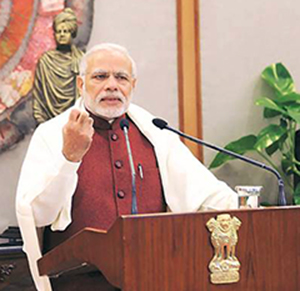
BJP faced more adversities in independent India than Cong under British: Modi

August 18, 2016

New Delhi, Aug 18: BJP has faced more adversities in independent India as compared to what Congress would have during the British rule, Prime Minister Narendra Modi said today and lamented that every effort of his party was seen in "bad light".modi-7

Asserting that BJP has made more sacrifices than any other party, Modi, who laid the foundation stone of the new party headquarters here, said fissiparous forces have become more active as the country's strength has grown and it is now more imperative to ensure that the society is strengthened and becomes more harmonious.

Underlining his party's commitment to take everybody along with the motto of 'sabka saath, sabka vikaas', he asked party workers to present to the country and the democratic world an example of how a party "devoted to ideals and devoid of dynasty" functions as the world knows the saffron outfit "not the way it is but based on hearsay".
"BJP will be the only party which has faced adversities since its birth. It faced difficulties at every turn and its every effort was seen in bad light.

"Even during the British times, the Congress party would not have faced so much adversity that we, our dedicated workers have gone through in 50-60 years," he said at the event attended by top BJP leaders including party chief Amit Shah, L K Advani, Rajnath Singh and Arun Jaitley among others.

During the recent West Bengal assembly polls, it was difficult for the BJP candidates to even hire an office in Kolkata as anybody willing to given them space would face trouble, he said in an apparent attack on the ruling Trinamool Congress.

"No party has perhaps made more sacrifices than us (BJP) after freedom," he said, adding that "hundreds of" its workers were killed because they were not associated with the prevalent ideology of those times.

BJP workers do not work for crowd but for organisation as "anybody can collect a crowd by talking about populist issues but what is more important is to stick to ideology", he said.

In a lighter vain, he said election candidates of no other party would have forfeited more deposits than those of BJP as they kept fighting for their ideology irrespective of the results.

Modi used the occasion to congratulate grappler Sakshi Malik for bringing glory to the country by winning a bronze medal in the Rio Olympics.

Comments

SK
 - 
Thursday, 18 Aug 2016

Fekuji, you should thank Nehru for stopping Sardar Patel, for not banning GOONDA RSS organisation ...He was the right man to ban such goons... If that has happened, then India would have been a peaceful country ..... Naren are you reading the news of killing of BJP worker by your own goonda RSS....

Add new comment

  • Coastaldigest.com reserves the right to delete or block any comments.
  • Coastaldigset.com is not responsible for its readers’ comments.
  • Comments that are abusive, incendiary or irrelevant are strictly prohibited.
  • Please use a genuine email ID and provide your name to avoid reject.
News Network
July 16,2020

New Delhi, Jul 16: With the highest single-day spike of 32,695 cases and 606 deaths reported in the last 24 hours, India's COVID-19 tally on Thursday reached 9,68,876, informed the Union Ministry of Health and Family Welfare on Thursday.

The total number of COVID-19 cases includes 3,31,146 active cases, 6,12,815 cured/discharged/migrated and 24,915 deaths.

As per the Ministry, Maharashtra -- the worst-affected state from the infection -- has a total of 2,75,640 COVID-19 cases and 10,928 fatalities. While Tamil Nadu has a tally of 1,51,820 cases and 2,167 deaths due to COVID-19.

Delhi has reported a total of 1,16,993 cases and 3,487 deaths due to COVID-19.

Meanwhile, as per the information provided by the Indian Council of Medical Research (ICMR), 1,27,39,490 samples have been tested for COVID-19 till 15th July, of these 3,26,826 samples were tested yesterday.

Comments

Add new comment

  • Coastaldigest.com reserves the right to delete or block any comments.
  • Coastaldigset.com is not responsible for its readers’ comments.
  • Comments that are abusive, incendiary or irrelevant are strictly prohibited.
  • Please use a genuine email ID and provide your name to avoid reject.
News Network
May 29,2020

May 29: A total of 367 domestic flights, carrying 30,136 passengers, operated throughout the country till 5 pm on Thursday, Civil Aviation Minister Hardeep Singh Puri said.

Airports in West Bengal also started operations on Thursday, three days after domestic air travel resumed in India after a gap of two months.

All scheduled domestic passenger services were suspended in India from March 25 to May 24 due to restrictions in the wake of the coronavirus pandemic.

Earlier in the day, Puri had said that 460 domestic flights carrying 34,336 passengers were operated on Wednesday.

In the case of West Bengal, the minister on Sunday had said that the state will handle domestic flights from Thursday.

"Figures for domestic flights for 28th May 2020 are in. Departures 367, 30,136 passengers handled. Arrivals 310, 25,530 passengers handled. Total movements 677 with 55,666 passenger footfalls at airports.

 “Total number of flyers 30,136. These are numbers till 1700 hrs for Day 4," Puri said in a tweet.

A total of 428 domestic flights carrying 30,550 passengers and 445 domestic services carrying 62,641 flyers were operated in the country on Monday and Tuesday, respectively.

In February this year, when the lockdown was not imposed, around 4.12 lakh passengers travelled daily through domestic flights in India, according to Directorate General of Civil Aviation (DGCA) data.

During the pre-lockdown period, Indian airports handled around 3,000 daily domestic flights, aviation industry sources said. A total of 16 asymptomatic passengers on seven different flights including 13 of them who travelled by IndiGo have tested positive for COVID-19 since the resumption of domestic air services on Monday, according to airlines data.

Two of the three asymptomatic passengers who tested positive for the infection had travelled by Spicejet while one took a flight of Air India subsidiary Alliance Air.

The Karnataka government, meanwhile, said on Thursday it has requested the civil aviation ministry to reduce the number of flights originating from five states--Maharashtra, Gujarat, Tamil Nadu, Madhya Pradesh and Rajasthan--in the light of the high number of COVID-19 cases there, hours after a minister said it has "suspended" air travel from these states.

Seeking to clarify his statement, Law and Parliamentary Affairs Minister J C Madhuswamy maintained that Karnataka has not sought imposing a ban on flights from the five states as reported in some sections of the media. "India is flying high. Domestic operation figures for May 27, 2020 (till 23.59 hrs): Departures 460 with 34,336 passengers handled. Arrivals 464 with 33,525 passengers handled," Puri had said earlier in the day on Twitter.

If a flight takes off before midnight and lands in another airport after midnight, its departure and arrival are counted on different days, leading to a seeming mismatch in the figures of a particular day.

The Delhi airport, India's busiest airport, is scheduled to handle 147 departures and 145 arrivals on Thursday, said senior government officials. The Mumbai airport's operator MIAL said it handled a total of 50 domestic flights on Thursday. International passenger flights continue to remain suspended in the country.

Airports in West Bengal, Andhra Pradesh, Maharashtra, Telangana and Tamil Nadu have been allowed to handle a restricted number of daily flights as these states do not want a huge influx of flyers amid the rising number of COVID-19 cases.

While domestic services resumed in Andhra Pradesh on Tuesday, they restarted in West Bengal on Thursday.

Though domestic flight operations across the country began on May 25, they could not be restarted in Kolkata and Bagdogra as the state's machinery was involved in relief and restoration work after cyclone Amphan's devastation.

"Welcome Back, Passengers! Kolkata Airport saw the arrival of 122 passengers from @DelhiAirport after two long months and 40 passengers departed to Guwahati. Proper checks were followed, and regular sanitization was carried out in the terminal which was abuzz with passengers," the Kolkata airport tweeted.

On Thursday, eleven flights took off from Kolkata and an equal number arrived in the city, sources at the Netaji Subhas Chandra Bose International Airport said.

"A total of 1,745 passengers arrived and 1,214 passengers flew out of the city today (Thursday)," airport sources said.

The airports in Kolkata and Bagdogra are permitted to handle 20 daily flights each from Thursday onwards.

While it is not clear how many flights were handled by the Bagdogra airport on Thursday, the officials said 899 passengers arrived while 484 passengers departed from the airport during the day.

The West Bengal government recently came up with a set of guidelines for people arriving in the state on domestic flights.

According to it, those entering the state from Thursday must submit a self-declaration form, stating that they have not tested positive for COVID-19 in the past two months.

The passengers will also need to undergo health screening after they arrive at the airport, the state's guidelines said.

Comments

Add new comment

  • Coastaldigest.com reserves the right to delete or block any comments.
  • Coastaldigset.com is not responsible for its readers’ comments.
  • Comments that are abusive, incendiary or irrelevant are strictly prohibited.
  • Please use a genuine email ID and provide your name to avoid reject.
News Network
April 24,2020

New Delhi, Apr 24: The trajectory of COVID-19 cases could have plateaued and might even fall for some weeks after the lockdown is lifted but India is likely to see a second wave in late July or August with a surge in the number of cases during the monsoon, say scientists.

The timing of the peak will depend on how India is able to control physical distancing and on the level of infection spreads after restrictions are relaxed, they said.

It looks apparent that the trajectory of daily new cases has reached a plateau and eventually it will take a downward fall, maybe for some weeks or even months, Samit Bhattacharya, associate professor at the Department of Mathematics, Shiv Nadar University, said.

Still, we may get a surge of new cases of the same coronavirus and this will be considered a second wave, Bhattacharya explained.

The second epidemic may come back in late July or August in the monsoon, although the peak timing will depend on how we control social distancing during that time, he said.

Rajesh Sundaresan, professor at Bengaluru's Indian Institute of Science (IISc), agreed.

“Once we return to normal activity levels, there is a chance that infection may begin to rise again. China is seeing this to some extent post easing of some restrictions on travel,” Sundaresan, corresponding author of a working paper by researchers at IISc and the Tata Institute of Fundamental Research (TIFR) in Mumbai, said.

On March 25, when the number of coronavirus cases was 618 with 13 deaths, the government announced a nationwide lockdown that was later extended to May 3.

On Friday, the death toll due to COVID-19 rose to 718 and the number of cases to 23,077, according to the Union Health Ministry.

In good news, officials said this week that the doubling rate of cases has slowed down in the period, going from 3.4 days before lockdown to 7.5 days, with 18 states doing better than the national average. The recovery rate has also almost doubled in the last 10 days.

"Looking at the new cases in the past few days, it seems the growth of new daily infection is much slower than earlier. This apparently indicates that we might have reached at the plateau of the growth curve, Bhattacharya said.

He noted that recent studies in China and Europe observed that the infection might relapse in those people who have already recovered from earlier phases.

So, there is no evidence that the earlier infection may help acquire immunity against the second infection. And in that way, the entire population may be vulnerable to the second wave to some extent, said the scientist.

In their study unveiled this week, IISc and TIFR researchers analysed the impact of strategies such as case isolation, home quarantine, social distancing and various post-lockdown restrictions on COVID-19 that might remain in force for some time.

The study modelled on Bengaluru and Mumbai suggests the infection is likely to have a second wave and the public health threat will remain, unless steps are taken to aggressively trace, localise, isolate the cases, and prevent influx of new infections.

The new levels and the peaking times for healthcare demand depend on the levels of infection spreads in each city at the time of relaxation of restrictions, they said.

The lockdown is currently upon us. It has given us valuable time. Let us test, trace, quarantine, isolate, practice better hygiene, search for a vaccine, etc. We should do these anyway, and these are being done. When and how to lift the lockdown is going to be a difficult decision to make, said Sundaresan.

It's clear that it's going to be phased. What our team is focusing on is to come up with tools to help the decision makers assess the public health impact of various choices, he said.

According to the experts, infectious diseases spread via contact between infectious and susceptible people. In the absence of any control measures, an outbreak will grow as long as the average number of people infected by each infectious person is more than one.

Once enough people are immune there will be fewer people susceptible to the infection and the outbreak will die.

However, when an outbreak is brought under control by social distancing and other interventions, it is possible only a small proportion of the population will have been infected and gained immunity, they said.

This means enough susceptible people may remain to fuel a second wave if controls are relaxed and infection is reintroduced.

Until the vaccine comes on the market, we have to remain alert Once sporadic cases occur here and there in the country, we immediately need to implement quarantine or social distancing locally for the people in that region, and also need to perform tests to identify positive cases irrespective of showing symptoms, Bhattacharya explained.

Note that these monsoon months are also flu season in many places of India. So, we should not ignore the early signs of the flu symptoms. Irrespective of symptoms, we need to increase tests in the hotspots to identify people and contain the surge, he said.

Sundaresan added that the timeline for a second wave will depend on a lot of circumstances which may change as the time passes.

Significant testing may have been underway, there may be behavioural changes with people becoming more careful about their hygiene, wearing masks may become more common, etc. All these responses may help restrict the second wave, he said.

A study published in The Lancet journal earlier this month modelled the potential adverse consequences of premature relaxation of interventions, and found it might lead to a second wave of infections.

The finding is critical to governments globally, because it warns against premature relaxation of strict interventions, the researchers said.

While interventions to control the spread of SARS-CoV-2 are in place, countries will need to work toward returning to normalcy; thus, knowledge of the effect of each intervention is urgently required, they said in the study.

According to a recent analysis by the Harvard Chan School of Public Health, the best strategy to ease the critical care burden and loss of life from COVID-19 might be on-again, off-again social distancing.

In the absence of such interventions, surveillance and intermittent distancing may need to be maintained into 2022, which would present a substantial social and economic burden, the researchers wrote.p


Comments

Add new comment

  • Coastaldigest.com reserves the right to delete or block any comments.
  • Coastaldigset.com is not responsible for its readers’ comments.
  • Comments that are abusive, incendiary or irrelevant are strictly prohibited.
  • Please use a genuine email ID and provide your name to avoid reject.