


BJP planning to bring Amit Shah to trouble-hit Bantwal in August?

Agencies
June 22, 2017

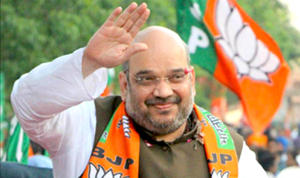
Mangaluru, Jun 22: The Bharatiya Janata Party supremo Amit Shah, who will be touring Karnataka for three days from August 3 may visit the communally sensitive areas of Dakshina Kannada district too, a local leader of the party said on condition of anonymity.shah
Entire Bantwal taluk is reeling under prohibitory orders under Section 144 of CrPC for almost past one month thanks to the communal tensions erupted after the sporadic incidents of stabbing and stone pelting in areas like Kalladka. The murder of SDPI activist Ashraf Kalai in Benjanapadavu village on June 21 has worsened the situation in the taluk.

The Sangh Parivar has been demanding the release of the accused belonging to saffron outfits arrested in connection with the recent communal clashes in Kalladka. Hindutva groups had also planned a massive protest in Bantwal taluk on June 24.

The political activities also have gained momentum in the taluk as BJP has formally extended complete support the protest aimed targeting Congress leader and district in-charge minister B Ramanath Rai. However, the extension prohibitory orders in four taluks of Dakshina Kannada district till June 27 may force the saffron groups to postpone the protest.

If sources are to be believed, the district BJP has planned to continue to pressurize Mr Rai till 2018 Karnataka polls. As part of this plan, the state BJP leadership may ask Mr Shah to pay a visit to Bantwal taluk.

During his Karnataka visit, Mr Shah will interact with BJP office-bearers, MPs and MLAs to get a feedback on the organisational issues and preparedness for the Assembly elections. The BJP is also keen on doing well in Karnataka, keeping the 2019 Lok Sabha elections in mind.

Comments

Sharat
 - 
Thursday, 22 Jun 2017

Great news. Amit Shah ji should camp in Kalladka for one week to prevent it from becoming another Kashmir.

SYED
 - 
Thursday, 22 Jun 2017

Great News!!!!!!!Mr. Sharat, AMit Shah Goonda should be camp in behind bars of Bellary for one week to prevent it from becoming another kashmir.

Rikaz
 - 
Thursday, 22 Jun 2017

Is he coming to turn Mangalore to Gujarath....

Ashok
 - 
Friday, 23 Jun 2017

Title of the news should be
SANGHIS CREATED A PLATFORM AS PLANNED TO BRING DAKU TO BANTWAL

Arshi
 - 
Saturday, 24 Jun 2017

Be careful, heavily raining in southern part of karnataka..slippery road, bald head, no helmet also..Ram naam sathya he hojayega..

Add new comment

  • Coastaldigest.com reserves the right to delete or block any comments.
  • Coastaldigset.com is not responsible for its readers’ comments.
  • Comments that are abusive, incendiary or irrelevant are strictly prohibited.
  • Please use a genuine email ID and provide your name to avoid reject.
coastaldigest.com news network
June 2,2020

Kasaragod, June 2: As Kerala commenced fresh academic year with online classes from Monday, a ninth-standard student at Malappuram district in North Kerala ended life allegedly owing to lack of online study facilities like television connection and a smartphone at her house.

Devika, daughter of Balakrishnan, hailing from a Dalit community at Valancherry, about 25 kilometres from Malappuram town, ended her life.

Balakrishnan told the media that he could not recharge the television connection owing to financial crunches. He was working as a daily wage worker and owing to COVID-19 and lockdown, he was not having much work these days. 

The family also did not have a smartphone or computer. The family members alleged that Devika was quite upset as she could not attend the virtual class that began on Monday. She was a student of a nearby government school.

Local police said that Devika, who was the eldest among four children of Balakrishnan, was suspected to have self-immolated using kerosene at a premise close to her house on Monday evening. The cause and provocations were still being probed only. No suicide notes were recovered yet.

Comments

Add new comment

  • Coastaldigest.com reserves the right to delete or block any comments.
  • Coastaldigset.com is not responsible for its readers’ comments.
  • Comments that are abusive, incendiary or irrelevant are strictly prohibited.
  • Please use a genuine email ID and provide your name to avoid reject.
News Network
June 26,2020

Bengaluru, Jun 26: The National Restaurant Association of India (NRAI) on Thursday came up with a Standard Operating Procedure (SOP) for restaurants whereby among other physical distancing norms, it has suggested a 2-metre gap between tables.

Formulated in partnership with Releski, a Bengaluru based skill-tech company, the SoP suggests that in case of back-to-back seating, people sitting with their backs towards each other will have their seats divided by 'Plexiglass' divider raised up to 2 meters from the ground.

"In a typical restaurant, the improvised seating plan should have a minimum distance of 2 metres between tables. The distance of 2 metres (6 feet) between tables should measure from one edge of the table to the other table's edge," it said.

In case of loose or free seating such as in banquet style or food court style seating, a minimum 2 meters of distance should be maintained between tables.

The guidelines noted that, to encourage physical distancing, restaurants have to sacrifice their seating capacity, to promote health and safety, and also to gain trust from their patrons.

"In order to perform this, divide your restaurants under different sectors. Pull out your restaurant's floor plan and colour code different sections red and yellow. Red sections are potential areas where maximum footfall or traffic is observed. Yellow sections are areas where the footfalls are average," it said.

All the red sections are encircled or bordered by placing barricades or Q manager and will open at specific points to access the yellow section and all the opening points will have hand sanitisers and sprays, and every guest who walks from red zones to yellow zones will sanitise himself/herself to reduce the chances of contamination.

For air conditioning, the guidelines of CPWD shall be followed which inter alia emphasises that the temperature setting of all air conditioning devices should be in the range of 24-30 degree Celsius, relative humidity should be in the range of 40- 65 per cent, intake of fresh air should be as much as possible and cross ventilation should be adequate, the guidelines suggested.

The industry body has also suggested appointment of a COVID-free Ambassador who would operate as the Chief Health Officer within the restaurant team, preferably from the management team in each shift.

The ambassador's would put the new daily work routines into practice, to monitor compliance with good practice and to lead the preventative measures, adapt to health & safety recommendations and requirements of the restaurant and oversee the implementation of the norms.

Anurag Katriar, President of NRAI and CEO & Executive Director of deGustibus Hospitality, said: "Every restaurant cutting across formats is facing the harsh reality of subdued to shut business volumes in the present and the uncertainty of business environment in the future. One thing is certain that hygiene and safety will be a key differentiator in the post-pandemic restaurant operations."

Comments

Add new comment

  • Coastaldigest.com reserves the right to delete or block any comments.
  • Coastaldigset.com is not responsible for its readers’ comments.
  • Comments that are abusive, incendiary or irrelevant are strictly prohibited.
  • Please use a genuine email ID and provide your name to avoid reject.
News Network
February 1,2020

New Delhi, Feb 1: The budget is a little more demanding of the non-resident Indian. Firstly, to be categorized a non-resident, an Indian now has to stay abroad for 240 days, against 182 previously. In other words, an Indian national, to claim the non-resident status, can’t stay in India for 120 days or more in a year.

“We've made changes in Income Tax Act where if an Indian citizen stays out of the country for more than 182 days, he becomes non-resident,” said Revenue Secy Ajay Bhushan Pandey. “Now in order to become non-resident, he has to stay out of the country for 240 days.”

The second rule is more deadly: a non-resident Indian, who is not taxed in the foreign country, will become taxable in India.

“If any Indian citizen is not a resident of any country in the world, he'll be deemed to be a resident of India and his worldwide income will be taxed,” said Pandey.

"It's a very big disadvantage for Indians residing overseas only to save on tax,"  said Dinesh Kanabar of Dhruva Advisors. He expects that many Indians stay abroad in countries, where the income tax is low or nil such as Dubai. Now they will be taxed in India if they are in the income tax bracket.

For Indians, finance minister Nirmala Sitharaman revised income tax rats and proposed new tax slabs.

The new income tax rates will, however, not allow exemptions under Section 80C. Home loan exemption, insurance exemptions, the standard deduction will also not stay under the regime.

"The new tax regime will be optional and the taxpayers will be given the choice to either remain in the old regime with exemptions and deductions or opt for the new reduced tax rate without those exemptions," Sitharaman said while unveiling Budget.

Comments

Kannadiga
 - 
Saturday, 1 Feb 2020

Good news NRIs vote for modi . 

Add new comment

  • Coastaldigest.com reserves the right to delete or block any comments.
  • Coastaldigset.com is not responsible for its readers’ comments.
  • Comments that are abusive, incendiary or irrelevant are strictly prohibited.
  • Please use a genuine email ID and provide your name to avoid reject.