


British MPs may have to comply with Sharia law

January 30, 2016

London, Jan 30: British lawmakers may have to comply with the Sharia law including an alcohol ban when they move out of the Westminster Palace which is set to undergo much- needed repairs as the new complex they will shift into is governed by the Islamic law.parliamen
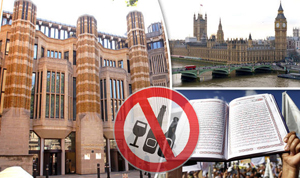
A UK parliamentary committee searching for a new temporary home for the House of Commons away from the Palace of Westminster has identified Richmond House, home to the UK's Department of Health, as a favoured option.

But the building in the Whitehall political hub of London was transferred to finance an Islamic bond scheme of "Sukuk" two years ago, and a condition of its lease is that it cannot be used for purposes not sanctioned by Sharia law.

An official told The Times newspaper that under terms of the deal agreed with the UK Treasury, the sale of alcohol is among activities explicitly forbidden.

"It is true. If MPs want to use Richmond House they'd better give up any hopes it will include a bar," he said.

MPs and peers were told this week that they are likely to have to move out of the Palace of Westminster entirely for at least six years to allow for a four-billion pounds overhaul of the crumbling neo-Gothic pile.

According to the newspaper, parliamentarians will have to leave behind at least 10 licensed bars and restaurants, each well-stocked with competitively priced drinks.

The Richmond House complex, just north of the existing parliamentary estate, has been narrowed down as a favoured options as it can easily be taken within a security cordon and could comfortably accommodate a temporary debating chamber.

In July 2014, UK Chancellor George Osborne had announced that the Treasury was launching the first Islamic bond in a western financial centre.

The 200 million pounds bonds, known as Sukuk, would help make Britain "the western hub of Islamic finance" and the "undisputed centre of the global financial system", he said.

The offer was more than 10 times oversubscribed as central banks and sovereign wealth funds in Gulf states snapped up bonds that pay just over two per cent annually for five years.

Devout Muslims cannot buy traditional government bonds because they pay interest.
Sukuk, an Islamic alternative, permit guaranteed returns if they are linked to rental payments.

In the Treasury version, three government buildings — including Richmond House — are being used to finance the products. To ensure that the Sukuk were fully compliant with Sharia, the Treasury agreed to conditions on the properties' use including a ban on the sale of alcohol.

"The committee is looking at a range of options and no final decision has been taken. It is aware that Richmond House is under a bond," a spokesperson for the joint committee on the Palace of Westminster said.

The 182-year-old Palace of Westminster currently has eight bars in its premises.

Comments

Add new comment

  • Coastaldigest.com reserves the right to delete or block any comments.
  • Coastaldigset.com is not responsible for its readers’ comments.
  • Comments that are abusive, incendiary or irrelevant are strictly prohibited.
  • Please use a genuine email ID and provide your name to avoid reject.
News Network
February 5,2020

Chennai, Feb 5: In order to ensure housing for all, the Madras High Court has proposed ban on non-resident Indians from purchasing houses in India, prohibit speculative sale, and impose 100 per cent extra stamp duty on purchase of second house.

The court on its own impleaded the Union housing and finance ministries as party respondents.

It has directed them to answer a series of questions including as to how many families have basic amenity of housing in India as well as in Tamil Nadu, population and housing ratio in the country and in the state, when 'Housing for All' mission of the central government would be achieved.

"Why the government does not consider imposing such restrictions to control escalation of house prices and to provide a house to every family in the country, a division bench of Justice N Kirubakaran and Justice Abdul Quddhose wondered.

Directing the authorities to inform as to whether the central and state have got special schemes to provide housing for the marginalized and economically weaker sections including SC/ST communities, the bench has also sought the details of the number of families that possess more than one house.

"Why the governments do not restrict families/individuals from purchasing/possessing more than one housing unit/flat/plot till "Housing for all" is achieved?

Why not the government charge 100 per cent more or extra stamp duty to discourage buying more than one house by a family while purchasing second house?

Why not the government conditionally allow the families to purchase more than one house provided the said family pays 100 per cent extra statutory dues like property tax, electricity charges, water and sewerage charges on the second property?" the bench said.

This apart, the court also wanted the authorities to know as to why it should not prohibit the NRIs from purchasing houses in India to bring down the cost of housing.

Justifying its directions, the court said "Lakhs and lakhs of people are living on platforms, roads, and cement pipes, slums, under the trees and on banks of water bodies without proper shelter and basic amenities and safety."

It is true that the Centre had taken a policy decision to provide housing unit to every family.

It should be achieved at the earliest, the court said, adding it could become fruitful when restrictions are put on persons who hold more than one housing units.

The court passed the order while hearing an appeal moved by the Tamil Nadu Housing Board challenging a single judge order against acquisition of about 369 acres of private land in Thudiyalur and Vellakinar areas of Coimbatore for a housing scheme.

Comments

Suresh SS
 - 
Wednesday, 5 Feb 2020

We believed that only Indian Govt. ministers, MP and MLAs has this disease, now it is spreading everywhere even Indian High courts. it is certainly very harmful virus  

Add new comment

  • Coastaldigest.com reserves the right to delete or block any comments.
  • Coastaldigset.com is not responsible for its readers’ comments.
  • Comments that are abusive, incendiary or irrelevant are strictly prohibited.
  • Please use a genuine email ID and provide your name to avoid reject.
News Network
June 6,2020

Bengaluru, Jun 6: Karnataka Chief Minister B S Yediyurappa on Saturday said hotels and restaurants would be allowed to re-open, but the precautionary measures laid down by the Centre against coronavirus were mandatory.

The Chief Minister on Friday held a meeting with the tourism and transport department, also stakeholders, regarding revival of tourism in the state.

Hotels associations and transport companies have said they would follow the guidelines issued by the government, an official press release said here.

The Karnataka government had said it would go by the Centre's direction on opening religious places of worship, shopping malls, hotels, restaurants and other hospitality services on June 8.

Buses, hotels and taxi owners association placed some demands at the meeting, the release said, adding that Yediyurappa informed them that he would examine their demands and take appropriate decisions.

The Chief Minister also released a handout regarding the guidelines that need to be followed as the tourism department is opening hotels, guest houses and tourist destinations.

Deputy Chief Minister Laxman Savadi, Tourism Minister C T Ravi and senior officials of the department participated in the meeting.

The government had, on Thursday, said safaris, trekking, jungle lodges and resorts in areas that fall outside the COVID-19 containment zones can re-open provided they adhere to social distancing, hygiene as issued by the governments.

Comments

Add new comment

  • Coastaldigest.com reserves the right to delete or block any comments.
  • Coastaldigset.com is not responsible for its readers’ comments.
  • Comments that are abusive, incendiary or irrelevant are strictly prohibited.
  • Please use a genuine email ID and provide your name to avoid reject.
coastaldigest.com news network
March 25,2020

Mangaluru, Mar 25: The Indian Council of Medical Research (ICMR) has so far given nod to three private laboratories in Karnataka for testing COVID-19. The ICMR comes under the Department of Health, Government of India

The three labs are KMC Hospital Manipal, Shankar Research Centre's laboratory, and SRL laboratory on Bowring Hospital Road at Shivajinagar, Bengaluru.

Eight private labs from Maharashtra, two from Haryana, three from Tamil Nadu, four from Delhi, and three each from Karnataka and Gujarat have been given permission. 

These labs have over 15,000 collection centres all over the country. Blood samples and throat swabs of coronavirus suspects can be given at these centres.

Comments

Add new comment

  • Coastaldigest.com reserves the right to delete or block any comments.
  • Coastaldigset.com is not responsible for its readers’ comments.
  • Comments that are abusive, incendiary or irrelevant are strictly prohibited.
  • Please use a genuine email ID and provide your name to avoid reject.