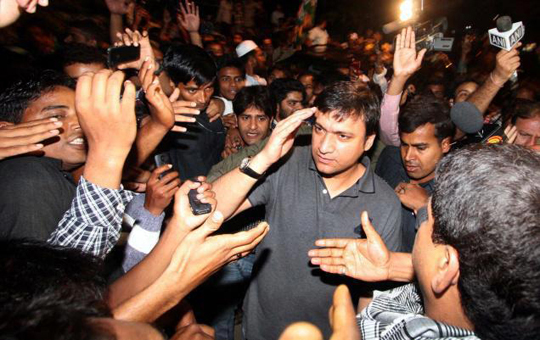
Can win 50 MP seats with votes of 'brethren', says Owaisi, BJP cries foul

Agencies
July 4, 2017

Hyderabad, Jul 4: AIMIM MLA Akbaruddin Owaisi stoked a controversy when he claimed his brother and party chief Asaduddin Owaisi could help the outfit win 50 seats in Parliament with the votes of "our brethren", remarks that BJP dubbed as "hate speech".

Owaisi

Owaisi was also purportedly shown in the video, which has gone viral, criticising the Modi government for the recent killing of Muslims.

He referred to the killings of Mohammed Akhlaq, Pehlu Khan and 15-year-old Junaid Khan and asked "if it is a crime to wear a cap, grow your beard and be a Muslim".

"There is no need for the sympathy, support of anybody. Our brother (his brother and MIM president Asaduddin Owaisi) can win 50 parliament seats for the party with the votes of our brethren," Akbaruddin, the MLA from Chandrayangutta in Hyderabad, was heard saying in the video.

Hitting out at the VHP and Bajrang Dal, he said: "Jitna ye mulkterahai, utna ye mulkmerabhihai". (This country is mine as much as it is yours).

It was not immediately clear where and when Akbaruddin Owaisi made the alleged speech.

Responding to Akbaruddin's alleged comments which were seen as appealing to Muslim sentiments, BJP spokesperson Krishna Saagar Rao alleged the MLA made a hate speech which could "incite" people.

Wondering why the TRS government in the state had not filed charge-sheet in the case of hate speech made earlier by Akbaruddin Owaisi, the BJP leader demanded that a police case be registered against him.

BJP would approach the Election Commission seeking cancellation of MIM's recognition, he said.

Comments

Fayaz
 - 
Friday, 7 Jul 2017

Terrorist grup tried to kill the innocent muslim guy..

s
 - 
Tuesday, 4 Jul 2017

anything a muslim says is hate?

Add new comment

  • Coastaldigest.com reserves the right to delete or block any comments.
  • Coastaldigset.com is not responsible for its readers’ comments.
  • Comments that are abusive, incendiary or irrelevant are strictly prohibited.
  • Please use a genuine email ID and provide your name to avoid reject.
Agencies
July 1,2020

Sopore, Jammu And Kashmir: A three-year-old boy survived as his grandfather was killed in a terror attack on the Central Reserve Police Force (CRPF) in Jammu and Kashmir's Sopore town this morning. A CRPF jawan was also killed in the line of duty as terrorists opened fire on a patrol team.

In heart-wrenching images, the child is seen sitting on the blood-splattered body of his grandfather, a civilian caught in the crossfire. The boy was numb with fear when he was picked up by policemen, according to the police.

The Kashmir police also tweeted a photo of the child being carried to safety by a policeman.

"Jammu and Kashmir police rescued a three-year-old boy from getting hit by bullets during the terrorist attack in Sopore," said the tweet by the Kashmir Zone Police.

The child was travelling in a Maruti car with his grandfather from Srinagar to Handwara when it was hit by a spray of bullets in Sopore town, which is in Baramulla district about 50 km from Srinagar.

The police said terrorists hiding in a mosque fired indiscriminately at the patrol team as it was getting off a bus. The CRPF troops retaliated but the terrorists managed to escape.

According to the CRPF, the grandfather stopped the car and got out to run to a safe spot but was shot dead in the firing by terrorists. The boy was later rescued by a policeman standing nearby.

Last week, a six-year-old boy was killed during a terror attack on the CRPF in Anantnag.

Little Nihaan Bhat was sleeping in a parked car when he was hit by a bullet. Police say the terrorist was on a bike and opened fire from a pistol on a CRPF patrol. One jawan was killed. The child's killing drew widespread anger and condemnation.

The terrorist believed to be involved in the Anantnag attack escaped yesterday after an encounter with security forces. Police said two other terrorists who were hiding with him at a village were killed.

Comments

Add new comment

  • Coastaldigest.com reserves the right to delete or block any comments.
  • Coastaldigset.com is not responsible for its readers’ comments.
  • Comments that are abusive, incendiary or irrelevant are strictly prohibited.
  • Please use a genuine email ID and provide your name to avoid reject.
Agencies
May 23,2020

New Delhi, May 23: The nationwide lockdown will no longer help India in its fight against COVID-19, and in its place community-driven containment, isolation and quarantine strategies have to be brought into play, leading virologist Shahid Jameel said.

The recipient of Shanti Swarup Bhatnagar Prize for Science and Technology also stressed that testing should be carried out vigorously to identify coronavirus hotspots and isolate those areas.

"Our current testing rate at 1,744 tests per million population is one of the lowest in the world. We should deploy both antibody tests and confirmatory PCR tests. This will tell us about pockets of ongoing infection and past (recovered) infection. This will provide data to open up gradually and let economic activity resume," Jameel told PTI in an interview.

He stressed that testing has to be dynamic to continuously monitor red, orange and green zones and change these based on that data.

About community transmission of COVID-19 in India, Jameel said the country reached that stage long ago.

"We reached community transmission a long time ago. It's just that the health authorities are not admitting it. Even ICMR's own study of SARI (severe acute respiratory illness) showed that about 40 per cent of those who tested positive for SARS-CoV-2 did not have any history of overseas travel or contact to a known case. If this is not community transmission, then what is?" he posed.

Lockdown bought India time in its fight against coronavirus, but continuing it is unlikely to yield any further dividend, Jameel said.

"Instead, community-driven local lockdowns, isolations and quarantines have to come into play. Building trust is most important so that people follow rules. A public health problem cannot be dealt with as a law-and-order problem."

The nationwide lockdown, initially imposed from March 25 to April 14, has been extended thrice and will continue at least till May 31. The virus has claimed 3,720 lives and infected over 1.25 lakh people in the country so far.

Jameel has expertise in the fields of molecular biology, infectious diseases, and biotechnology. He is the CEO of Wellcome Trust/Department of Biotechnology's India Alliance and is best known for extensive research in Hepatitis E virus and HIV.

He said COVID-19 will eventually be controlled through herd immunity, which is acquired in two ways – when a sufficient fraction of the population gets infected and recovers, and with vaccination.

"It is estimated that for SARS-CoV-2 at least 60 per cent of the population would have to be infected and recovered, or vaccinated. This will happen over the course of the next few years," Jameel said.

Herd immunity is reached when the majority of a population becomes immune to an infectious disease, either because they have become infected and recovered, or through vaccination. When that happens, the disease is less likely to spread to people who aren't immune, because there just aren't enough infectious carriers.

"India has 1.38 billion people, a population density of about 400/sq km and a healthcare system ranked at 143 in the world. If we allow 60 per cent people to get infected quickly in the hopes of herd immunity, that would mean 830 million infections," Jameel said.

"If 15 per cent need hospitalization that means about 125 million isolation beds (we have 0.3 million). If five per cent need oxygen and ventilatory support, this amounts to about 42 million oxygen support and ICU beds; we have 0.1 million oxygen support beds and 34,000 ICU beds. This would overwhelm the healthcare system causing mayhem," he said.

Jameel said if the population level mortality is 0.5 per cent that would mean 40 lakh deaths. "Are we prepared to pay this price for herd immunity in the short term? Clearly not," he said.

He said it is unlikely that a vaccine would be available by the end of the year.

"Even then, we don't know yet how long it would give protection – weeks, months, one year, a few years? I don't think we will return to pre-coronavirus days for at least the next 3-5 years. This is also a chance to evaluate if we want to return to those unsustainable, environment-damaging ways. COVID-19 is a timely warning to reform our way of living," he said.

Jameel said it is hard to predict but plausible that COVID-19 would return in second or third wave.

"Later waves come when we don't understand the disease and become lax. A comparison to Spanish Flu is not entirely valid because in 1918 no one knew what caused it. No one had seen a virus till the mid-1930s as the electron microscope needed to view those was invented in 1931," he said.

"Today we know a lot more about the pathogen, its genetic makeup, how it transmits and how to prevent it. We need to be sensible and follow expert advice," he said.

If there is any scientific evidence linking deforestation, rapid urbanisation, climate change with pandemics like COVID-19, he said zoonotic viruses -- those that jump from animals to humans -- happen so when wild animal–human contacts increase.

"Deforestation destroys animal habitats bringing them closer to humans. When you cut forests, bats come to roost on trees closer to human habitations. Their viruses in secretions/stool get transmitted to domestic animals and on to humans. This happened clearly with Nipah virus outbreak in Malaysia in 1997-98 from fruit bats to pigs to humans," he said.

"COVID-19 possibly arose in wet animal markets due to dietary habits that bring all kinds of live and dead wild animals in close contact with humans," Jameel added.


Comments

Add new comment

  • Coastaldigest.com reserves the right to delete or block any comments.
  • Coastaldigset.com is not responsible for its readers’ comments.
  • Comments that are abusive, incendiary or irrelevant are strictly prohibited.
  • Please use a genuine email ID and provide your name to avoid reject.
News Network
March 21,2020

Mar 21: India’s economy, already in the grip of a slowdown, is in for more pain after Prime Minister Narendra Modi appealed to citizens to stay at and work from home to curb the coronavirus outbreak.

The services sector, which accounts for about 55% of India’s gross domestic product, is poised to be the worst hit after Modi, in a late evening address on Thursday, urged citizens to go on a self-imposed curfew for a day and private companies to allow employees to work from home for longer. In the country’s vast informal sector, social-distancing measures could mean a dent to productivity and consumption because of job or pay losses.

“The impact of a partial lock-down or social distancing will be significant,” said Rahul Bajoria, a senior economist at Barclays Plc in Mumbai. “If there’s a widespread community outbreak, GDP could fall as low as 3.5% in the year starting April 1.”

Shrinking output may limit growth in an economy that’s already set to expand at an 11-year low of 5% in the current year to March 31. Before the virus outbreak, India had forecast growth to recover to 6%-6.5% in the next fiscal year. S&P Global Ratings and Fitch Ratings have already slashed their growth forecast by 50 basis points.

“The current social-distancing measures will severely impact airlines, hotels, malls, multiplexes, restaurants and retailers,” according to analysts at Crisil Ltd., the local unit of S&P Global. “Lower footfalls and occupancies, decline in business volume and sub-optimal operating efficiencies will impact cash flows of companies in these sectors,” wrote the analysts led by Chief Economist Dharmakirti Joshi.

The government will try to announce a relief package for virus-affected sectors as early as possible, Finance Minister Nirmala Sitharaman said Friday.

In a televised address, Modi advised all citizens to stay at home for a day on March 22, as he sought to stem the spread of the coronavirus -- cases of which are relatively low in India at about 200, compared with more than 200,000 infected people globally. His government also barred incoming flights for a week from that day, joining a growing list of countries effectively sealing their borders.

What Bloomberg’s Economists Say

We had only earlier this week lowered our GDP outlook to consider the direct impact of the local outbreak as confirmed virus cases exceeded 100 as of March 15 and the federal and state governments announced social distancing measures that have already started to crimp economic activity. We are now revising down our GDP estimate for 4Q fiscal 2020 to 3.3%, from our 3.5%.

-- Abhishek Gupta, India economist

For more, click here

“Consumption being the biggest component of GDP, a lock-down is bound to have a big impact on the economy,” said Devendra Kumar Pant, chief economist at India Ratings and Research, the local unit of Fitch. “Modeling uncertainty in any system will be very difficult, but one can say the slowdown could deepen or prolong further.”

Work From Home

While companies, including billionaire Mukesh Ambani-controlled Reliance Industries Ltd., are asking employees to work from home, the option isn’t feasible in India’s vast informal sector.

“The option to work remotely simply won’t exist for most,” said Shilan Shah, an economist with Capital Economics Pte. in Singapore.

As many households don’t have savings buffers, the government would probably have to back this up with large-scale cash handouts that reach the poorest, he said.

Work from home is posing implementation challenges for the manufacturing sector where workers are required to be physically present at the production sites. The services sector, such as banking and information technology, also needs employees to be present in offices as confidential data is used, according to industry group Federation of Indian Chambers of Commerce and Industry.

Comments

Add new comment

  • Coastaldigest.com reserves the right to delete or block any comments.
  • Coastaldigset.com is not responsible for its readers’ comments.
  • Comments that are abusive, incendiary or irrelevant are strictly prohibited.
  • Please use a genuine email ID and provide your name to avoid reject.