



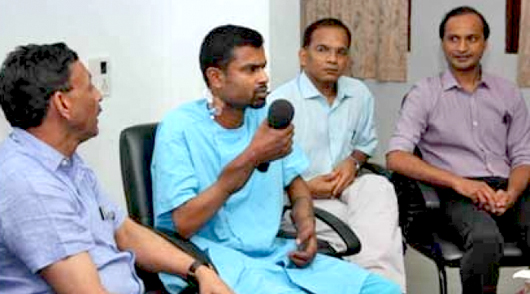
India's first double hand transplant successful, says doctors

February 1, 2015

hand transplant

Thiruvananthapuram, Feb 1: With the first successful double hand transplant, Indian doctorshave registered a rare feat of carrying out the world's first hand transplant of a coloured skin and the first hand transplant in any developing country.

So far, only 110 successful hand transplants have been done, since the first one in France 13 years ago, in USA, European countries, China and Australia.

The honour for the rare feat goes to a team of surgeons at the Kochi-based Amrita Institute of Medical Sciences. The transplant was carried out on January 12 and 13 to a train accident victim - 30-year-old Manu, who received both the hands of a 24-year-old road accident victim.

"The operation lasted for 16 hours with more than 20 surgeons participating in the procedure. Each hand required connecting two bones, two arteries, four veins and about 14 tendons," saidDr. Subramania Iyer, Professor and Head of the Plastic Surgery Department.

"The immune suppressant drugs were started before the start of the surgery and continued after it. He was shifted to a transplant ICU. Careful monitoring of the blood supply to the hands was done and all precautions to prevent infections was instituted in the nursing. Another operation to replace an area of bad skin was done for his left hand on the second day," he added.

Dr. Iyer further said, "After14 days post-surgery, both the hands have been accepted by the recipient's body and he started regaining movements. He has been shifted out of the ICU and post-surgical rehabilitation process has started under supervision."

"Manu will be able to move his hands since his own muscles of the forearm are working to move the fingers. The sensations will return only slowly and is expected in three to four months. His immunosuppressant drugs (to prevent rejection of the transplanted hands) will have to be continued indefinitely, but at a reduced rate from three months," he added.

Dr. Iyer said, the current transplant is important, since follow up of the transplanted skin is done by the appearance of the skin and skin biopsies every month to see signs of rejection.

He said the details of the transplant have been added to the International Registry of Hand Transplants, which maintains stringent standards in the follow-up of these cases.

The entire expense for the transplant was borne by Mata Amritanandamayiu Math.

"This transplant has put the Indian scientific community among the league of a few developed nations in the field of composite tissue allotransplant," said Dr. Iyer.

Comments

Add new comment

  • Coastaldigest.com reserves the right to delete or block any comments.
  • Coastaldigset.com is not responsible for its readers’ comments.
  • Comments that are abusive, incendiary or irrelevant are strictly prohibited.
  • Please use a genuine email ID and provide your name to avoid reject.
Agencies
May 30,2020

Drinking coffee may help reduce the risk of certain digestive disorders, including gallstone disease and pancreatitis, a new study has suggested.

The study from the Institute for Scientific Information on Coffee (ISIC) also highlighted other beneficial effects that coffee consumption may have on the process of digestion, including supporting gut microflora and promoting gut motility.

"Data indicates benefits against common digestive complaints such as constipation, as well as a potential reduction in the risk of more serious conditions like chronic liver diseases," said study author Carlo La Vecchia from the University of Milan in Italy.

Gallstone disease is a common digestive disorder, caused by the accumulation of gallstones in the gallbladder or bile duct, which affects approximately 10-15 per cent of the adult population.

While the mechanism by which coffee may protect against gallstone disease is not yet known, it has been observed that the risk for the condition declines with increasing daily consumption of coffee, the researchers said.

Caffeine is thought to play a role in these associations, as the same effect is not observed with decaffeinated coffee.

A common question among consumers and focus area for research is whether coffee is associated with heartburn or gastro-oesophageal reflux disease (GORD).

While a small number of studies have suggested an association between coffee drinking and GORD, the majority of studies reviewed suggest that coffee is not a major trigger of these conditions.

The report also reviewed a growing area of health and nutrition research, namely: the effect of coffee on the gut microflora (microorganism populations).

Recent studies suggest that populations of the beneficial gut bacteria Bifidobacterium spp, increase after drinking coffee.

The findings showed the dietary fibre and polyphenols found in coffee, support the healthy growth of microflora populations.

Additional research findings highlighted that coffee consumption is thought to stimulate digestion by encouraging the release of gastric acid, bile and pancreatic secretions.

Coffee is one of the most widely researched components of the diet, and its effect on digestion remains a growing area of research, the researchers noted.

Comments

Add new comment

  • Coastaldigest.com reserves the right to delete or block any comments.
  • Coastaldigset.com is not responsible for its readers’ comments.
  • Comments that are abusive, incendiary or irrelevant are strictly prohibited.
  • Please use a genuine email ID and provide your name to avoid reject.
Agencies
March 3,2020

Taking multiple courses of antibiotics within a short span of time may do people more harm than good, suggests new research which discovered an association between the number of prescriptions for antibiotics and a higher risk of hospital admissions.

Patients who have had 9 or more antibiotic prescriptions for common infections in the previous three years are 2.26 times more likely to go to hospital with another infection in three or more months, said the researchers.

Patients who had two antibiotic prescriptions were 1.23 times more likely, patients who had three to four prescriptions 1.33 times more likely and patients who had five to eight 1.77 times more likely to go to hospital with another infection.

"We don't know why this is, but overuse of antibiotics might kill the good bacteria in the gut (microbiota) and make us more susceptible to infections, for example," said Professor Tjeerd van Staa from the University of Manchester in Britain.

The study, published in the journal BMC Medicine, is based on the data of two million patients in England and Wales.

The patient records, from 2000 to 2016, covered common infections such as upper respiratory tract, urinary tract, ear and chest infections and excluded long term conditions such as cystic fibrosis and chronic lung disease.

The risks of going to hospital with another infection were related to the number of the antibiotic prescriptions in the previous three years.

A course is defined by the team as being given over a period of one or two weeks.

"GPs (general physicians) care about their patients, and over recent years have worked hard to reduce the prescribing of antibiotics,""Staa said.

"But it is clear GPs do not have the tools to prescribe antibiotics effectively for common infections, especially when patients already have previously used antibiotics.

"They may prescribe numerous courses of antibiotics over several years, which according to our study increases the risk of a more serious infection. That in turn, we show, is linked to hospital admissions," Staa added.

It not clear why hospital admissions are linked to higher prescriptions and research is needed to show what or if any biological factors exist, said the research team.

"Our hope is that, however, a tool we are working for GPs, based on patient history, will be able to calculate the risks associated with taking multiple courses of antibiotics," said Francine Jury from the University of Manchester.

Comments

Add new comment

  • Coastaldigest.com reserves the right to delete or block any comments.
  • Coastaldigset.com is not responsible for its readers’ comments.
  • Comments that are abusive, incendiary or irrelevant are strictly prohibited.
  • Please use a genuine email ID and provide your name to avoid reject.
Agencies
June 21,2020

Lower neighbourhood socioeconomic status and greater household crowding increase the risk of becoming infected with SARS-CoV-2, the virus that causes COVID-19, warn researchers.

"Our study shows that neighbourhood socioeconomic status and household crowding are strongly associated with risk of infection," said study lead author Alexander Melamed from Columbia University in the US.

"This may explain why Black and Hispanic people living in these neighbourhoods are disproportionately at risk for contracting the virus," Melamed added.

For the findings, published in the journal JAMA, the researchers examined the relationships between COVID-19 infection and neighbourhood characteristics in 396 women who gave birth during the peak of the Covid-19 outbreak in New York City. Since March 22, all women admitted to the hospitals for delivery have been tested for the virus, which gave the researchers the opportunity to detect all infections -- including infections with no symptoms -- in a defined population

The strongest predictor of COVID-19 infection among these women was residence in a neighbourhood where households with many people are common.The findings showed that women who lived in a neighbourhood with high household membership were three times more likely to be infected with the virus. Neighbourhood poverty also appeared to be a factor, the researchers said.Women were twice as likely to get COVID-19 if they lived in neighbourhoods with a high poverty rate, although that relationship was not statistically significant due to the small sample size.

The study revealed that there was no association between infection and population density.

"New York City has the highest population density of any city in the US, but our study found that the risks are related more to density in people's domestic environments rather than density in the city or within neighbourhoods," says co-author Cynthia Gyamfi-Bannerman."

The knowledge that SARS-CoV-2 infection rates are higher in disadvantaged neighbourhoods and among people who live in crowded households could help public health officials target preventive measures," the authors wrote.

Recently, another study published in the Journal of the American Planning Association, showed that dense areas were associated with lower COVID-19 death rates.

Comments

Add new comment

  • Coastaldigest.com reserves the right to delete or block any comments.
  • Coastaldigset.com is not responsible for its readers’ comments.
  • Comments that are abusive, incendiary or irrelevant are strictly prohibited.
  • Please use a genuine email ID and provide your name to avoid reject.