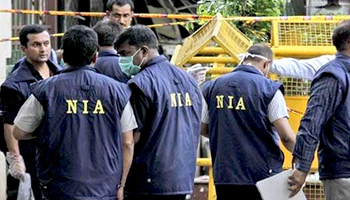
NIA arrests Bhatkal man, two others deported from Dubai for alleged IS links

[email protected] (News Network)
January 30, 2016

New Delhi, Jan 30: Three Indians, said to have links with terrorist outfit Islamic State (IS) were detained and later arrested by the National Investigation Agency (NIA) from the IGI airport in Delhi on Thursday night after they were deported from the UAE on India’s request.

niaIndia had alerted the UAE authorities about the suspects, based on information provided by the 14 arrested in countrywide raids last week, a senior government official said. 

The trio — Sheikh Azhar al Islam Abdul Sattar Sheikh from Jammu and Kashmir, Mohammed Farhan Mohammed Rafiq Shaikh from Mumbra in Mumbai, and Adnan Hussain Mohammed Hussain from Bhatkal — were deported from the United Arab Emirates for allegedly planning to carry out terror strikes in India and abroad, the NIA said on Friday.

The anti-terror agency registered a case against the three and detained them upon their arrival in Delhi. So far, around two dozen Indians have been deported from the Gulf on suspicion of links with the IS.
The three terror suspects were later arrested and will be produced in court on Saturday. “The trio wanted to recruit Indians here and abroad for terror strikes,” said the investigator.

Between September and October 2015, the UAE deported 12 Indians for suspected IS links. 

Comments

Ganesh
 - 
Saturday, 30 Jan 2016

Yes SIMI group the same one which Madani worked.When govt banned this group they changed their name and now it is SDPI.need to ban these mf for ever

Kumar
 - 
Saturday, 30 Jan 2016

Why terrorists are always Muslims??? :P

Add new comment

  • Coastaldigest.com reserves the right to delete or block any comments.
  • Coastaldigset.com is not responsible for its readers’ comments.
  • Comments that are abusive, incendiary or irrelevant are strictly prohibited.
  • Please use a genuine email ID and provide your name to avoid reject.
News Network
July 22,2020

Bengaluru, July 22: Complete lockdown on Sundays and daily night curfew would continue across Karnataka to contain the coronavirus spread, a top officia.

"Though lockdown will be lifted from 5 am on Wednesday across the state, night curfew will continue daily from 9 pm to 5 am to restrict movement of people and vehicles. Total lockdown on Sundays will also continue on July 26 and August 2," said state Chief Secretary T.M. Vijaya Bhaskar in an order here.

The order to unlock Bengaluru and four other districts - Dakshina Kannada, Dharwad, Kalaburagi and Kodagu, which have been under 7-9 day lockdown since March 14 night came after Chief Minister B.S. Yediyurappa declared that lockdowns would not be re-imposed across the state hereafter.

Besides restrictions in containment areas to control the virus spread, the order banned reopening of gyms and prevented use of benches in parks by walkers or joggers.

"All vegetable and fruit markets in cities and towns across the state will be shifted to the suburbs or outskirts to decongest them and prevent crowding," said the order in Kannada.

Wearing mask, sanitising hands and maintaining social distancing will be strictly enforced and violators will be fined.

Suburban train and metro services will continue to remain shut till further orders.

Select long-distance express trains will continue to operate as per the standard operating procedure given by the Union Ministry of Home Affairs on May 30.

"State-run and private buses in cities and on intra-state and inter-state routes will operate with limited number of passengers to ensure physical distancing. All buses will be sanitized and fumigated after every trip," said the order.

Schools, colleges, cinema theatres, multiplexes will remain shut to prevent crowding and violation of social distancing.

Ban on religious functions and mass gatherings will also continue.

Comments

Add new comment

  • Coastaldigest.com reserves the right to delete or block any comments.
  • Coastaldigset.com is not responsible for its readers’ comments.
  • Comments that are abusive, incendiary or irrelevant are strictly prohibited.
  • Please use a genuine email ID and provide your name to avoid reject.
Ram Puniyani
March 8,2020

They say ‘history repeats itself first as a tragedy and then as a farce’. In case of India, communal violence not only keeps repeating itself, the pattern of the tragedy keeps changing every next time. Some features of the violence are constant, but they are under the wraps mostly. The same can be said about the Delhi violence (February 2020). The interpretations, the causative factors are very discernible, but those who are generally the perpetrators have a knack of shifting the blame on the victim community or those who stand for the victims.

As the carnage began presumably in the aftermath of statement of Kapil Mishra of BJP, which was given in front of a top police official, in which he threatened to get the roads emptied. The roots of violence were sown earlier. The interpretations given by the Hindu Nationalist camp is that the riot is due to the changing demographic profile of the area with Muslims increasing in number in those areas, and coming up of Shaheen Bagh which was presented was like ‘Mini Pakistan’. As per them the policies of BJP in matters of triple talaq, Article 370 and CAA, NPR, NRC has unnerved the ‘radical’ elements and so this violence.

As such before coming to the observations of the activists and scholars of communal violence in India, we can in brief say that violence, in which nearly 46 people have died, include one from police and another from intelligence. Majority victims are Muslims. The violence started right under the nose of the police and the ruling party. From the videos and other eye accounts, police not only looked the other way around, at places it assisted those attacking the innocent victims and burning and looting selective shops. Home minister, Amit Shah, was nowhere on the scene. For first three days the rioters had free run. After the paramilitary force was brought in; the violence simmered and slowly reduced in intensity. The state AAP Government, which in a way is the byproduct of RSS supported Anna Hazare movement, was busy reading Hanuman Chalisa and praying at Rajghat with eyes closed to the mayhem going in parts of Delhi.

Communal violence is the sore point of Indian society. It did begin during colonial period due to British policy of ‘Divide and Rule’. At root cause was the communal view of looking at history and pro active British acts to sow the seeds of Hindu-Muslim divide. At other level the administrative and police the British were fairly neutral. On one hand was the national movement, uniting the people and creating and strengthening the fraternal feeling among all Indians. On the other were Muslim Communalists (Muslim League) and Hindu Communalists (Hindu Mahasabha, RSS) who assisted the British goal of ‘divide and rule’ promoting hatred between the communities. After partition the first major change was the change in attitude of police and administration which started tilting against Muslims. Major studies by Dr. Asghar Ali Engineer, Paul Brass and Omar Khalidi demonstrated that anti Muslim bias is discernible in during and after the riots.

Now the partisan role of police has been visible all through. Sri Krishna Commission report brought forth this fact; as did the research of the Ex DIG of UP police Dr. V.N.Rai. Dr. Rai’s studies also concluded that no communal violence can go on beyond 24 hours unless state administration is complicit in the carnage. In one of the violence, investigation of which was done by concerned Citizen’s team (Dhule, 2013) this author observed that police itself went on to undertake the rampage against Muslims and Muslim properties.

General observation about riots is that violence sounds to be spontaneous, as the Home Minister is pointing out, but as such it is well planned act. Again the violence is orchestrated in such a way that it seems Muslims have begun the riots. Who casts the First stone? To this scholars point out that the carnage is so organized that the encircled community is forced to throw the first stone. At places the pretext is made that ‘they’ (minorities) have thrown the first stone.

The pretexts against minorities are propagated, in Gujarat violence Godhra train burning, in Kandhamal the murder of Swami Laxamannand and now Shaheen bagh! The Hindu Muslim violence began as riots. But it is no more a riot, two sides are not involved. It is plain and simple anti Minority violence, in which some from the majority are also the victims.

This violence is possible as the ‘Hate against this minority’ is now more or less structural. The deeper Hate against Muslims and partly against Christians; has been cultivated since long and Hindu nationalist politics, right from its Shakhas to the social media have been put to use for spreading Hatred. The prevalent deeper hate has been supplanted this time by multiple utterances from BJP leaders, Modi (Can be recognized by clothes), Shah (press EVM machine button so hard that current is felt in Shaheen Bagh), Anurag Thakur (Goli (bullet) Maro) Yogi Aditya Nath (If Boli (Words)Do not work Goli will) and Parvesh Varma (They will be out to rape).

The incidental observation of the whole tragedy is the coming to surface of true colors of AAP, which not only kept mum as the carnage was peaking but also went on to praise the role of police in the whole episode. With Delhi carnage “Goli Maro” seems to be becoming the central slogan of Hindu nationalists. Delhi’s this violence has been the first one in which those getting killed are more due to bullets than by swords or knifes! Leader’s slogans do not go in vain! Courts the protectors of our Constitution seem to be of little help as if one of them like Murlidhar Rao gives the verdict to file against hate mongers, he is immediately transferred.

And lastly let’s recall the academic study of Yale University. It concludes; BJP gains in electoral strength after every riot’. In India the grip of communalism is increasing frighteningly. Efforts are needed to combat Hate and Hate mongers.

Comments

Add new comment

  • Coastaldigest.com reserves the right to delete or block any comments.
  • Coastaldigset.com is not responsible for its readers’ comments.
  • Comments that are abusive, incendiary or irrelevant are strictly prohibited.
  • Please use a genuine email ID and provide your name to avoid reject.
News Network
January 25,2020

New Delhi, Jan 25: The latest edition of the Oxford Advanced Learner's Dictionary features 26 new Indian English words, including Aadhaar, chawl, dabba, hartal and shaadi.

The 10th edition of the dictionary, which was launched on Friday, has 384 Indian English words and incorporates over 1,000 new words such as chatbot, fake news and microplastic.

The dictionary focuses on language change and its evolution through the years, and has ensured that the language and examples used in the new edition are relevant and up to date with the times, Oxford University Press (OUP) said.

The new edition comes with interactive online support through the Oxford Learner's Dictionaries website and an app. The website includes advanced features such as audio-video tutorials, video walkthroughs, self-study activities and enhanced iWriter and iSpeaker tools.

"This edition has 26 new Indian English words of which 22 figure in the printed dictionary. The other four are in the digital version," said Fathima Dada, Managing Director (Education Division) at OUP.

Some of other new Indian words in the dictionary are auntie (while aunty already figures in the English dictionary, auntie is an Indianism), bus stand, deemed university, FIR, non-veg, redressal, tempo, tube light, veg and videograph.

The four new Indian English words in the online version of the dictionary are current (for electricity), looter, looting and upazila (one of the areas that a district is divided into for administration purposes).

According to OUP, the new edition provides better, more accurate and understandable definitions with examples, usage notes and additional resources to help the learner use the right word in the right context.

"Prevalence and common usage are the main criteria for enlisting new words. We scan the globe for words which are often used by people while speaking English. Then these words go through a rigorous testing process," Dada said.

"As OUP is the custodian of English language globally, these words have to go through its processes," she told PTI.

The Oxford Advanced Learner's Dictionary, she said, has been reinventing itself for nearly eight decades, anticipating the growing learning requirements of learners.

"The 10th edition also is equipped with a strong digital support system, including an app," she said.

It is equipped with several digital tools. With iSpeaker, learners can get help preparing for speaking exams and presentations. With iWriter, learners can plan, write and review their written work. Text Checker allows the teacher to check any text against the Oxford 3000, 5000, and OPAL (Oxford Phrasal Academic Lexicon) written word list.

Resources accessible through online premium access include lesson plans, worksheets, video walkthroughs, and classroom and self-study activities. With the OALD app one can find 86,000 words, 95,000 phrases, 112,000 meanings and 237,000 examples.

The dictionary, which spans 77 years, was originally published in Japan in 1942 and was first brought out by OUP in 1948. The learner's dictionary is based on the original values of its creator, Albert Sydney Hornby, whose aim was to help language learners worldwide understand the meaning of English words.


Comments

Add new comment

  • Coastaldigest.com reserves the right to delete or block any comments.
  • Coastaldigset.com is not responsible for its readers’ comments.
  • Comments that are abusive, incendiary or irrelevant are strictly prohibited.
  • Please use a genuine email ID and provide your name to avoid reject.