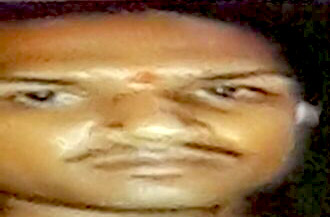
Hizbul Mujahideen Chief Commander Pradeep, who threatened to destroy Mysore arrested

[email protected] (CD Network)
September 27, 2014

Pavan terrorMysore, Sep 27: A 25-year-old anti-national thug, who threatened to destroy Mysore by carrying out bomb blasts during Dasara, was arrested by the police.

The arrested terrorist has been identified as Pradeep, a resident of SIT Extension in Tumkur. It is learnt that he is a BCA student.

Pradeep had sent the e-mail to the office of city Police Commissioner at around 8.27 p.m. on September 21.

The e-mail, sent in the name of'Chief Commander of Hizbul Mujahideen', read: œtargeting Dasara RDX and time bombs fixed in 30 different places in Mysore, save your Mysore .

The city police registered a case under Section 66 (A) and immediately entrusted the investigation to the City Crime Branch. The CCB traced the sender of the e-mail to Tumkur and arrested Pradeep.

Confessing to have sent the mail to the Police Commissioner, Pradeep claimed that he was disgusted over the society and mentally upset and done this.

He was produced before the court and taken into judicial custody. The Commissioner appreciated the work done by the CCB and complemented it for tracing the culprit.

Comments

Jonathan
 - 
Saturday, 12 Mar 2016

I really like your blog.. very nice colors & theme. Did you design this
website yourself or did you hire someone to do it for
you? Plz answer back as I'm looking to construct my own blog and would like to find out where u got this from.
many thanks

Here is my web site :: mayoral: http://www.zjwy360.com/comment/html/?736.html&page=

Add new comment

  • Coastaldigest.com reserves the right to delete or block any comments.
  • Coastaldigset.com is not responsible for its readers’ comments.
  • Comments that are abusive, incendiary or irrelevant are strictly prohibited.
  • Please use a genuine email ID and provide your name to avoid reject.
News Network
January 25,2020

New Delhi, Jan 25: The latest edition of the Oxford Advanced Learner's Dictionary features 26 new Indian English words, including Aadhaar, chawl, dabba, hartal and shaadi.

The 10th edition of the dictionary, which was launched on Friday, has 384 Indian English words and incorporates over 1,000 new words such as chatbot, fake news and microplastic.

The dictionary focuses on language change and its evolution through the years, and has ensured that the language and examples used in the new edition are relevant and up to date with the times, Oxford University Press (OUP) said.

The new edition comes with interactive online support through the Oxford Learner's Dictionaries website and an app. The website includes advanced features such as audio-video tutorials, video walkthroughs, self-study activities and enhanced iWriter and iSpeaker tools.

"This edition has 26 new Indian English words of which 22 figure in the printed dictionary. The other four are in the digital version," said Fathima Dada, Managing Director (Education Division) at OUP.

Some of other new Indian words in the dictionary are auntie (while aunty already figures in the English dictionary, auntie is an Indianism), bus stand, deemed university, FIR, non-veg, redressal, tempo, tube light, veg and videograph.

The four new Indian English words in the online version of the dictionary are current (for electricity), looter, looting and upazila (one of the areas that a district is divided into for administration purposes).

According to OUP, the new edition provides better, more accurate and understandable definitions with examples, usage notes and additional resources to help the learner use the right word in the right context.

"Prevalence and common usage are the main criteria for enlisting new words. We scan the globe for words which are often used by people while speaking English. Then these words go through a rigorous testing process," Dada said.

"As OUP is the custodian of English language globally, these words have to go through its processes," she told PTI.

The Oxford Advanced Learner's Dictionary, she said, has been reinventing itself for nearly eight decades, anticipating the growing learning requirements of learners.

"The 10th edition also is equipped with a strong digital support system, including an app," she said.

It is equipped with several digital tools. With iSpeaker, learners can get help preparing for speaking exams and presentations. With iWriter, learners can plan, write and review their written work. Text Checker allows the teacher to check any text against the Oxford 3000, 5000, and OPAL (Oxford Phrasal Academic Lexicon) written word list.

Resources accessible through online premium access include lesson plans, worksheets, video walkthroughs, and classroom and self-study activities. With the OALD app one can find 86,000 words, 95,000 phrases, 112,000 meanings and 237,000 examples.

The dictionary, which spans 77 years, was originally published in Japan in 1942 and was first brought out by OUP in 1948. The learner's dictionary is based on the original values of its creator, Albert Sydney Hornby, whose aim was to help language learners worldwide understand the meaning of English words.


Comments

Add new comment

  • Coastaldigest.com reserves the right to delete or block any comments.
  • Coastaldigset.com is not responsible for its readers’ comments.
  • Comments that are abusive, incendiary or irrelevant are strictly prohibited.
  • Please use a genuine email ID and provide your name to avoid reject.
News Network
July 4,2020

Bengaluru, Jul 4: Amid the rising COVID-19 cases in the state, the Karnataka COVID-19 Task Force has decided to set up booth-level committees across the state including 8,800 here for effective monitoring and surveillance.

The task force also released detailed guidelines for home isolation for asymptomatic cases including 17 days ''home isolation'' for patients below 50 years of age. It also warned of legal action against those health workers for disrespect to the bodies.

Briefing reporters after the meeting on Friday, Medical Education Minister Dr K Sudhakar said the local management will be strengthened for effective monitoring and surveillance of COVID-19 cases. "There will be booth-level task force committees throughout the state right from the village to Bengaluru.

These task force committees will act at the ultra local level. The task force will act as a structural and functional unit of COVID-19 dealing with monitoring, surveillance, checking of all the ILI cases, ambulances and hospitals," he added.

He also said the committees will comprise one member each from the Health department, police department, municipalities or Panchayat, volunteers, valveman. The committee will have five to six members.

The principal secretary in the Village Development and Panchayat Raj department L K Ateeq has been appointed as the nodal officer to manage the task force in the rural areas whereas in the urban areas, the Urban Development secretary, the municipal administration directors and the municipal commissioner will form the local task force.

"In Bengaluru alone 8,800 teams will be formed, which will be coterminous with the 8,800 booths in the city. They will provide the real-time data. They will be imparted training," the minister added. Noting that there were about 8,800 electoral booths in Bengaluru city and each booth will have a task force committee, he said a nodal officer has been appointed to oversee this.

The state level task force also came out with a slew of conditions. As far as home isolation is concerned, it would apply for patients who are below 50 years and have no symptoms of any other disease, and their homes should have a toilet and have an attendant.

He also said home isolation duration has been increased from 14 to 17 days. "People should not get fever in the next three days after completing 14 days, else they will be quarantined for another seven days. If they don''t get fever then they will be freed to perform their personal activities," Sudhakar said.

Those who are above 50 years and have comorbidities, will be treated at the COVID care centres only and they will be under medical supervision and be subjected to regular tests. The state is also making arrangements for telecommunication for those who are asymptomatic but wish to speak to a doctor.

It was also decided to have at least two ambulances in each of the 198 wards of Bengaluru. The minister said the additional commissioner of police (traffic) will be the nodal officer to coordinate the movement of ambulances. The task force has also appointed a nodal officer to manage the hospitals based on the availability of beds and ventilators. The officer will provide real time information about beds.

"We want to make sure that no one has to run from one hospital to another," Sudhakar said. On the cremation of the bodies, Sudhakar said guidelines have been issued on how to handle bodies at mortuaries, taking them in the ambulances, human treatment to the deceased while performing the last rites and fumigation of the bed. "Legal action will be taken against those who treat bodies in an inhuman way," Sudhakar said.

The state-level task force has also decided to arrange for test reports within 24 hours. It has also been decided to increase the testing capacity from the existing 15,000 a day to 25,000. In view of the spurt in COVID-19 cases, the task force also recommended antigen tests in crowded areas to check whether there was community spread.

To a question on closing down the border, the minister said there is no question of lockdown. "We cannot hide from this disease. It is not a solution. We have to live with it now, yet maintain a distance from it," he added. Sudhakar, who is a doctor himself, said COVID-19 is not as deadly a virus as those he had seen in the past and asked people not to be scared of it.

Comments

Add new comment

  • Coastaldigest.com reserves the right to delete or block any comments.
  • Coastaldigset.com is not responsible for its readers’ comments.
  • Comments that are abusive, incendiary or irrelevant are strictly prohibited.
  • Please use a genuine email ID and provide your name to avoid reject.
News Network
April 18,2020

Bengaluru, Apr 18: The Indian Council of Medical Research has approved 16 laboratories, comprising 11 government and five private laboratories in Karnataka, for testing the samples of COVID-19 suspected cases, the state government said on Saturday.

Meetings and negotiations were held with some private laboratories for conducting COVID-19 sample testing, additional chief secretary (health and family welfare) Jawaid Akhtar said in a circular.

"Based on the negotiations, the cost per test has been fixed at Rs 2,250," the circular read.

These private labs have to abide by the conditions laid down by the state and union governments, it added.

Comments

Add new comment

  • Coastaldigest.com reserves the right to delete or block any comments.
  • Coastaldigset.com is not responsible for its readers’ comments.
  • Comments that are abusive, incendiary or irrelevant are strictly prohibited.
  • Please use a genuine email ID and provide your name to avoid reject.