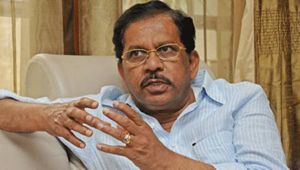
A Dalit leader should become CM of Karnataka, says Parameshwara

[email protected] (CD Network)
April 30, 2016

Hassan, Apr 30: Home Minister and Karnataka Pradesh Congress Committee president G. Parameshwara, on Friday, reiterated that a Dalit leader should become Chief Minister (CM) of the State.

G-ParameshwarSpeaking at the Dr. B.R. Ambedkar's 125th birth anniversary programme organised in Sakleshpur, he said that the demand for a Dalit CM?is only to prove the capability of the deprived class.

“I never said that I should become CM. Either Mallikarjun Kharge, Srinivas Prasad or anyone else should, for that matter,” he said.

The issue of a Dalit leader becoming Chief Minister had been raked up many times in the past.

However, he said, nothing will change at once if a Dalit becomes a CM. However, such a move can be an opportunity for Dalits to show the world that they can govern well too,” Mr. Parameshwara said.

Recalling various incidents in his life, Parameshwara said, “I?am proud of being a Dalit. I took every insult in my life as a challenge and thus attained this status.”

Further, he questioned the rationale behind referring to Dalits as backward classes'. “When will Dalits be taken off the list of backward classes,” he asked.

JD(S) MLA?H?K?Kumaraswamy,?in his presidential address said, except Congress, all political parties in the state have announced their CM?candidate. “I have no faith that a Dalit from JD(S) can become a CM. At the most, I?could become a minister but not the CM,” he said.

Comments

VOX POPULI
 - 
Saturday, 30 Apr 2016

Shame on you, useless creature. Is he begging for the post of CM???
Let him sincerely do the duty which has entrusted to him, rather than grumbling in the name of Dalit? These so called dirt and filth minded politicians are bane to the Natiion. They don't have an iota of dignity? These are like poisonous creatures, which spread their dirty venoms in the society and create hatred amongst the people and politicians. These sort of dirty thugs should be discarded by the like minded civilised citizens of our state and the Great Nation of India, to have a peaceful and cordial relationship among its Gentleman Citizens. Jai Ho., jai Hind. Long Live India and Indians.

raaz
 - 
Saturday, 30 Apr 2016

Go and catch absconded Naresh Shenoy... Mr.Pari moosa

Add new comment

  • Coastaldigest.com reserves the right to delete or block any comments.
  • Coastaldigset.com is not responsible for its readers’ comments.
  • Comments that are abusive, incendiary or irrelevant are strictly prohibited.
  • Please use a genuine email ID and provide your name to avoid reject.
News Network
January 25,2020

New Delhi, Jan 25: The latest edition of the Oxford Advanced Learner's Dictionary features 26 new Indian English words, including Aadhaar, chawl, dabba, hartal and shaadi.

The 10th edition of the dictionary, which was launched on Friday, has 384 Indian English words and incorporates over 1,000 new words such as chatbot, fake news and microplastic.

The dictionary focuses on language change and its evolution through the years, and has ensured that the language and examples used in the new edition are relevant and up to date with the times, Oxford University Press (OUP) said.

The new edition comes with interactive online support through the Oxford Learner's Dictionaries website and an app. The website includes advanced features such as audio-video tutorials, video walkthroughs, self-study activities and enhanced iWriter and iSpeaker tools.

"This edition has 26 new Indian English words of which 22 figure in the printed dictionary. The other four are in the digital version," said Fathima Dada, Managing Director (Education Division) at OUP.

Some of other new Indian words in the dictionary are auntie (while aunty already figures in the English dictionary, auntie is an Indianism), bus stand, deemed university, FIR, non-veg, redressal, tempo, tube light, veg and videograph.

The four new Indian English words in the online version of the dictionary are current (for electricity), looter, looting and upazila (one of the areas that a district is divided into for administration purposes).

According to OUP, the new edition provides better, more accurate and understandable definitions with examples, usage notes and additional resources to help the learner use the right word in the right context.

"Prevalence and common usage are the main criteria for enlisting new words. We scan the globe for words which are often used by people while speaking English. Then these words go through a rigorous testing process," Dada said.

"As OUP is the custodian of English language globally, these words have to go through its processes," she told PTI.

The Oxford Advanced Learner's Dictionary, she said, has been reinventing itself for nearly eight decades, anticipating the growing learning requirements of learners.

"The 10th edition also is equipped with a strong digital support system, including an app," she said.

It is equipped with several digital tools. With iSpeaker, learners can get help preparing for speaking exams and presentations. With iWriter, learners can plan, write and review their written work. Text Checker allows the teacher to check any text against the Oxford 3000, 5000, and OPAL (Oxford Phrasal Academic Lexicon) written word list.

Resources accessible through online premium access include lesson plans, worksheets, video walkthroughs, and classroom and self-study activities. With the OALD app one can find 86,000 words, 95,000 phrases, 112,000 meanings and 237,000 examples.

The dictionary, which spans 77 years, was originally published in Japan in 1942 and was first brought out by OUP in 1948. The learner's dictionary is based on the original values of its creator, Albert Sydney Hornby, whose aim was to help language learners worldwide understand the meaning of English words.


Comments

Add new comment

  • Coastaldigest.com reserves the right to delete or block any comments.
  • Coastaldigset.com is not responsible for its readers’ comments.
  • Comments that are abusive, incendiary or irrelevant are strictly prohibited.
  • Please use a genuine email ID and provide your name to avoid reject.
News Network
April 8,2020

Bengaluru, Apr 8: Heavy rain lashed Belthangady taluk in Dakshina Kannada district and parts of Udupi district on Tuesday providing much-needed relief to the people from the sultry heat.

Belthangady, Guruvayanakere, Madantyaru, Venoor, Naravi and surrounding areas received rain coupled with lightning and thunder. 

Rain also lashed Karkala, Kundapura, Kollur, Siddapura, Gangolli, Hemmady, Uppunda, Shiroor, Hebri and surrounding areas in Udupi district.

Parts of Malnad --- Koppa, Balehonnur and NR Pura taluks in the neighbouring Chikkamagaluru district --- received good rainfall coupled with lightning and thunder.

The rain has brought a smile on the face of coffee growers as it will help in the blossoming of the flowers in coffee plants.

In Kodagu district, heavy rain lashed Madikeri, Hudikeri, Ponnampet, Srimangala, Siddapura, Galiubeedu, Bapoklu, Talacauvery and Bhagamandala.

Parts of Mysuru city and district, Chamarajanagar, and Hassan received a good spell of rain on Monday night, bringing down the mercury levels.

Heavy rain lashed T Narasipur taluk in Mysuru district and the Kothegala Gram panchayat limits received 7 cm rainfall. Karya village in Nanjangud taluk received 5 cm rainfall.

Male Mahadeshwara Hills in Chamarajanagar district received good rain in the evening. 

Meanwhile, the Agriculture Research Station at Naganahalli has predicted thunderstorms, on April 7 and 8 in the region. The research centre recorded 12 mm rain on Sunday night and 22.5 mm on Monday midnight. 

Moderate to heavy rain, accompanied by strong wind and lightning, lashed some parts of Shivamogga district, including Ripponpet, Sorab, Bhadravathi, Thirthahalli, Sagar
and Shikariput. 

Bhatkal in Uttara Kannada district received heavy rain from 4 to 7 pm. The town had also received the rain for about half-an-hour in the morning.

Hosapete town and the surrounding villages also received the rain. At some places, the rain brought down the branches of the trees. The rain has cooled the mercury level at Hosur, Nagenahalli, Basavadurga, Kamalapur, Hampi and other villages in Hosapete taluk. 

Rain also lashed several places in Ballari district, including the Ballari city. Rain, accompanied by hailstones, brought cheers to the people at Kottur. 

Meanwhile, rain and hailstones have destroyed the standing paddy crop in hundreds of acres of land at Maraladinni, Katagal, Uskihal, Belladamaradi and other villages in Maski taluk of Raichur. The farmers are waiting to harvest the crop.

Comments

Add new comment

  • Coastaldigest.com reserves the right to delete or block any comments.
  • Coastaldigset.com is not responsible for its readers’ comments.
  • Comments that are abusive, incendiary or irrelevant are strictly prohibited.
  • Please use a genuine email ID and provide your name to avoid reject.
Ram Puniyani
February 10,2020

Noam Chomsky is one of the leading peace workers in the world. In the wake of America’s attack on Vietnam, he brought out his classic formulation, ‘manufacturing consent’. The phrase explains the state manipulating public opinion to have the public approve of it policies—in this case, the attack of the American state on Vietnam, which was then struggling to free itself from French colonial rule.

In India, we are witness to manufactured hate against religious minorities. This hatred serves to enhance polarisation in society, which undermines India’s democracy and Constitution and promotes support for a Hindu nation. Hate is being manufactured through multiple mechanisms. For example, it manifests in violence against religious minorities. Some recent ghastly expressions of this manufactured hate was the massive communal violence witnessed in Mumbai (1992-93), Gujarat (2002), Kandhamal (2008) and Muzaffarnagar (2013). Its other manifestation was in the form of lynching of those accused of having killed a cow or consumed beef. A parallel phenomenon is the brutal flogging, often to death, of Dalits who deal with animal carcasses or leather.

Yet another form of this was seen when Shambhulal Regar, indoctrinated by the propaganda of Hindu nationalists, burned alive Afrazul Khan and shot the video of the heinous act. For his brutality, he was praised by many. Regar was incited into the act by the propaganda around love jihad. Lately, we have the same phenomenon of manufactured hate taking on even more dastardly proportions as youth related to Hindu nationalist organisations have been caught using pistols, while police authorities look on.

Anurag Thakur, a BJP minster in the central government recently incited a crowd in Delhi to complete his chant of what should happen to ‘traitors of the country...” with a “they should be shot”. Just two days later, a youth brought a pistol to the site of a protest at Jamia Millia Islamia university and shouted “take Azaadi!” and fired it. One bullet hit a student of Jamia. This happened on 30 January, the day Nathuram Godse had shot Mahatma Gandhi in 1948. A few days later, another youth fired near the site of protests against the CAA and NRC at Shaheen Bagh. Soon after, he said that in India, “only Hindus will rule”.

What is very obvious is that the shootings by those associated with Hindu nationalist organisations are the culmination of a long campaign of spreading hate against religious minorities in India in general and against Muslims in particular. The present phase is the outcome of a long and sustained hate campaign, the beginning of which lies in nationalism in the name of religion; Muslim nationalism and Hindu nationalism. This sectarian nationalism picked up the communal view of history and the communal historiography which the British introduced in order to pursue their ‘divide and rule’ policy.

In India what became part of “social common sense” was that Muslim kings had destroyed Hindu temples, that Islam was spread by force, and that it is a foreign religion, and so on. Campaigns, such as the one for a temple dedicated to the Hindu god Rama to be built at the site where the Babri masjid once stood, further deepened the idea of a Muslim as a “temple-destroyer”. Aurangzeb, Tipu Sultan and other Muslim kings were tarnished as the ones who spread Islam by force in the subcontinent. The tragic Partition, which was primarily due to British policies, and was well-supported by communal streams also, was entirely attributed to Muslims. The Kashmir conflict, which is the outcome of regional, ethnic and other historical issues, coupled with the American policy of supporting Pakistan’s ambitions of regional hegemony, (which also fostered the birth of Al-Qaeda), was also attributed to the Muslims.

With recurring incidents of communal violence, these falsehoods went on going deeper into the social thinking. Violence itself led to ghettoisation of Muslims and further broke inter-community social bonds. On the one hand, a ghettoised community is cut off from others and on the other hand the victims come to be presented as culprits. The percolation of this hate through word-of-mouth propaganda, media and re-writing of school curricula, had a strong impact on social attitudes towards the minorities.

In the last couple of decades, the process of manufacturing hate has been intensified by the social media platforms which are being cleverly used by the communal forces. Swati Chaturvedi’s book, I Am a Troll: Inside the Secret World of the BJP’s Digital Army, tells us how the BJP used social media to spread hate. Whatapp University became the source of understanding for large sections of society and hate for the ‘Other’, went up by leaps and bounds. To add on to this process, the phenomenon of fake news was shrewdly deployed to intensify divisiveness.

Currently, the Shaheen Bagh movement is a big uniting force for the country; but it is being demonised as a gathering of ‘anti-nationals’. Another BJP leader has said that these protesters will indulge in crimes like rape. This has intensified the prevalent hate.

While there is a general dominance of hate, the likes of Shambhulal Regar and the Jamia shooter do get taken in by the incitement and act out the violence that is constantly hinted at. The deeper issue involved is the prevalence of hate, misconceptions and biases, which have become the part of social thinking.

These misconceptions are undoing the amity between different religious communities which was built during the freedom movement. They are undoing the fraternity which emerged with the process of India as a nation in the making. The processes which brought these communities together broadly drew from Gandhi, Bhagat Singh and Ambedkar. It is these values which need to be rooted again in the society. The communal forces have resorted to false propaganda against the minorities, and that needs to be undone with sincerity.

Combating those foundational misconceptions which create hatred is a massive task which needs to be taken up by the social organisations and political parties which have faith in the Indian Constitution and values of freedom movement. It needs to be done right away as a priority issue in with a focus on cultivating Indian fraternity yet again.

Comments

Add new comment

  • Coastaldigest.com reserves the right to delete or block any comments.
  • Coastaldigset.com is not responsible for its readers’ comments.
  • Comments that are abusive, incendiary or irrelevant are strictly prohibited.
  • Please use a genuine email ID and provide your name to avoid reject.