


India tops global slavery index with 18.35 mn people enslaved

May 31, 2016

Melbourne, May 31: India has the dubious distinction of having the highest number of people in the world trapped in modern slavery with 18.35 million victims of forced labour, ranging from prostitution and begging, according to a new report, which estimated that nearly 46 million people are enslaved globally.
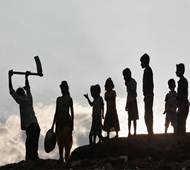
slavery copy copyAccording to the 2016 Global Slavery Index released by Australia-based human rights group Walk Free Foundation today, an estimated 45.8 million people, including women and children, are subject to some form of modern slavery in the world, compared to 35.8 million in 2014.

The report said India has the highest absolute numbers of people trapped in slavery with 18.35 million slaves among its 1.3 billion population while North Korea has the highest incidence (4.37 per cent of the population) and the weakest government response to deal with it.

In the last report in 2014, India had nearly 14.3 million people enslaved.
Incidences of slavery were found in all 167 countries in the index, with Asian countries occupy the top five for people trapped in slavery.

Behind India was China (3.39 million), Pakistan (2.13 million), Bangladesh (1.53 million) and Uzbekistan (1.23 million).

The index said that these five countries combined accounted for almost 58 per cent of the world's enslaved, or 26.6 million people.

The Index presents a ranking of 167 countries based on the proportion of the population that is estimated to be in modern slavery.

Modern slavery refers to situations of exploitation that a person cannot leave because of threats, violence, coercion, abuse of power or deception.

The research included over 42,000 interviews conducted in 53 languages across 25 countries, including 15 state-level surveys in India. These representative surveys covered 44 per cent of the global population.

The countries with the highest estimated prevalence of modern slavery by the proportion of their population are North Korea, Uzbekistan, Cambodia, Cambodia, India, and Qatar.

The countries with the lowest estimated prevalence of modern slavery by the proportion of their population are Luxembourg, Ireland, Norway, Denmark, Switzerland, Austria, Sweden and Belgium, the United States and Canada, and Australia and New Zealand.

The study also tracked the government actions and responses to the modern slavery and of the 161 assessed, 124 nations had criminalised human trafficking in line with the UN trafficking Protocol and 96 nations had developed national action plans to coordinate government response.

It noted that while India had more people enslaved than any other country, it had made significant progress in introducing measures to tackle the problem.

"It has criminalised trafficking, slavery, forced labour, child prostitution and forced marriage. The Indian government is currently tightening legislation against human trafficking, with tougher punishment for repeat offenders. It will offer victims protection and recovery support," it said.

It said that in addition to economic growth in India, ambitious programmes of legal and social reform are being undertaken right across the board, from regulation of labour relations to systems of social insurance for the most vulnerable.

Those governments taking the least action to combat modern slavery are North Korea, Iran, Eritrea, Equatorial Guinea, Hong Kong, Central African Republic, Papua New Guinea, Guinea, the Democratic Republic of the Congo and South Sudan.

The governments that have the strongest response to modern slavery are The Netherlands, the United States of America, the United Kingdom, Sweden, Australia, Portugal, Croatia, Spain, Belgium and Norway.

Seeking strong laws to abolish slavery, Andrew Forrest, Chairman and Founder of Walk Free Foundation, said eradicating slavery makes sense, morally, politically, logically and economically, and called on the governments of the world's leading economies to provide an example to others by enacting and implementing robust anti-slavery measures.

"We call on governments of the top 10 economies of the world to enact laws, at least as strong as the UK Modern Slavery Act 2015, with a budget and capability to ensure organisations are held to account for modern slavery in their supply chains, and to empower independent oversight."

Forrest said leaders of the world's major economies must bring the power of business to this issue, by requiring a focus on supply chain transparency.

"I believe in the critical role of leaders in government, business and civil society. Through our responsible use of power, strength of conviction, determination and collective will, we all can lead the world to end slavery," he said.

Forrest emphasised the key role that business needs to play in eradicating slavery.

"Businesses that don't actively look for forced labour within their supply chains are standing on a burning platform. Business leaders who refuse to look into the realities of their own supply chains are misguided and irresponsible," he said.

Comments

SK
 - 
Thursday, 2 Jun 2016

Since India is facing slavery, Naren has run away to Singapore to enjoy snake/ dog/cat/beef dishes......

Naren kotian
 - 
Tuesday, 31 May 2016

In that mostly 75% are from Muslim community as they enslave women as per their cult following .they have not changed since 6th century ...che papa ...ummah gang ge pitta netti geriruthe ..feku Anthe kumda ...for Muslims he might be feku ..but for nationalist Indians he is true hero who is transforming India .

Add new comment

  • Coastaldigest.com reserves the right to delete or block any comments.
  • Coastaldigset.com is not responsible for its readers’ comments.
  • Comments that are abusive, incendiary or irrelevant are strictly prohibited.
  • Please use a genuine email ID and provide your name to avoid reject.
News Network
June 5,2020

Bengaluru, Jun 5: Karnataka Chief Minister B S Yediyurappa on Thursday said government employees and owners of tractors and other vehicles must return the BPL ration cards immediately, failing which stringent legal action would be initiated against them.

The CM issued directions in this regard to officials as he conducted a review meeting of the Food and Civil Supplies and Consumer Affairs department today. Proper supply of ration must be ensured to eligible beneficiaries and action has to be taken to prevent misuse of the facility by those not eligible, Yediyurappa was quoted as saying by his office in a release.

Nearly 63,000 ration cards were cancelled before the COVID-19 outbreak, he noted and directed officials to initiate a campaign to cancel all illegal ration cards. "this campaign would help in curtailing the financial burden on the State's reserves," he added.

In the backdrop of coronavirus pandemic, both the Central and State governments have distributed sufficient quantities of ration, and about 95 percent ration cardholders have availed the benefit, the release said. Under the Chief Ministers Anila Bhagya Scheme, 98,079 beneficiaries have been given 3 gas cylinders free of cost, it said.

Comments

Add new comment

  • Coastaldigest.com reserves the right to delete or block any comments.
  • Coastaldigset.com is not responsible for its readers’ comments.
  • Comments that are abusive, incendiary or irrelevant are strictly prohibited.
  • Please use a genuine email ID and provide your name to avoid reject.
News Network
April 23,2020

Mangaluru, Apr 23: An astronomical phenomenon, ‘Zero Shadow Day', will be observed in Mangaluru on April 24 and in Udupi on April 25. 

According to a press release from Poornaprajna Amateur Astronomers’ Club, the wonder will commence and people will see their shadows disappear for a few moments at 12:28 pm.

The phenomenon is called as Zero Shadow Day. If a person takes a candle in a dark room and use it to create a shadow of one’s palm on the wall, the hand will cast shadow on the wall as one moves the hand. But when one places the palm on the wall, there will be no shadow.

In the phenomenon, the sun at these times shines exactly above the heads on these days. In astronomy, this point is called as Zenith. The point in the sky directly above an observer at any given location. So it is quite clear now that on Zero Shadow Day, the sun passes through the Zenith as a result of which, all objects will have minimal or no shadow if they are on the ground.

The reason for this happens on some specific days is concerned with astronomy. The earth spins around on its own axis and causes days and nights. It also revolves around the sun causing a year. But the seasons are caused because the axis is tilted at an angle of 23.5 degrees. It is because of this tilt that the sun rises every day in the east gradually moving towards the north till June 21st and then slowly proceeding towards the south till December 21st every year. “We call these days solstice. This means the sun shines between the Tropic of Cancer and Tropic of Capricorn every day passing by the equator on the days we call equinox,” the release stated.

As the earth moves around the sun and revolves on its own axis, for all the people between Tropic of Cancer and Tropic of Capricorn, the Sun at noon moves father and closer to the zenith passing through zenith twice causing two Zero Shadow Days per year. People at Mangaluru will observe this on April 24 and August 18 every year and People in Udupi will observe this on April 25 and August 17 every year.

Places with same latitudes will observe the same days of Zero Shadow but the time would vary with longitude. For example, people of Bengaluru as they share the latitude with Mangaluru will also observe it on April 24. While the people of Mangaluru will observe their shadows disappear at 12.28pm, people of Bengaluru will observe this at 12:17pm. Places like Moodabidri, Bantwal, Sakleshpur and Hassan will also observe Zero Shadow on April 24.

Places like Brahmavar, Karkala, Sringeri, Kudremukha, Chikkamagaluru will observe the Zero Shadow Day on the same day as Udupi on April 25.

Comments

Add new comment

  • Coastaldigest.com reserves the right to delete or block any comments.
  • Coastaldigset.com is not responsible for its readers’ comments.
  • Comments that are abusive, incendiary or irrelevant are strictly prohibited.
  • Please use a genuine email ID and provide your name to avoid reject.
News Network
May 21,2020

Mangaluru, May 21: The Supreme Court has awarded Rs 7.64 crore compensation to the next of kin of a man who was killed in a crash-landing of Air India Express Flight 812 from Dubai in Mangalore on May 22, 2010. The accident killed 158 out of 166 passengers on board.

The family of the 45-year-old Mahendra Kodkany, which include his wife, daughter and son, were earlier granted Rs 7.35 crore as compensation by National Consumer Disputes Redressal Commission (NCDRC). This compensation will now get enhanced after adding 9 per cent interest per annum (on the amount yet to be paid), to be paid by Air India.

Kodkany was the regional director for the Middle East for a UAE-based company. The aircraft overshot the runway and went down a hillside and burst into flames.

A bench comprising Justices D.Y. Chandrachud and Ajay Rastogi said: "The total amount payable on account of the aforesaid heads works out to Rs 7,64,29,437. Interest at the rate of nine per cent per annum shall be paid on the same basis as has been awarded by the NCDRC. The balance, if any, that remains due and payable to the complainants, after giving due credit for the amount which has already been paid, shall be paid within a period of two months."

The apex court noted that in a claim for compensation arising out of the death of an employee, the income has to be assessed on the basis of the entitlement of the employee. The top court said: "We are unable to accept the reasons which weighed with the NCDRC in making a deduction of AED (UAE currency) 30,000 from the total CTC. Similarly, and for the same reason, we are unable to accept the submission of Air India that the transport allowance should be excluded. The bifurcation of the salary into diverse heads may be made by the employer for a variety of reasons."

The top court observed that the deceased was evidently, a confirmed employee of his employer. "We have come to the conclusion that thirty per cent should be allowed on account of future prospects", added the court.

The top court noted that if the amount which has been paid by Air India is in excess of the payable under the present judgement, "we direct under Article 142 of the Constitution (discretionary powers) that the excess shall not be recoverable from the claimants," said the court.

Comments

A.Rahman
 - 
Friday, 22 May 2020

First of all  A Salute To Lawyer One Who Handled This Case Against Carriers Mismanagement Wrong Action.


Sure this is the second victory for the lawyer against arriers mismanagement.


Over all it is the sign  of a profesional ; qualified  eligble  lawyers efforts and right decision from a capable knowlegable judge. Suit case operating lawyers cannot handle such specilized cases.

They lawyer may handled rest of the vicitms cases or he not. But for his siincere efforts for the past ten years delcares whatn he  is. Am personally met him and  witnessed his court appearance  hope and wish him all the best and success .


Add new comment

  • Coastaldigest.com reserves the right to delete or block any comments.
  • Coastaldigset.com is not responsible for its readers’ comments.
  • Comments that are abusive, incendiary or irrelevant are strictly prohibited.
  • Please use a genuine email ID and provide your name to avoid reject.