


India tops global slavery index with 18.35 mn people enslaved

May 31, 2016

Melbourne, May 31: India has the dubious distinction of having the highest number of people in the world trapped in modern slavery with 18.35 million victims of forced labour, ranging from prostitution and begging, according to a new report, which estimated that nearly 46 million people are enslaved globally.
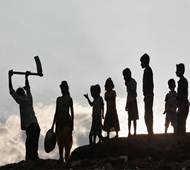
slavery copy copyAccording to the 2016 Global Slavery Index released by Australia-based human rights group Walk Free Foundation today, an estimated 45.8 million people, including women and children, are subject to some form of modern slavery in the world, compared to 35.8 million in 2014.

The report said India has the highest absolute numbers of people trapped in slavery with 18.35 million slaves among its 1.3 billion population while North Korea has the highest incidence (4.37 per cent of the population) and the weakest government response to deal with it.

In the last report in 2014, India had nearly 14.3 million people enslaved.
Incidences of slavery were found in all 167 countries in the index, with Asian countries occupy the top five for people trapped in slavery.

Behind India was China (3.39 million), Pakistan (2.13 million), Bangladesh (1.53 million) and Uzbekistan (1.23 million).

The index said that these five countries combined accounted for almost 58 per cent of the world's enslaved, or 26.6 million people.

The Index presents a ranking of 167 countries based on the proportion of the population that is estimated to be in modern slavery.

Modern slavery refers to situations of exploitation that a person cannot leave because of threats, violence, coercion, abuse of power or deception.

The research included over 42,000 interviews conducted in 53 languages across 25 countries, including 15 state-level surveys in India. These representative surveys covered 44 per cent of the global population.

The countries with the highest estimated prevalence of modern slavery by the proportion of their population are North Korea, Uzbekistan, Cambodia, Cambodia, India, and Qatar.

The countries with the lowest estimated prevalence of modern slavery by the proportion of their population are Luxembourg, Ireland, Norway, Denmark, Switzerland, Austria, Sweden and Belgium, the United States and Canada, and Australia and New Zealand.

The study also tracked the government actions and responses to the modern slavery and of the 161 assessed, 124 nations had criminalised human trafficking in line with the UN trafficking Protocol and 96 nations had developed national action plans to coordinate government response.

It noted that while India had more people enslaved than any other country, it had made significant progress in introducing measures to tackle the problem.

"It has criminalised trafficking, slavery, forced labour, child prostitution and forced marriage. The Indian government is currently tightening legislation against human trafficking, with tougher punishment for repeat offenders. It will offer victims protection and recovery support," it said.

It said that in addition to economic growth in India, ambitious programmes of legal and social reform are being undertaken right across the board, from regulation of labour relations to systems of social insurance for the most vulnerable.

Those governments taking the least action to combat modern slavery are North Korea, Iran, Eritrea, Equatorial Guinea, Hong Kong, Central African Republic, Papua New Guinea, Guinea, the Democratic Republic of the Congo and South Sudan.

The governments that have the strongest response to modern slavery are The Netherlands, the United States of America, the United Kingdom, Sweden, Australia, Portugal, Croatia, Spain, Belgium and Norway.

Seeking strong laws to abolish slavery, Andrew Forrest, Chairman and Founder of Walk Free Foundation, said eradicating slavery makes sense, morally, politically, logically and economically, and called on the governments of the world's leading economies to provide an example to others by enacting and implementing robust anti-slavery measures.

"We call on governments of the top 10 economies of the world to enact laws, at least as strong as the UK Modern Slavery Act 2015, with a budget and capability to ensure organisations are held to account for modern slavery in their supply chains, and to empower independent oversight."

Forrest said leaders of the world's major economies must bring the power of business to this issue, by requiring a focus on supply chain transparency.

"I believe in the critical role of leaders in government, business and civil society. Through our responsible use of power, strength of conviction, determination and collective will, we all can lead the world to end slavery," he said.

Forrest emphasised the key role that business needs to play in eradicating slavery.

"Businesses that don't actively look for forced labour within their supply chains are standing on a burning platform. Business leaders who refuse to look into the realities of their own supply chains are misguided and irresponsible," he said.

Comments

SK
 - 
Thursday, 2 Jun 2016

Since India is facing slavery, Naren has run away to Singapore to enjoy snake/ dog/cat/beef dishes......

Naren kotian
 - 
Tuesday, 31 May 2016

In that mostly 75% are from Muslim community as they enslave women as per their cult following .they have not changed since 6th century ...che papa ...ummah gang ge pitta netti geriruthe ..feku Anthe kumda ...for Muslims he might be feku ..but for nationalist Indians he is true hero who is transforming India .

Add new comment

  • Coastaldigest.com reserves the right to delete or block any comments.
  • Coastaldigset.com is not responsible for its readers’ comments.
  • Comments that are abusive, incendiary or irrelevant are strictly prohibited.
  • Please use a genuine email ID and provide your name to avoid reject.
News Network
May 3,2020

Bengaluru, May 3: Erection of barricades and drawing up of boxes or circles aimed at maintaining social distancing were seen in front of liquor shops in different parts of Karnataka on Sunday, a day ahead of their reopening after a gap of over 40-days, due to the lockdown.

Karnataka Excise Commissioner on Saturday had ordered that only CL-2 (retail shops) and CL-11C (state-run retail shops like Mysore Sales International Limited) would open from May 4.

It had permitted liquor sale liquor between 9 am and 7 pm only in areas that are outside COVID-19 containment zones.

Reports of barricades being erected to ensure that people stand in line and drawing of boxes or circles in front of shops to maintain social distancing in front of retail and MSIL shops have emerged from across the state, including the state capital.

Also reports about shop keepers doing special poojas outside liquor shops in Kolar and some even illuminating their outlets with lights from outside have surfaced from other parts of the state.

Meanwhile, officials were engaged in checking stocks ahead of the shops opening on Monday morning.

"We are making all preparations to ensure that government rules are followed. We also seek the cooperation of the people and police," the manager of a shop said.

Another said there may be a rush initially, after which things may get back to normal.

"We expect things to go on smoothly," he added.

Calling for number of customers to be limited to five at a time while ensuring that they maintain social distancing of not less than six feet distance, the order states that customers and the staff will have to wear masks and sanitizers should be used at the shops.

Only stand alone CL-2 and CL-11C shops are allowed to commence liquor sale and not those at malls and super markets, it said.

Officials in Bengaluru said liquor sale is prohibited in 26 containment zones in the city, while in other places rules that have been prescribed need to be followed.

In case of any violation, strict action would be taken, including imposing of penalty, they said.

There was pressure on the government to kick start economic activities, including allowing sale of liquor, to boost the state's finances as excise is the key area which generates revenue.

State Excise Minister H Nagesh had recently pegged the losses at Rs 60 crore per day because of closure of liquor shops, due to the lockdown.

Comments

Add new comment

  • Coastaldigest.com reserves the right to delete or block any comments.
  • Coastaldigset.com is not responsible for its readers’ comments.
  • Comments that are abusive, incendiary or irrelevant are strictly prohibited.
  • Please use a genuine email ID and provide your name to avoid reject.
coastaldigest.com news network
July 18,2020

Mangaluru, Jul 18: Days after Air India operated a flight from Qatar to Mangaluru,  the Karnataka Cultural Foundation (KCF) chartered a flight from Doha to this coastal city to repatriate the stranded NRIs. The flight landed at Mangaluru International Airport on July 16.

This KCF operated flight left the Hamad International Airport Doha at 9:35 am and reached Mangaluru international Airport at 16:10 pm on Thursday. 

The flight had over 174 NRIs, included pregnant women, patients in need of urgent medical treatment, senior citizens, and those who were stuck with expired visit visa and job loss. With the timely intervention Dr Arathi Krishna has helped a patient to make his approval from embassy, who had to leave for medical treatment on emergency basis.

Starting from the registration of travellers, KCF has provided all with the necessary documental, health-related information and each of them have been met by KCF representatives along with snacks and PPE kit to be worn during the journey as a precaution against the spread of the pandemic. 

Organization workers were constantly in touch with each of its passengers, supporting them for their safety and serve them during journey and stay at the hotels and this will continue until the quarantine is completed.

KCF, the proud organization of Kannadigas has been working in the public sphere, and this initiative of charter flight and their dedication on this have been praised by travellers.

On their successful charter, KCF thanks Dr Arathi Krishna, former vice-chairman of Karnataka State NRI Forum for her extensive support on acquiring relevant documental clearances. Sindhu B Rupesh, the deputy commissioner of Mangaluru, Dr Yathish Ullal, assistant commissioner of Mangaluru, Meena Nagaraj, the nodal officer, Bengaluru, are also praised for their timely approvals and permissions for this charter.

The untiring efforts, hard works by the workers and leaders of SSF, SYS and Karnataka Muslim Jama-ath have been appreciated and background supports by Moulana Shafi Sa-adi, the member of Karnataka state Waqf Board is also remembered by KCF Qatar.

The members of KCF Qatar have been tirelessly working behind this grand success, the chairman Abdul Raheem Saadi and general convener Muneer Magundi have thanked all its members, including Embassy officials and Indigo Airlines for all cooperation.

Comments

Shamshuddin Mohammed
 - 
Sunday, 19 Jul 2020

Mask use for covid19 they use as tie

Add new comment

  • Coastaldigest.com reserves the right to delete or block any comments.
  • Coastaldigset.com is not responsible for its readers’ comments.
  • Comments that are abusive, incendiary or irrelevant are strictly prohibited.
  • Please use a genuine email ID and provide your name to avoid reject.
News Network
March 6,2020

Bengaluru, Mar 6: In the face of unprecedented economic difficulties, Chief Minister B S Yediyurappa has chosen to hike the prices of fuel and liquor to fund development in his 2020-21 Budget, which tries to offer something for everybody with the available resources.

Yediyurappa announced a 3% hike in the rate of tax on petrol and diesel. This will result in the prices of petrol going up by Rs 1.60 per litre and diesel by Rs 1.59 per litre. This is expected to fetch the government Rs 1,500 crore.

By hiking additional excise duty on Indian Made Liquor (IML) by 6%, the government hopes to mop up Rs 1,200 crore.

In essence, Yediyurappa, the finance minister, pointed fingers at the Centre for the state’s fiscal woes. He said Karnataka’s share in Central taxes has come down this fiscal by Rs 8,887 crore. Plus, Rs 3,000 crore GST compensation will also be reduced as collections from the GST cess are not on expected lines, he said in his Budget speech. 

“It has become difficult to reach the 2019-20 Budget targets due to these reasons. To manage this situation within the bounds of the Karnataka Fiscal Responsibility Act, it has become inevitable this year to cut down the expenditure of many departments,” he said.

Under the 15th Finance Commission, Karnataka will see a reduction of Rs 11,215 crore in the state’s share of central taxes in 2020-21, Yediyurappa said. He also pointed out that expenditure on salaries, pensions and loan interest payments had risen by Rs 10,000 crore. “Serious difficulties are being faced in resource mobilisation efforts of the state. The state never faced economic difficulties of this magnitude in the previous years,” he said.

But in an attempt to please all, Yediyurappa made announcements across sectors and communities. Instead of the usual department-wise announcements, the CM chose to divide the Budget into six sectors: agriculture & allied activities; welfare & inclusive growth; stimulating economic growth; Bengaluru development; culture, heritage & natural resources and administrative reforms & public service delivery.

Farmers will get additional incentives under PM-KISAN costing Rs 2,600 crore and a waiver of interest on loans they have borrowed from cooperative banks worth Rs 466 crore.

The CM has earmarked Rs 500 crore to start work on the Kalasa-Banduri canals under the Mahadayi project. Also, Yediyurappa has given Rs 1,500 crore to commission the Yettinahole drinking water project.

This project will cater to the districts of Hassan, Chikkamagaluru, Tumakuru, Bengaluru Rural, Ramanagara, Chikkaballapur and Kolar.

For Bengaluru, the CM has made an allocation of Rs 8,772 crore. This includes Rs 500 crore for the suburban rail project, an electric bike taxi project and bus priority lanes.

Significantly, Yediyurappa has not made any allocation to mutts. However, the government will spend Rs 100 crore on the Anubhava Mantapa at Basavakalyan, Rs 66 crore for a 100 ft Kempegowda statue in Bengaluru and Rs 20 crore on a 325 ft statue of Basavanna at the Murugha Mutt in Chitradurga.

The CM has given Rs 305 crore for the development of various communities — Christians (Rs 200 crore), Upparas (Rs 10 crore), Vishwakarma (Rs 25 crore), Ambigara Chaudaiah (Rs 50 crore), Arya Vysya (Rs 10 crore) and Kumbara (Rs 10 crore).

Also, nearly 22.5 lakh government employees and their dependents will get cashless treatment facility for surgical treatment procedures at an estimated annual cost of Rs 50 crore under the Jyothi Sanjini scheme, the CM said.

Comments

Add new comment

  • Coastaldigest.com reserves the right to delete or block any comments.
  • Coastaldigset.com is not responsible for its readers’ comments.
  • Comments that are abusive, incendiary or irrelevant are strictly prohibited.
  • Please use a genuine email ID and provide your name to avoid reject.