


India tops global slavery index with 18.35 mn people enslaved

May 31, 2016

Melbourne, May 31: India has the dubious distinction of having the highest number of people in the world trapped in modern slavery with 18.35 million victims of forced labour, ranging from prostitution and begging, according to a new report, which estimated that nearly 46 million people are enslaved globally.
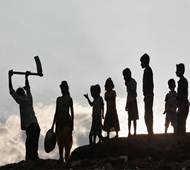
slavery copy copyAccording to the 2016 Global Slavery Index released by Australia-based human rights group Walk Free Foundation today, an estimated 45.8 million people, including women and children, are subject to some form of modern slavery in the world, compared to 35.8 million in 2014.

The report said India has the highest absolute numbers of people trapped in slavery with 18.35 million slaves among its 1.3 billion population while North Korea has the highest incidence (4.37 per cent of the population) and the weakest government response to deal with it.

In the last report in 2014, India had nearly 14.3 million people enslaved.
Incidences of slavery were found in all 167 countries in the index, with Asian countries occupy the top five for people trapped in slavery.

Behind India was China (3.39 million), Pakistan (2.13 million), Bangladesh (1.53 million) and Uzbekistan (1.23 million).

The index said that these five countries combined accounted for almost 58 per cent of the world's enslaved, or 26.6 million people.

The Index presents a ranking of 167 countries based on the proportion of the population that is estimated to be in modern slavery.

Modern slavery refers to situations of exploitation that a person cannot leave because of threats, violence, coercion, abuse of power or deception.

The research included over 42,000 interviews conducted in 53 languages across 25 countries, including 15 state-level surveys in India. These representative surveys covered 44 per cent of the global population.

The countries with the highest estimated prevalence of modern slavery by the proportion of their population are North Korea, Uzbekistan, Cambodia, Cambodia, India, and Qatar.

The countries with the lowest estimated prevalence of modern slavery by the proportion of their population are Luxembourg, Ireland, Norway, Denmark, Switzerland, Austria, Sweden and Belgium, the United States and Canada, and Australia and New Zealand.

The study also tracked the government actions and responses to the modern slavery and of the 161 assessed, 124 nations had criminalised human trafficking in line with the UN trafficking Protocol and 96 nations had developed national action plans to coordinate government response.

It noted that while India had more people enslaved than any other country, it had made significant progress in introducing measures to tackle the problem.

"It has criminalised trafficking, slavery, forced labour, child prostitution and forced marriage. The Indian government is currently tightening legislation against human trafficking, with tougher punishment for repeat offenders. It will offer victims protection and recovery support," it said.

It said that in addition to economic growth in India, ambitious programmes of legal and social reform are being undertaken right across the board, from regulation of labour relations to systems of social insurance for the most vulnerable.

Those governments taking the least action to combat modern slavery are North Korea, Iran, Eritrea, Equatorial Guinea, Hong Kong, Central African Republic, Papua New Guinea, Guinea, the Democratic Republic of the Congo and South Sudan.

The governments that have the strongest response to modern slavery are The Netherlands, the United States of America, the United Kingdom, Sweden, Australia, Portugal, Croatia, Spain, Belgium and Norway.

Seeking strong laws to abolish slavery, Andrew Forrest, Chairman and Founder of Walk Free Foundation, said eradicating slavery makes sense, morally, politically, logically and economically, and called on the governments of the world's leading economies to provide an example to others by enacting and implementing robust anti-slavery measures.

"We call on governments of the top 10 economies of the world to enact laws, at least as strong as the UK Modern Slavery Act 2015, with a budget and capability to ensure organisations are held to account for modern slavery in their supply chains, and to empower independent oversight."

Forrest said leaders of the world's major economies must bring the power of business to this issue, by requiring a focus on supply chain transparency.

"I believe in the critical role of leaders in government, business and civil society. Through our responsible use of power, strength of conviction, determination and collective will, we all can lead the world to end slavery," he said.

Forrest emphasised the key role that business needs to play in eradicating slavery.

"Businesses that don't actively look for forced labour within their supply chains are standing on a burning platform. Business leaders who refuse to look into the realities of their own supply chains are misguided and irresponsible," he said.

Comments

SK
 - 
Thursday, 2 Jun 2016

Since India is facing slavery, Naren has run away to Singapore to enjoy snake/ dog/cat/beef dishes......

Naren kotian
 - 
Tuesday, 31 May 2016

In that mostly 75% are from Muslim community as they enslave women as per their cult following .they have not changed since 6th century ...che papa ...ummah gang ge pitta netti geriruthe ..feku Anthe kumda ...for Muslims he might be feku ..but for nationalist Indians he is true hero who is transforming India .

Add new comment

  • Coastaldigest.com reserves the right to delete or block any comments.
  • Coastaldigset.com is not responsible for its readers’ comments.
  • Comments that are abusive, incendiary or irrelevant are strictly prohibited.
  • Please use a genuine email ID and provide your name to avoid reject.
News Network
January 30,2020

Hubballi, Jan 30: Seeking to disabuse people of the notion that the Citizenship (Amendment) Act (CAA), recently passed by the BJP-led central government threatened the legitimacy of Muslims in the country, yoga guru Baba Ramdev on Wednesday said that he would among the first to take to the streets should the community face any such trouble. “If the National Register of Citizens (NRC) threatens injustice to Indian Muslims, it I not just I, but a billion Indians will protest against its implementation,” he added.

Recalling his longstanding association with Prime Minister Narendra Modi, Ramdev said, “I have known Modi for more than 15 years, and I can assure you that he cannot be called anti-Muslim. There is nothing in the CAA that threatens the rights of Muslims, some of whom are being misled by a few.”

The yoga guru said that, while 99% of the Muslims in India were patriotic, the remaining ones were seeking to divide the country, which he said was resulting in Islam falling into disgrace. “I appeal to all Muslims to keep away from such anti-national forces seeking to bring a bad name to Islam,” said Ramdev, calling on the people to stay united in the face of the severe economic crisis that the country was presently in the grips of.

He added that he was as committed to his goal of getting black money back to India. However, when quizzed by journalists as to how long he was willing to wait for PM Modi to realise this objective, Ramdev said, “Chodi, mere aur Modi ke beech jagada mat lao (Please do not incite a fight between Modi and me).”

The yoga guru also endorsed the decision of the Centre to recognise singer Adnan Sami with a Padma award.

Comments

Suresh SS
 - 
Thursday, 30 Jan 2020

Dear Ravan dev,

keep ready Shawar Khameez to wear and run, beware RSS leaid BJPs futere is very dark. This time not only Muslims, Hindus Christians & all those who have spain joined hands together. 

Indian Soul
 - 
Thursday, 30 Jan 2020

those who drink cow urine and eat cow dung want to protect the muslims? hahaha


we have the God of the universe who is protecting us from the begining of earth...not only muslim all mankind including you. you better shut your mouth and make money by selling animal urine to foolish people...

Add new comment

  • Coastaldigest.com reserves the right to delete or block any comments.
  • Coastaldigset.com is not responsible for its readers’ comments.
  • Comments that are abusive, incendiary or irrelevant are strictly prohibited.
  • Please use a genuine email ID and provide your name to avoid reject.
Agencies
February 20,2020

India ranked 77th on a sustainability index that takes into account per capita carbon emissions and ability of children in a nation to live healthy lives and secures 131st spot on a flourishing ranking that measures the best chance at survival and well-being for children, according to a UN-backed report.

The report was released on Wednesday by a commission of over 40 child and adolescent health experts from around the world. It was commissioned by the World Health Organization (WHO), UN Children's Fund (UNICEF) and The Lancet medical journal.

In the report assessing the capacity of 180 countries to ensure that their youngsters can survive and thrive, India ranks 77th on the Sustainability Index and 131 on the Flourishing Index, it said.

Flourishing is the geometric mean of Surviving and Thriving. For Surviving, the authors selected maternal survival, survival in children younger than 5 years old, suicide, access to maternal and child health services, basic hygiene and sanitation, and lack of extreme poverty.

For Thriving, the domains were educational achievement, growth and nutrition, reproductive freedom, and protection from violence.

Under the Sustainability Index, the authors noted that promoting today's national conditions for children to survive and thrive must not come at the cost of eroding future global conditions for children's ability to flourish.

The Sustainability Index ranks countries on excess carbon emissions compared with the 2030 target. This provides a convenient and available proxy for a country's contribution to sustainability in future.

The report noted that under realistic assumptions about possible trajectories towards sustainable greenhouse gas emissions, models predict that global carbon emissions need to be reduced from 39·7 giga­ tonnes to 22·8 gigatonnes per year by 2030 to maintain even a 66 per cent chance of keeping global warming below 1·5°C.

It said that the world's survival depended on children being able to flourish, but no country is doing enough to give them a sustainable future.

"No country in the world is currently providing the conditions we need to support every child to grow up and have a healthy future," said Anthony Costello, Professor of Global Health and Sustainability at University College London, one of the lead authors of the report.

"Especially, they're under immediate threat from climate change and from commercial marketing, which has grown hugely in the last decade," said Costello – former WHO Director of Mother, Child and Adolescent health.

Norway leads the table for survival, health, education and nutrition rates - followed by South Korea and the Netherlands. Central African Republic, Chad and Somalia come at the bottom.

However, when taking into account per capita CO2 emissions, these top countries trail behind, with Norway 156th, the Republic of Korea 166th and the Netherlands 160th.

Each of the three emits 210 per cent more CO2 per capita than their 2030 target, the data shows, while the US, Australia, and Saudi Arabia are among the 10 worst emitters. The lowest emitters are Burundi, Chad and Somalia.

According to the report, the only countries on track to beat CO2 emission per capita targets by 2030, while also performing fairly – within the top 70 – on child flourishing measures are: Albania, Armenia, Grenada, Jordan, Moldova, Sri Lanka, Tunisia, Uruguay and Vietnam.

"More than 2 billion people live in countries where development is hampered by humanitarian crises, conflicts, and natural disasters, problems increasingly linked with climate change," said Minister Awa Coll-Seck from Senegal, Co-Chair of the commission.

The report also highlights the distinct threat posed to children from harmful marketing.

Evidence suggests that children in some countries see as many as 30,000 advertisements on television alone in a single year, while youth exposure to vaping (e-cigarettes) advertisements increased by more than 250 per cent in the US over two years, reaching more than 24 million young people.

Studies in Australia, Canada, Mexico, New Zealand and the US – among many others – have shown that self-regulation has not hampered commercial ability to advertise to children.

Children's exposure to commercial marketing of junk food and sugary beverages is associated with purchase of unhealthy foods and overweight and obesity, linking predatory marketing to the alarming rise in childhood obesity, it said.

The number of obese children and adolescents increased from 11 million in 1975 to 124 million in 2016 – an 11-fold increase, with dire individual and societal costs, the report said.

To protect children, the authors call for a new global movement driven by and for children.

Specific recommendations include stopping CO2 emissions with the utmost urgency, to ensure children have a future on this planet; placing children and adolescents at the centre of global efforts to achieve sustainable development, the report said.

New policies and investment in all sectors to work towards child health and rights; incorporating children's voices into policy decisions and tightening national regulation of harmful commercial marketing, supported by a new Optional Protocol to the UN Convention on the Rights of the Child, it said.

Comments

Add new comment

  • Coastaldigest.com reserves the right to delete or block any comments.
  • Coastaldigset.com is not responsible for its readers’ comments.
  • Comments that are abusive, incendiary or irrelevant are strictly prohibited.
  • Please use a genuine email ID and provide your name to avoid reject.
News Network
March 24,2020

Bengaluru, Mar 24: Underlining the seriousness of the coronavirus, which is spreading like wildfire in Karnataka, renowned Heart Surgeon and founder of Narayana Hrudayalaya Dr Devi Shetty on Tuesday predicted that Karnataka alone will have more than 80,000 people affected with the dreaded killer disease COVID-19 if people fail to protect themselves.

He urged the people to cooperate with the Government in preventing its further spread and immediately treat those who are affected.

Dr Shetty, urging the people to remain indoors and not to venture out, said those who are affected should not come out and remain in isolation even in their houses and take all precautions advised by doctors.

He said if 80,000 people in the state were affected, more than 20,000 need to be admitted to Hospital for treatment.

"More than 2000 affected need to be kept under ventilation and it requires more infrastructure in the hospitals," he said.

Comments

Add new comment

  • Coastaldigest.com reserves the right to delete or block any comments.
  • Coastaldigset.com is not responsible for its readers’ comments.
  • Comments that are abusive, incendiary or irrelevant are strictly prohibited.
  • Please use a genuine email ID and provide your name to avoid reject.