


The secrets of Udupi's Madhwa Brahmin kitchen leaked!

[email protected] (News Network | KM Acharya)
August 26, 2015

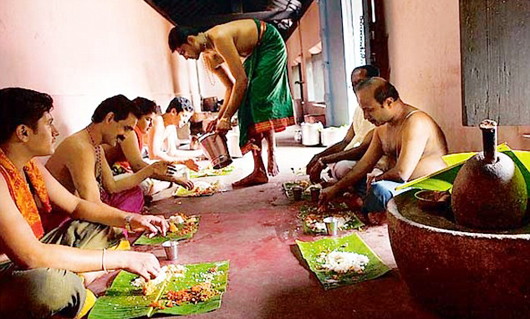
Udupi, Aug 26: What connects Bisi Bele Hulianna, Saaru, Modaka, Huggi, Majjige Palidya and Drakshi Gojju? These are some of the famed dishes of the Madhwa Brahmin community of Udupi, a coastal town in Karnataka where the Krishna temple acts as a pivot in people's lives.
brahmin

Laying out the geographical expanse and scientific logic to the regions Madhwa Brahmins vegetarian food habits, culinary expert Malati Srinivasan and arts and crafts connoisseur Geetha Rao showcase the hitherto unknown vegetarian recipes from Udupi in their book "The Udupi Kitchen."

The authors straddle the traditional and modern and list what was once easily cooked in Udupi households - spice powders, salads and chutneys, savoury snacks, desserts - and elaborate on several recipes which are all-time favourites like Bisi Bele Hulianna, Saaru, Masal Dose and Modaka.

While Bisi Bele Hulianna is a dish of spicy red gram, rice and vegetables, Saaru is spicy red gram soup, Huggi is rice and green gram with black pepper and cumin and Modaka is dumplings with coconut and jiggery filling.

Majjige Palidya is ash gourd with coconut and cumin in sour yoghurt and Drakshi Gojju is raisins in sweet, sour and spicy gravy.

Split into 12 sections, the Udupi Kitchen, published by Westland Ltd, celebrates vegetarian food with aplomb from a town where food is religion as well as a complete mouth-watering experience.

At the core of Udupi cuisine is the use of indigenous vegetables and fruits, cereals and pulses special to the Parashurama Kshetra and traditional Brahmins ate only vegetarian fare without onion and garlic.

According to the authors, Udupi cuisine has a vast variety and is not limited to tiffins or snacks.

"As I began working on this project, I realised how vast and varied our family’s repertoire of Udupi (Madhwa) cuisine was. I wrote down 175 recipes, but have used about a 100 of them in the book," says Srinivasan.

"Writing a cook book for both Indian and non-Indian readers required that a comprehensive multi-lingual glossary be compiled. It also meant using internationally accepted terminology: 'henchu' or 'tava' became griddle, bandle or 'kadhai' became wok, 'tappele' or 'bartan' became saucepan," says Rao.

She says for some kitchen tools like 'eelgemane' and 'ogarane chamcha', which had no "internationally understood" words, substitute words like curved knife blade and tempering-ladle had to be coined.

The story of Udupi cuisine is the story of how a temple-based, Brahmanical culinary tradition got modernised and became a global phenomenon. Food is religion in Udupi.

Fourteen varieties of food are cooked daily and offered to the deity at different times of the day. The food offered to god is 'naivediya', and the food eaten by human beings is 'prasada', food that is blessed.

In Udupi, meals are served on banana leaves in a particular order. Many recipes and foods have also proven health benefits. For example, dishes made from the inner banana stem prevent kidney stones, pepper rasam helps with the lactation of new mothers, jackfruit seeds have high protein content and so on.

The authors also say that the original of the masal dose or the famous masala dosa is attributed to Udupi.

Before it was invented, plain dosa was served with potato playa, without onions, in a separate cup. With changing food tastes, the Udupi chefs began to saute the mashed potatoes with onions and spices.

"As onions were considered taboo food for orthodox Brahmins, it is said that the doses were stuffed with onion-laced playa, instead of served in a separate cup, so that the onion could be 'hidden'," the authors say.

Comments

Usha moorthy
 - 
Wednesday, 8 Jun 2016

I'm extremely pleased that I now have a book to refer to for genuine udupi food!!! Thanks to the authors for painstakingly bringing together these wonderful recipes!!;

Add new comment

  • Coastaldigest.com reserves the right to delete or block any comments.
  • Coastaldigset.com is not responsible for its readers’ comments.
  • Comments that are abusive, incendiary or irrelevant are strictly prohibited.
  • Please use a genuine email ID and provide your name to avoid reject.
News Network
April 14,2020

Bengaluru, Apr 14: Bracing for post-lockdown hard times, the Karnataka government on Monday decided to auction about 12,000 BDA sites and regularise unauthorised constructions across the state in a bid to shore up its already-thin finances.

"Some 12,000 corner sites (developed by Bangalore Development Authority, or BDA) are lying idle in Bengaluru. We hope to net about Rs 15,000 crore from the auction of the sites," chief minister BS Yediyurappa said after chairing a meeting with senior ministers and officials to discuss ways to raise funds.

"The Covid-19 pandemic has thrown Karnataka into a deep financial crisis. There's a need for such measures," the chief minister said in defence of the decisions.

The sites – mainly of 40x60ft and 50x80ft dimensions – are in nine layouts. Also, the state government will auction corner and vacant sites in layouts formed by development authorities in other major cities of Karnataka.

Industry experts said that in a tepid market, it wasn’t easy to find buyers for the sites, each of which costs about Rs 1 crore. The CM said, “Since it’s an open auction, I’m confident of a good price since corner sites are always in demand. If we don’t get the expected price, then we will stop the process.”

The meeting decided to fast-track disposal of the cases related to regularisation of unauthorised constructions pending before courts. “If courts decide these cases, then thousands of people will be relieved, besides helping the government in mobilising resources to take up development works,” the CM said.

The government hopes to get about Rs 4,000 crore from the layout-regularisation move.
The government decided to amend the law to allow hundreds of private and cooperative housing societies to allot residential plots.

Comments

Add new comment

  • Coastaldigest.com reserves the right to delete or block any comments.
  • Coastaldigset.com is not responsible for its readers’ comments.
  • Comments that are abusive, incendiary or irrelevant are strictly prohibited.
  • Please use a genuine email ID and provide your name to avoid reject.
News Network
February 16,2020

Bengaluru, Feb 16: Deputy chief minister Laxman Savadi’s election to the lone vacant council seat, for which a bypoll has been called, is only a formality as the only other candidate in the contest, independent BR Anil Kumar, dropped out on Saturday.

Kumar conveyed his decision to council secretary and returning officer Vishalakshmi. He decided to withdraw from the February 17 bypoll after failing to get support from Congress and JD(S) legislators.

The bypoll was necessitated after sitting member Rizwan Arshad of Congress resigned as he moved to the legislative assembly as an MLA. Rizwan won the Shivajinagar bypoll in December last year.

“Since the notification on candidates in the fray, after the last date of withdrawal, has already been published, irrespective of any candidate’s retirement, the election has to be conducted,” an official said.

Savadi’s victory was always assured as BJP has 119 members in the House.

Still, Ramanagara BJP district president Rudresh and MP BY Raghavendra reportedly approached Kumar, urging him to withdraw. Kumar, however, denied that he was persuaded by BJP.

“I entered the fray thinking secular parties and likeminded MLAs will support me, but that didn’t happen, so I decided to retire,”he said.

A section of Congress and JD(S) politicians, led by former minister HD Revanna, had persuaded Kumar to enter the contest with the hope that disgruntlement among some BJP legislators over Savadi’s promotion as the deputy CM would result in an upset.

Former chief minister HD Kumaraswamy also offered to support Kumar. Siddaramaiah of Congress refused to do the same. Congress and JD(S) did not field any candidates of their own as they don’t have the requisite numbers in the House.

Savadi must get elected to the council before February 20, otherwise he will lose his cabinet role. According to rules, a person who is not a member of either House should get elected within six months after becoming a minister. Savadi took oath on August 20 last year.

Comments

Add new comment

  • Coastaldigest.com reserves the right to delete or block any comments.
  • Coastaldigset.com is not responsible for its readers’ comments.
  • Comments that are abusive, incendiary or irrelevant are strictly prohibited.
  • Please use a genuine email ID and provide your name to avoid reject.
coastaldigest.com web desk
June 9,2020

With the steep hike in excise duty in the past couple of months, an average consumer of petrol now pays over 275% in taxes to centre and states on a litre of the fuel.  The base price of petrol is just about Rs 18. The taxes are close to Rs 50 and the pump price is over Rs 72.

India imports 85% of all its crude oil demand.  After a steep hike in excise duty in the past two months despite a hold on daily price revisions by the oil public sector undertakings (PSUs), Indian consumers now pay 275% collectively in excise duty to state and centre. 

The central government hiked excise on petrol and diesel by Rs 10 and Rs 13 respectively last month. The excise duty on petrol is taxed around Rs 33-a-litre while the same on diesel it is Rs 32.

The Value-Added Tax (VAT) on both petrol and diesel is Rs 16.44 and Rs 16.26 respectively. Both the taxes together are around Rs 49 while it is sold at petrol pumps at 73-per-litre.

These two taxes cumulatively account for 69% of tax which is higher than anywhere else in the world. The same is taxed at 19% in the US, 47% in Japan, UK 62% and 63% in France. The government does not pass on the benefit of lower crude oil prices to the customer.

It is to be noted that Indian consumers continued to pay Rs 70-a-litre even when crude oil prices hit a paltry US $ 20-a-barrel on April 12.

Former finance minister and Congress leader recently took a jab at the Centre over rising prices stating, “Fuel selling prices raised twice in two days, following tax hikes two weeks ago. This time to benefit oil companies. Government is poor, it needs more taxes. Oil companies are poor, they need better prices. Only the poor and middle class are not poor, so they will pay”.

Comments

Lovely indian
 - 
Wednesday, 10 Jun 2020

Acche din for modi bakth....lets enjoy


you need only ram mandir and NRC

Add new comment

  • Coastaldigest.com reserves the right to delete or block any comments.
  • Coastaldigset.com is not responsible for its readers’ comments.
  • Comments that are abusive, incendiary or irrelevant are strictly prohibited.
  • Please use a genuine email ID and provide your name to avoid reject.