Temple desecration: Internet services suspended in Jammu

June 17, 2016

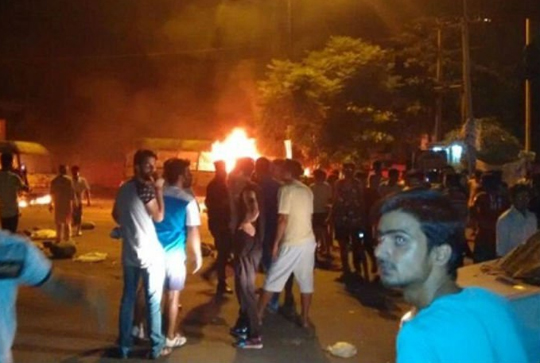
Jammu, Jun 17: Authorities today decided to suspend all Internet services across Jammu region to stop spread of rumours on social networking sites following the desecration of a temple here last evening.

desecration

All mobile and broadband-based Internet services have been suspended, a district official said.

"To stop rumour mongering on social networking sites in the wake of the desecration of Shiv temple in Nanak Nagar area, the authorities decided to temporarily suspend all Internet services including mobile and landline Internet services," the official said.

One more temple was allegedly desecrated in Jammu yesterday, leading to tension briefly in parts of the city.

"A man entered a temple in the Nanak Nagar area and tried to vandalise it. The man has been identified and arrested," Deputy Commissioner of Jammu Simrandeep Singh had said.

A large number of people came onto the roads after news spread. Shopkeepers in the area downed their shutters and held a protest demanding action against the accused.

"Though some people held protest in the area, the situation is normal and under control. Adequate police personnel have been deployed to foil any untoward incident in the area," Singh said.

The incident took place even as normalcy had returned to Jammu following alleged desecration of a temple in another area Roopnagar on Tuesday by a man who was described by police as "mentally disturbed". The city had witnessed violence and arson over that incident.

Comments

naren kotian
 - 
Friday, 17 Jun 2016

arming hindus like jews in judea and samaria ( israel) should happen in Jammu ... enough is enough ... shoot at sight and coordinate with army and finish the followers of rotten stuff ... pundits and hindus only areas must be created in valley .

Add new comment

  • Coastaldigest.com reserves the right to delete or block any comments.
  • Coastaldigset.com is not responsible for its readers’ comments.
  • Comments that are abusive, incendiary or irrelevant are strictly prohibited.
  • Please use a genuine email ID and provide your name to avoid reject.
News Network
February 11,2020

New Delhi, Feb 11: The Aam Aadmi Party on Tuesday appeared to be heading back to power for a second term in Delhi with the party leading in 52 seats of the 70 and the BJP ahead in 18 as votes for last week's assembly elections were counted, according to Election Commission figures. The contest for political power over the national capital was a bipolar one with the Congress nowhere in the reckoning, according to initial trends.

AAP supremo and chief minister Arvind Kejriwal was leading in the New Delhi seat by 4,300 seats, while his deputy Manish Sisodia from Patparganj seat was ahead by 102 votes.

BJP leader Vijender Gupta, who is also leader of opposition in the Delhi legislative assembly, was trailing by over 1,200 votes from Rohini.

As early celebrations broke out in the AAP headquarters in Rouse Avenue, BJP's Delhi unit chief Manoj Tiwari asked his party supporters not to lose hope.

"There are 27 seats where the difference of votes is between 700 to 1,000," Tiwari told reporters.

Looking ahead at victory, he said he was not nervous and was ready to take on the responsibilities that a win would bring.

"All talk is over. We have to wait for the blessings of the people. I am confident it will be a good day for BJP. We are coming to power in Delhi today. Don't be surprised if we win 55 seats," Tiwari said.

Kejriwal, who had led his party to a spectacular win of 67 of 70 seats in 2015, is expected to address party workers and the media later in the day. However, his party workers were upbeat and in celebratory mode.

"We have been saying since the beginning that the upcoming polls will be fought on the basis of work done by us... You wait and watch, we will register a massive win," AAP spokesperson Sanjay Singh told reporters.

"We hope we get such a clear majority that a message goes out that doing Hindu-Muslim politics will not work anymore," said AAP volunteer Fareen Khan at the party office.

The headquarters were decorated with blue and white balloons and big cutouts of Kejriwal were placed in different parts of the office.

Labour minister and AAP's Delhi unit convenor Gopal Rai was leading in Badarpur constituency by 1,994 votes.

Atishi, AAP's Kalkaji candidate, who was also instrumental in the transformation of Delhi government schools, was trailing by 190 votes.

AAP's Timarpur candidate Dilip Pandey was leading by over 1,500 votes.

BJP's Tajinder Singh Bagga was trailing on Hari Nagar seat by over 50 votes, while AAP's Raghav Chadha is leading from Rajinder Nagar constituency.

Congress' Chandni Chowk candidate Alka Lamba, who is sitting MLA from the constituency, was trailing by over 5,800 votes.

Counting centres are spread across 21 locations in 11 districts, including at the CWG Sports Complex in east Delhi, NSIT Dwarka in west Delhi, Meerabai Institute of Technology and G B Pant Institute of Technology in southeast Delhi, Sir CV Raman ITI, Dheerpur in central Delhi, and Rajiv Gandhi Stadium in Bawana in north Delhi.

The assembly elections were held on February 8.

A total of 672 candidates, including 593 men and 79 women, were in the fray for the hotly contested, often divisive polls with the anti-CAA protests in Shaheen Bagh occupying centrestage towards the end of the campaign.

While the AAP, of course, put forward Kejriwal, Prime Minister Narendra Modi, home minister Amit Shah and Uttar Pradesh chief minister Yogi Adityanath were among those who extensively campaigned for the BJP.

The Congress, still recovering maybe from the death of its three-time Delhi chief minister Sheila Dikshit in July last year, got into campaign mode much later. Former prime minister Manmohan Singh and party leaders Rahul Gandhi and Priyanka Gandhi were among those who campaigned for the Congress.


Comments

Add new comment

  • Coastaldigest.com reserves the right to delete or block any comments.
  • Coastaldigset.com is not responsible for its readers’ comments.
  • Comments that are abusive, incendiary or irrelevant are strictly prohibited.
  • Please use a genuine email ID and provide your name to avoid reject.
News Network
June 9,2020

Jun 9: Prime Minister Narendra Modi wants all 1.3 billion Indians to be “vocal for local” — meaning, to not just use domestically made products but also to promote them. As an overseas citizen living in Hong Kong, I’m doing my bit by very vocally demanding Indian mangoes on every trip to the grocery. But half the summer is gone, and not a single slice so far.

My loss is due to India’s COVID-19 lockdown, which has severely pinched logistics, a perennial challenge in the huge, infrastructure-starved country. But more worrying than the disruption is the fruity political response to it. Rather than being a wake-up call for fixing supply chains, the pandemic seems to be putting India on an isolationist course. Why?

Granted that the liberal view that trade is good and autarky bad isn’t exactly fashionable anywhere right now. What makes India’s lurch troublesome is that the pace and direction of economic nationalism may be set by domestic business interests. The Indian liberals, many of whom are Western-trained academics, authors and — at least until a few years ago — policy makers, want a more competitive economy. They will be powerless to prevent the slide.

Modi’s call for a self-reliant India has been echoed by Home Minister Amit Shah, the cabinet’s unofficial No. 2, in a television interview. If Indians don’t buy foreign-made goods, the economy will see a jump, he said. The strategy — although it’s too nebulous yet to call it that — has a geopolitical element. A military standoff with China is under way, apparently triggered by India’s completion of a road and bridge near the common border in the tense Himalayan region of Ladakh. It’s very expensive to fight even a limited war there. With India’s economy flattened by COVID, New Delhi may be looking for ways to restore the status quo and send Beijing a signal.

Economic boycotts, such as Chinese consumers’ rejection of Japanese goods over territorial disputes in the East China Sea, are well understood as statecraft. In these times, it’s not even necessary to name an enemy. An undercurrent of popular anger against China, the source of both the virus and India’s biggest bilateral trade deficit, is supposed to do the job. But is it ever that easy?

A hastily introduced policy to stock only local goods in police and paramilitary canteens became a farcical exercise after the list of banned items ended up including products by the local units of Colgate-Palmolive Co., Nestle SA, and Unilever NV, which have had significant Indian operations for between 60 and 90 years, as well as Dabur India Ltd., a New Delhi-based maker of Ayurveda brands. The since-withdrawn list demonstrates the practical difficulty of bureaucrats trying to find things in a globalized world that are 100% indigenous.

Free-trade champions fret that the prime minister, whom they saw as being on their side six years ago, is acting against their advice to dismantle statist controls on land, labor and capital to help make the country more competitive. Engage with the world more, not less, they caution. But Modi also has to satisfy the Rashtriya Swayamsevak Sangh, the umbrella Hindu organisation that gets him votes. Its backbone of small traders, builders and businessmen — the RSS admits only men — was losing patience with the anemic economy even before the pandemic. Now, they’re in deep trouble, because India’s broken financial system won’t deliver even state-guaranteed loans to them.

The U.S.-China tensions — over trade, intellectual property, COVID responsibility and Hong Kong’s autonomy — offer a perfect backdrop. A dire domestic economy and trouble at the border provide the foreground. Big business will dial economic nationalism up and down to hit a trifecta of goals: Block competition from the People's Republic; make Western rivals fall in line and do joint ventures; and tap deep overseas capital markets. The first goal is being achieved with newly placed restrictions on investment from any country that shares a land border with India. The second aim is to be realized by corporate lobbying to influence India's whimsical economic policies. As for the third objective, with the regulatory environment becoming tougher for U.S.-listed Chinese companies like Alibaba Group Holding Ltd., an opportunity may open up for Indian firms.

All this may bring India Shenzhen-style enclaves of manufacturing and trade, but it will concentrate economic power in fewer hands, something that worries liberals. They’re moved by the suffering of India’s low-wage workers, who have borne the brunt of the COVID shutdown. But when their vision of a more just society and fairer income distribution prompts them to make common cause with the ideological Left, they’re quickly repelled by the Marxist voodoo that all cash, property, bonds and real estate held by citizens or within the nation “must be treated as national resources available during this crisis.” Who will invest in a country that does that instead of just printing money?

At the same time, when liberals look to the business class, they see a sudden swelling of support for ideas like a universal basic income. They wonder if this isn’t a ploy by industry to outsource part of the cost of labor to the taxpayer. Slogans like Modi’s vocal-for-local stir the pot and thicken the confusion. The value-conscious Indian consumer couldn’t give two hoots for calls to buy Indian, but large firms will know how to exploit economic nationalism. One day soon, I’ll get my mangoes — from them.

Comments

Add new comment

  • Coastaldigest.com reserves the right to delete or block any comments.
  • Coastaldigset.com is not responsible for its readers’ comments.
  • Comments that are abusive, incendiary or irrelevant are strictly prohibited.
  • Please use a genuine email ID and provide your name to avoid reject.
Agencies
August 2,2020

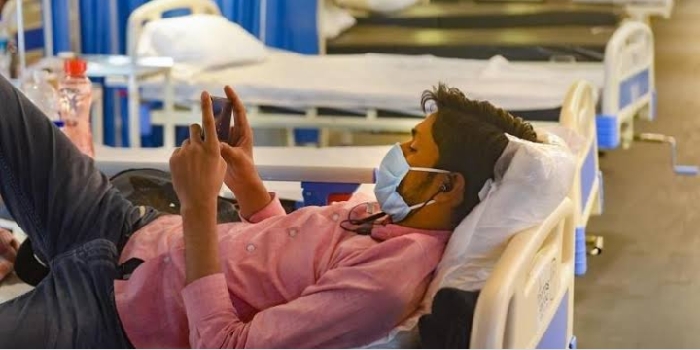
New Delhi, Aug 2: The Centre has written to all states and Union Territories stating that smartphones and tablet devices should be allowed for hospitalised Covid-19 patients so that they can interact with family and friends through video conferencing, which would provide them psychological support.

Though mobile phones are allowed in hospital wards, the missive was issued following some representation from the kin of patients alleging otherwise.

Director-General of Health Services (DGHS) in the Health Ministry Dr Rajiv Garg in the letter to the principal secretaries of health and medical education of states and Union territories said appropriate protocols for disinfecting devices and allotting timeslots can be developed by the hospital concerned to facilitate contact between patients and their family.

He underlined that administrative and medical teams should be responsive to the psychological needs of patients admitted in Covid-19 wards and ICUs of various hospitals.

"Social connection can calm down patients and also reinforce the psychological support given by the treating team. Please instruct all concerned that they should allow smartphones and tablet devices in patient areas so that the patient can video conference with their family and friends," stated the letter issued on July 29.

"Though mobile phones are allowed in the wards to enable a patient stay in touch with his or her family, we received representations from the patient families from some states stating mobile phones are not being allowed by hospital administrations because of which they were not being able to stay in contact with the patient," said Dr Garg.

Comments

Add new comment

  • Coastaldigest.com reserves the right to delete or block any comments.
  • Coastaldigset.com is not responsible for its readers’ comments.
  • Comments that are abusive, incendiary or irrelevant are strictly prohibited.
  • Please use a genuine email ID and provide your name to avoid reject.