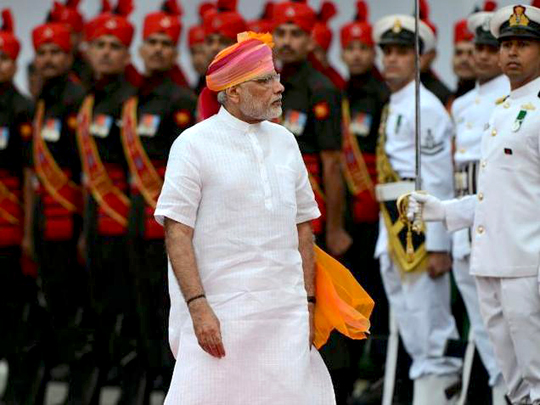
I-Day lie exposed: Village mentioned by PM Modi still without power!

August 18, 2016

Lucknow, Aug 18: Nagla Fatela village in Uttar Pradesh's Hathras district, which found mention in Prime Minister Narendra Modi's Independence Day speech as being “electrified” 70 years after freedom, is still “powerless”.

modi

According to the UP Power Corporation officials here, Nagla Fatela did have power lines, but they were meant only for supplying power for irrigation and running the tubewells and not lighting homes. Some residents, however, had electrified their homes through illegal connections, the officials said. They said that the village was being supplied power for irrigation purposes for the last 25 years.

The corporation sources here said that the work of installing transformers, poles and wires, which was taken up under the Deen Dayal Upadhyaya Village Electrification Project, had almost been completed in the village, but power was yet to be supplied.

A resident of the village said power lines had been installed almost a year ago. The residents also said that the village where the people were shown watching TV during the prime minister's speech in a post on social media by a Union minister was not theirs.

Sources said that power officials rushed to the village to conduct a survey after Modi mentioned the village in his speech. “We are expecting supply of power within a few days,” said a senior official.

Modi, during his I-Day speech, said that Nagla Fatela village was three hours drive from Delhi, but it took 70 years for power to reach the village.

Comments

Manku Thimma
 - 
Thursday, 18 Aug 2016

I really do not understand why these media people are exposing that man's lies day by day? Who world knows he is a liar. Once in a week he speaks truth also. make it a news saying man with 56 inch chest finally spoke a truth!

UMMAR
 - 
Thursday, 18 Aug 2016

modhiji good for publicity then nothing

fekuu jii... ab ki baar fekuuu sarkaar...

Sameer
 - 
Thursday, 18 Aug 2016

Fekna mera kaam hey sun'na ulluon k kaam hey..

Shuaib
 - 
Thursday, 18 Aug 2016

fekna mera janma sidh adhikar hai!

Add new comment

  • Coastaldigest.com reserves the right to delete or block any comments.
  • Coastaldigset.com is not responsible for its readers’ comments.
  • Comments that are abusive, incendiary or irrelevant are strictly prohibited.
  • Please use a genuine email ID and provide your name to avoid reject.
News Network
January 25,2020

New Delhi, Jan 25: The latest edition of the Oxford Advanced Learner's Dictionary features 26 new Indian English words, including Aadhaar, chawl, dabba, hartal and shaadi.

The 10th edition of the dictionary, which was launched on Friday, has 384 Indian English words and incorporates over 1,000 new words such as chatbot, fake news and microplastic.

The dictionary focuses on language change and its evolution through the years, and has ensured that the language and examples used in the new edition are relevant and up to date with the times, Oxford University Press (OUP) said.

The new edition comes with interactive online support through the Oxford Learner's Dictionaries website and an app. The website includes advanced features such as audio-video tutorials, video walkthroughs, self-study activities and enhanced iWriter and iSpeaker tools.

"This edition has 26 new Indian English words of which 22 figure in the printed dictionary. The other four are in the digital version," said Fathima Dada, Managing Director (Education Division) at OUP.

Some of other new Indian words in the dictionary are auntie (while aunty already figures in the English dictionary, auntie is an Indianism), bus stand, deemed university, FIR, non-veg, redressal, tempo, tube light, veg and videograph.

The four new Indian English words in the online version of the dictionary are current (for electricity), looter, looting and upazila (one of the areas that a district is divided into for administration purposes).

According to OUP, the new edition provides better, more accurate and understandable definitions with examples, usage notes and additional resources to help the learner use the right word in the right context.

"Prevalence and common usage are the main criteria for enlisting new words. We scan the globe for words which are often used by people while speaking English. Then these words go through a rigorous testing process," Dada said.

"As OUP is the custodian of English language globally, these words have to go through its processes," she told PTI.

The Oxford Advanced Learner's Dictionary, she said, has been reinventing itself for nearly eight decades, anticipating the growing learning requirements of learners.

"The 10th edition also is equipped with a strong digital support system, including an app," she said.

It is equipped with several digital tools. With iSpeaker, learners can get help preparing for speaking exams and presentations. With iWriter, learners can plan, write and review their written work. Text Checker allows the teacher to check any text against the Oxford 3000, 5000, and OPAL (Oxford Phrasal Academic Lexicon) written word list.

Resources accessible through online premium access include lesson plans, worksheets, video walkthroughs, and classroom and self-study activities. With the OALD app one can find 86,000 words, 95,000 phrases, 112,000 meanings and 237,000 examples.

The dictionary, which spans 77 years, was originally published in Japan in 1942 and was first brought out by OUP in 1948. The learner's dictionary is based on the original values of its creator, Albert Sydney Hornby, whose aim was to help language learners worldwide understand the meaning of English words.


Comments

Add new comment

  • Coastaldigest.com reserves the right to delete or block any comments.
  • Coastaldigset.com is not responsible for its readers’ comments.
  • Comments that are abusive, incendiary or irrelevant are strictly prohibited.
  • Please use a genuine email ID and provide your name to avoid reject.
Agencies
June 10,2020

Bengaluru, Jun 10: The Karnataka Anti-Corruption Bureau on Wednesday conducted raids at 14 places linked to four government officials in the state.

On receiving received credible information about the officials amassing disproportionate assets, an illegal assets case was registered and raids are being conducted at 14 places linked to them, ACB said in a release.

It said the raids are still on and investigation is being carried out about their assets.

Raids are being conducted on properties linked to L Sathish Kumar, Additional Commissioner, Department of Commercial Tax; N Ramakrishna, Divisional Forest Officer, Srinivasapura, Kolar; Gopalshetty Mallikarjuna, Executive Engineer, District Development Cell, Raichur; Raghappa Lalappa Lamani, Krishna Bhagya Jala Nigam Ltd official in Almatti, Bagalkote, the release said.

Comments

Add new comment

  • Coastaldigest.com reserves the right to delete or block any comments.
  • Coastaldigset.com is not responsible for its readers’ comments.
  • Comments that are abusive, incendiary or irrelevant are strictly prohibited.
  • Please use a genuine email ID and provide your name to avoid reject.
News Network
March 5,2020

Mar 5: The Karnataka government on Thursday proposed to increase rate of tax on petrol and diesel by three per cent which would make the fuel dearer by Rs 1.60 and Rs 1.59 per litre, respectively.

Presenting the 2020-21 budget in the Legislative Assembly, Chief Minister B S Yediyurappa proposed to increase rate of tax on petrol from 32 per cent to 35 per cent and diesel from 21 per cent to 24 per cent, as part of additional resource mobilisation measures.

Yediyurappa, who also holds the finance portfolio, increased excise duty on Indian Made Liquor (KML) across 18 slabs by six per cent.

However, to promote affordable housing, the government proposed to reduce stamp duty on first time registration of new apartments/flats costing less than Rs 20 lakh from existing five per cent to two per cent.

This is the first budget of the BJP government after coming to power last year; it's the seventh presented by Yediyurappa.

"For the year 2020-21, a total amount of Rs 55,732 crore is provided for stimulating economic growth sector", the Chief Minister said.

He said the revenue collection target for the Commercial Taxes department for the year 2020-21 is fixed at Rs 82,443 crore.

Stating the government had fixed a revenue target of Rs 20,950 crore for the excise department for the year 2019- 20, he said at the end of February Rs 19,701 crore had been collected.

"We hope to achieve the budget target."

He also hoped with the increase in rates and effective enforcement and regulatory measures, the Excise department would be achieving the target of Rs 22,700 crore fixed for the financial year 2020-21.

On the transport sector, Yediyurappa said it is proposed to levy motor vehicle tax on contract carriages having seating capacity to carry more than 12 passengers, but not more than 20 passengers at the rate of Rs 900 per seat per quarter.

He said it is also proposed to levy vehicle tax on new model sleeper coaches which are granted permits under section 88 (9) of MV Act 1988 at the rate of Rs 4,000 per sleeper per quarter.

Noting that a target of Rs 7,100 crore revenue collection is expected to be achieved in 2019-20 in transport sector, he said for 2020-21 revenue collection target has been fixed at Rs 7,115 crore.

He said the revenue collection target for 2019-20 under stamps and registration was fixed at Rs 11,828 crore and against this Rs 10,248 crore has been collected till the end of February 2020 which is 87 per cent of full year target.

While the revenue collection target for 2020-21 under stamps and registration is fixed at Rs 12,655 crore.

Comments

Add new comment

  • Coastaldigest.com reserves the right to delete or block any comments.
  • Coastaldigset.com is not responsible for its readers’ comments.
  • Comments that are abusive, incendiary or irrelevant are strictly prohibited.
  • Please use a genuine email ID and provide your name to avoid reject.