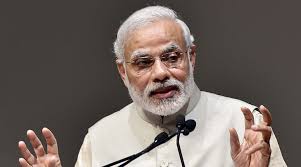
Unity & Love are basic mantras to address Kashmir problem: PM

August 28, 2016

New Delhi, Aug 28: Prime Minister Narendra Modi today said "Ekta" (unity) and "Mamata" (love) are the basic mantras for addressing the Kashmir problem even as he slammed those pushing children to create unrest, saying they will have to give answers to those "innocent" kids some day. He emphasised that if any life is lost in Kashmir, whether of any youth or any securityman, "that loss is ours, of our own country".

modipmSpeaking on the unrest in the valley in his monthly radio programme 'Mann Ki Baat', Modi said, "From the interactions I had with all parties on Kashmir, one thing emerged from those, which can be put in simple words as 'Ekta' and 'Mamata'. These two things were the basic mantra."

He said all the political parties had spoken in one voice on Kashmir, sending out a "message to the world as well as separatist forces" besides conveying "our sentiments to the people of Kashmir". He equated it to the passage of landmark GST Bill by Parliament for which all the parties came together.

"It is the view of all of us, the view of 125 crore people from a pradhan of a village to the Prime Minister, that if any life is lost in Kashmir, whether of any youth or any securityman, that loss is ours, our own country," Modi said.

At the same time, he slammed "those people who push small children to try to create unrest in Kashmir", saying "some day, they will have to give answers to these innocent children". The Prime Minister's remarks came a day after Jammu and Kashmir Chief MInister Mehbooba Mufti met him and presented a "three-pronged action plan" that includes dialogue with all stakeholders.

Comments

abdul
 - 
Sunday, 28 Aug 2016

Devil preaching the peace & harmony

Add new comment

  • Coastaldigest.com reserves the right to delete or block any comments.
  • Coastaldigset.com is not responsible for its readers’ comments.
  • Comments that are abusive, incendiary or irrelevant are strictly prohibited.
  • Please use a genuine email ID and provide your name to avoid reject.
Agencies
August 3,2020

New Delhi, Aug 3: President Ram Nath Kovind and Prime Minister Narendra Modi on Monday extended warm greetings and good wishes to the countrymen on the occasion of Rakshabandhan.

The President in his message said, "Greetings on Raksha Bandhan! Rakhi is the sacred thread of love and trust that connects sisters with brothers in a special bond. On this day, let us reiterate our commitment to secure the honour and dignity of women."

"Many wishes to all the countrymen on the auspicious occasion of Rakshabandhan," Prime Minister Modi tweeted in Hindi.

Rakshabandhan, which is being celebrated today, is a celebration of the unique bond between brothers and sisters. Tying of the Rakhi by sisters, symbolises love, affection and mutual trust between brothers and sisters. 

Comments

Add new comment

  • Coastaldigest.com reserves the right to delete or block any comments.
  • Coastaldigset.com is not responsible for its readers’ comments.
  • Comments that are abusive, incendiary or irrelevant are strictly prohibited.
  • Please use a genuine email ID and provide your name to avoid reject.
News Network
January 24,2020

Jan 24: India’s economy appears to be shaking off a slump, as activity in the services and manufacturing sectors expanded for a second straight month in December.

The needle on a gauge measuring so-called animal spirits signaled the economy may be taking a turn for the better, as five of the eight high-frequency indicators tracked by Bloomberg News came in stronger last month. The dial was last at the current position in August.

“Animal spirits” is a term coined by British economist John Maynard Keynes to refer to investors’ confidence in taking action, and the gauge uses the three-month weighted average to smooth out volatility in the single-month numbers.

The nascent recovery would need a helping hand, with expectations building that Finance Minister Nirmala Sitharaman will provide some stimulus when she presents the budget Feb. 1. Official forecasts show the economy is set to expand at 5% in the year ending March 2020 -- the weakest pace in more than a decade.

Here are the details of the dashboard:

Business Activity

The dominant services index rose to the highest level in five months in December as improving new work orders helped boost activity. The seasonally adjusted Markit India Services PMI index climbed to 53.3 from 52.7 in November, helping post a strong end to the calendar year.

India’s manufacturing PMI also rose -- to 52.7 from 51.2 a month ago -- boosted by the fastest increase in new orders since July. A reading above 50 means expansion while anything below that signals contraction.

The uptick in business confidence was accompanied by a rise in inflationary pressures, the survey showed. That trend may keep monetary policy makers from resuming interest-rate cuts anytime soon, leaving most of the heavy-lifting to boost growth with the government.

“The relative stability in macro indicators over the past two months suggests that the worst is behind, but the recovery is likely to be prolonged,” said Teresa John, an economist at Nirmal Bang Equities Pvt. in Mumbai. “Still, sluggish growth and rising inflation indicate that India may well remain in stagflation for most of 2020.”

Exports

Exports remained a laggard, falling 1.8% in December from a year ago. The drag was mainly because of a fall in export of engineering goods, which constitute a third of India’s non-oil exports.

Capital goods imports continued to contract and was lower by 16.5% year-on-year in December after a 22% drop in November. This was the seventh consecutive month of continuous decline, underscoring the weakness in the capex cycle, according to IDFC First Bank.

Consumer Activity

Weakness in demand for passenger vehicles persisted, with local sales falling 1.2% in December from a year ago, according to the Society of Indian Automobile Manufacturers. That capped the worst yearly passenger vehicle sales on record. A Nielsen study on demand for fast-moving consumer goods showed volume growth dropped to 3.5% in the last quarter of 2019 from 3.9% in the same period of 2018.

Funding conditions held out hope, showing considerable improvement in December, according to the Citi India Financial Conditions Index. Credit growth remained tardy though, with demand for loans rising at a slower 7.1% pace from a year ago compared with a nearly 8% growth in November.

Industrial Activity

Industrial output rose for the first time in four months in November. The pick up was broad-based, led by mining, manufacturing and electricity. Mining and manufacturing, in particular, posted a second month of sequential growth. Production of consumer goods also rose after a few months of contraction.

The index of eight core infrastructure industries, which feeds into the index of industrial production, however, declined 1.5% in November from a year ago -- the fourth straight month of contraction. That was on account of shrinking production of electricity, steel, coal, natural gas and crude oil. Both the core sector and industrial output numbers are reported with a one-month lag.


Comments

Add new comment

  • Coastaldigest.com reserves the right to delete or block any comments.
  • Coastaldigset.com is not responsible for its readers’ comments.
  • Comments that are abusive, incendiary or irrelevant are strictly prohibited.
  • Please use a genuine email ID and provide your name to avoid reject.
Agencies
July 6,2020

New Delhi, Jul 6: The Indian Academy of Sciences, a Bengaluru-based body of scientists, has said the Indian Council for Medical Research's (ICMR) target to launch a coronavirus vaccine by August 15 is "unfeasible" and "unrealistic".

The IASc said while there is an unquestioned urgent need, vaccine development for use in humans requires scientifically executed clinical trials in a phased manner.

While administrative approvals can be expedited, the "scientific processes of experimentation and data collection have a natural time span that cannot be hastened without compromising standards of scientific rigour", the IASc said in a statement.

In its statement, the IASc referred to the ICMR's letter which states that "it is envisaged to launch the vaccine for public health use latest by 15th August 2020 after completion of all clinical trials".

The ICMR and Bharat Biotech India Limited, a private pharmaceutical company, are jointly developing the vaccine against the novel coronavirus -- SARS-CoV-2.

The IASc welcomes the exciting development of a candidate vaccine and wishes that the vaccine is quickly made available for public use, the statement said.

"However, as a body of scientists including many who are engaged in vaccine development IASc strongly believes that the announced timeline is unfeasible. This timeline has raised unrealistic hope and expectations in the minds of our citizens," it said.

Aiming to launch an indigenous COVID-19 vaccine by August 15, the ICMR had written to select medical institutions and hospitals to fast-track clinical trial approvals for the vaccine candidate, COVAXIN.

Experts have also cautioned against rushing the process for developing a COVID-19 vaccine and stressed that it is not in accordance with the globally accepted norms to fast-track vaccine development for diseases of pandemic potential.

The IASc said trials for a vaccine involve evaluation of safety (Phase 1 trial), efficacy and side effects at different dose levels (Phase 2 trial), and confirmation of safety and efficacy in thousands of healthy people (Phase 3 trial) before its release for public use.

Clinical trials for a candidate vaccine require participation of healthy human volunteers. Therefore, many ethical and regulatory approvals need to be obtained prior to the initiation of the trials, it added.

The IASc said the immune responses usually take several weeks to develop and relevant data should not be collected earlier.

"Moreover, data collected in one phase must be adequately analysed before the next phase can be initiated. If the data of any phase are unacceptable then the clinical trial is required to be immediately aborted," it said.

For example, if the data collected from Phase 1 of the clinical trial show that the vaccine is not adequately safe, then Phase 2 cannot be initiated and the candidate vaccine must be discarded.

For these reasons, the Indian Academy of Sciences believes that the announced timeline is "unreasonable and without precedent", the statement said.

"The Academy strongly believes that any hasty solution that may compromise rigorous scientific processes and standards will likely have long-term adverse impacts of unforeseen magnitude on citizens of India," it said.

Comments

Add new comment

  • Coastaldigest.com reserves the right to delete or block any comments.
  • Coastaldigset.com is not responsible for its readers’ comments.
  • Comments that are abusive, incendiary or irrelevant are strictly prohibited.
  • Please use a genuine email ID and provide your name to avoid reject.