


Pak seeks bigger SAARC to counter India's influence

October 12, 2016

Islamabad, Oct 12: Pakistan is exploring the possibility of creating a greater South Asian economic alliance to include China, Iran and neighbouring Central Asian republics as part of its bid counter India's influence in SAARC, a media report said today.pak
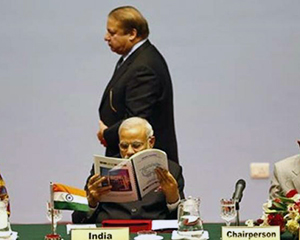
Dawn News, citing diplomatic observers, said Pakistan is exploring the possibility of creating a greater South Asian economic alliance to counter India's "controlling hold" on the eight-member South Asian Association for Regional Cooperation (SAARC).

A parliamentary delegation from Pakistan, which is now in New York, pitched this idea during its five-day visit to Washington last week, the report said.

"A greater South Asia is already emerging," Senator Mushahid Hussain Syed was quoted as saying in one of his interactions with the media.

"This greater South Asia includes China, Iran and the neighbouring Central Asian republics," he said.

He described the China-Pakistan Economic Corridor as the key economic route linking South Asia with Central Asia.

The Gwadar port, Syed said, would be the nearest warm water port, not only for China but also for the land-locked Central Asian states. "We want India to join this arrangement as well," said Syed.

Indians are "unlikely to accept" the offer as they are comfortable with the advantage that SAARC provides them, the report said.

"India used its influence in SAARC to isolate Pakistan when it announced that it would not attend the regional group's 19th summit, scheduled in Islamabad," the report said.

Citing continuous cross border terrorism by Pakistan, India had announced last month that "in the prevailing circumstances, the Indian government is unable to participate in the proposed Summit in Islamabad."

Besides India, four other SAARC members -- Bangladesh, Bhutan, Sri Lanka and Afghanistan -- had also pulled out of the summit.

"Among the eight SAARC nations, Afghanistan and Bangladesh are India's strong allies while Bhutan, surrounded by India from all sides, is too small to resist any move from New Delhi. The Maldives, Nepal and Sri Lanka have good ties with Pakistan, but they are not large enough to take on India," the report said.

The report cited that a senior diplomat had confirmed reports that Pakistan is actively seeking a new regional arrangement.

"Apparently, the showdown forced Pakistan to conclude that in its present shape, SAARC will always be dominated by India. That's why they are now talking about a greater South Asia," the diplomat was quoted as saying.

"Pakistan hopes that this new arrangement will give it more room to manoeuvre when India tries to force a decision on it," another diplomat said.

The report quoted diplomatic observers in Washington as saying that the proposed arrangement also suits China as it is also worried about India's rapidly growing influence in the region.

"They argue that China can play an important role in persuading Central Asian republics and Iran to join the new arrangement. But the observers warn that SAARC members will have little interest in supporting the idea," the report said.

"There is not much benefit for Bangladesh, Nepal and Sri Lanka in joining a land route far from their borders and Bangladesh and Sri Lanka have their own ports," it said.

The report stated thatt he member that is likely to get the most benefits from a greater South Asian alliance is Afghanistan, which is technically a land-locked Central Asian nation.

Any trade route that links South and Central Asian regions is good for Afghanistan, it noted.

"But observers believe that Afghanistan is too closely linked to India to join any arrangement that hurts India's interests. Afghanistan's presence in SAARC, however, justifies Pakistan's argument that Central Asian nations can be included in a greater South Asia.

Afghanistan applied for SAARC membership in 2006 and joined a year later, generating an interesting debate on the definition of South Asian identity because Afghanistan is a Central Asian country, the report said.

"But, as a South Asian diplomat pointed out, even if a greater South Asia became reality, there's no guarantee that its members would support Pakistan in its disputes with India," it said.

"Many Central Asian states have strong ties with India and Iran too has problems with Pakistan," the diplomat was quoted as saying.

Comments

Rikaz
 - 
Wednesday, 12 Oct 2016

India should not have cancelled this conference....

Add new comment

  • Coastaldigest.com reserves the right to delete or block any comments.
  • Coastaldigset.com is not responsible for its readers’ comments.
  • Comments that are abusive, incendiary or irrelevant are strictly prohibited.
  • Please use a genuine email ID and provide your name to avoid reject.
News Network
May 20,2020

Kensington (United States), May 20: The world cut its daily carbon dioxide emissions by 17% at the peak of the pandemic shutdown last month, a new study found.

But with life and heat-trapping gas levels inching back toward normal, the brief pollution break will likely be “a drop in the ocean" when it comes to climate change, scientists said.

In their study of carbon dioxide emissions during the coronavirus pandemic, an international team of scientists calculated that pollution levels are heading back up — and for the year will end up between 4% and 7% lower than 2019 levels.

That's still the biggest annual drop in carbon emissions since World War II.

It'll be 7% if the strictest lockdown rules remain all year long across much of the globe, 4% if they are lifted soon.

For a week in April, the United States cut its carbon dioxide levels by about one-third.

China, the world's biggest emitter of heat-trapping gases, sliced its carbon pollution by nearly a quarter in February, according to a study Tuesday in the journal Nature Climate Change. India and Europe cut emissions by 26% and 27% respectively.

The biggest global drop was from April 4 through 9 when the world was spewing 18.7 million tons (17 million metric tons) of carbon pollution a day less than it was doing on New Year's Day.

Such low global emission levels haven't been recorded since 2006. But if the world returns to its slowly increasing pollution levels next year, the temporary reduction amounts to ''a drop in the ocean," said study lead author Corinne LeQuere, a climate scientist at the University of East Anglia.

“It's like you have a bath filled with water and you're turning off the tap for 10 seconds," she said.

By April 30, the world carbon pollution levels had grown by 3.3 million tons (3 million metric tons) a day from its low point earlier in the month. Carbon dioxide stays in the air for about a century.

Outside experts praised the study as the most comprehensive yet, saying it shows how much effort is needed to prevent dangerous levels of further global warming.

“That underscores a simple truth: Individual behavior alone ... won't get us there,” Pennsylvania State University climate scientist Michael Mann, who wasn't part of the study, said in an email.

“We need fundamental structural change.”

If the world could keep up annual emission cuts like this without a pandemic for a couple decades, there's a decent chance Earth can avoid warming another 1.8 degrees (1 degree Celsius) of warming from now, study authors said. But getting the type of yearly cuts to reach that international goal is unlikely, they said.

If next year returns to 2019 pollution levels, it means the world has only bought about a year's delay in hitting the extra 1.8 degrees (1 degree Celsius) of warming that leaders are trying to avoid, LeQuere said. That level could still occur anywhere from 2050 to 2070, the authors said.

The study was carried out by Global Carbon Project, a consortium of international scientists that produces the authoritative annual estimate of carbon dioxide emissions. They looked at 450 databases showing daily energy use and introduced a measurement scale for pandemic-related societal “confinement” in its estimates.

Nearly half the emission reductions came from less transportation pollution, mostly involving cars and trucks, the authors said. By contrast, the study found that drastic reductions in air travel only accounted for 10% of the overall pollution drop.

In the US, the biggest pollution declines were seen in California and Washington with plunges of more than 40%.

Comments

Add new comment

  • Coastaldigest.com reserves the right to delete or block any comments.
  • Coastaldigset.com is not responsible for its readers’ comments.
  • Comments that are abusive, incendiary or irrelevant are strictly prohibited.
  • Please use a genuine email ID and provide your name to avoid reject.
Agencies
January 11,2020

New York, Jan 11: The United Nations Security Council (UNSC) on Friday renewed a six-year-long cross-border humanitarian aid deliveries mechanism into Syria.

According to Sputnik, the Security Council voted in favour of a resolution on Friday that allows cross border deliveries to be conducted via Turkey, preserving two checkpoints and excluding the Al-Yarubiyah border crossing with Iraq and the Al-Ramtha crossing with Jordan, until July 10, 2020.

Russia proposed to amend the adopted resolution by replacing a part of the draft which stipulates that humanitarian assistance into Syria should be delivered based on the principles of humanity, neutrality, impartiality and independence by the phrase that such aid should be provided "in accordance with the guiding principles of humanitarian emergency assistance, as contained in UNGA resolution 46/182."

The agreement was reached after Belgium and Germany decided to amend the original version of their joint resolution, which proposed keeping three points for cross-border deliveries into the Arab republic.

In December last year, the United Nations had said that over 235,000 people fled the Idlib region in the last two weeks after Russia and Syria launched airstrikes in a bid to take over the last major opposition bastion.

Russia backed Syria government launched a fresh assault to capture the province.

Syrian Bashar al-Assad regime, backed by Iran, has reportedly promised to take back the rebel-controlled area and broke a ceasefire that was announced in August.

They have since December 19 seized dozens of towns and villages from armed fighters amid clashes that have killed hundreds on both sides.

Comments

Add new comment

  • Coastaldigest.com reserves the right to delete or block any comments.
  • Coastaldigset.com is not responsible for its readers’ comments.
  • Comments that are abusive, incendiary or irrelevant are strictly prohibited.
  • Please use a genuine email ID and provide your name to avoid reject.
Agencies
February 23,2020

Washington, Feb 23: U.S. president Donald Trump on Saturday said he was looking forward to being with his "great friends" in India next week as he retweeted a short video in which his face was superimposed on the hit movie-character Bahubali, showing the president as a great saviour bringing peace to his kingdom.

Trump will pay a state visit to India on February 24 and 25, accompanied by a high-level delegation including first lady Melania Trump, his daughter Ivanka, son-in-law Jared Kushner and a galaxy of top American officials.

"Look so forward to being with my great friends India!" Trump said in the tweet.

Along with the tweet, Trump retweeted an 81-second video by a Twitter account identified as "Sol" with the handle Solmemes1.

"To celebrate Trump's visit to India I wanted to make a video to show how in my warped mind it will go... USA and India united!" the handle Solmemes1 tweeted in the original post with the video.

Trump appears as a great saviour, in the short animated clip, riding on a chariot with Melania. A few stills later, Trump is seen riding a horse carrying on his shoulders his son Donald Jr and daughter Ivanka.

Later, he is welcomed by Narendra Modi in a village setting. Hundreds and thousands of people are seen welcoming Trump in the video.

"This week Trump will visit India and in celebration I have created a new meme for the occasion... You few, who are my patrons, get to see it first!" Sol told viewers on subscription content service Patreon on Saturday. A few hours later, Trump retweeted the video.

In the Twitter description, Sol describes herself as "award winning master memetician, professor of memology at University of GFY, my views are my own and not associated with real life."

The Trump-Bahubali video, which ends with "USA and India United", went viral after Trump retweeted it. In a few hours, it was seen by nearly 6 lakh people.

Sol in one of her previous posts, dated January 23, writes she was inspired by a video of Bahubali sent to her by a friend, which is the story of 'good defeating evil.'

This inspired Sol to create her first Bahubali-theme meme. The video, lasting 93 seconds, is titled "Jiyo Re Baahu Trump", in which the first lady is seen wearing a saree. "Jiyo Re Bahubali," is the theme song of the video.

"I just loved this video when I saw it! A friend sent it to me and he told me that it is the story of good defeating evil... it was so fitting I had to make it (meme)..." Sol wrote in her post.

Sol's posts show that she is an admirer of Trump. Sol's January 23 video was released at the peak of Trump's impeachment proceedings.

Trump is seen being greeted by an elephant, which bears the logo of the Republican Party.

Towards the end of the video, Trump is seen riding the elephant, and putting on fire the effigy of "Raavan" marked as "D" in a big circle representing the opposition Democratic Party.

An arrow is given by warrior Narendra Modi to the First Lady, who then passes it on to Trump, before he lights the effigy.

Comments

Add new comment

  • Coastaldigest.com reserves the right to delete or block any comments.
  • Coastaldigset.com is not responsible for its readers’ comments.
  • Comments that are abusive, incendiary or irrelevant are strictly prohibited.
  • Please use a genuine email ID and provide your name to avoid reject.