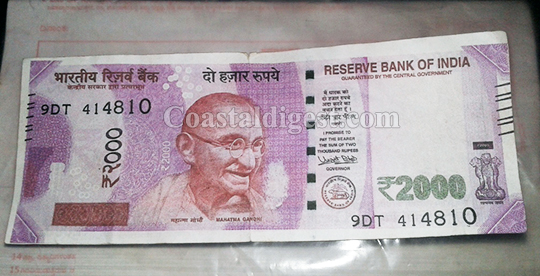
Panic in Dakshina Kannada as fake Rs 2,000 notes surface; probe begins

[email protected] (CD Network)
November 23, 2016

Mangaluru, Nov 23: Within a couple of days after the new Rs 2,000 notes went into circulation, miscreants in many parts of the country had duped innocents using its colour photo copy.

fake note

Now, the fake currency notes Rs 2,000 have surfaced in Bantwal taluk of Dakshina Kannada district triggering panic among the people in coastal Karnataka.

On Tuesday a resident of Punacha village near Vittla in Bantwal was taken aback after he was told that Rs 2,000 note he carried was just a colour photo copy of the original.

In a complaint to Vittla police, Krishnappa, said that he pledged his gold ring at a outlet of Muthoot Finance and got the Rs 2,000 note.

He used the note to purchase liquor at the outlet of MSIL. As he was going towards his house, two MSIL employees came in a vehicle and stopped Krishnappa. They told him that the note he had given was a colour photo copy of the original.

They took away the liquor and gave him back the note he had given them. Krishnappa went to Muthoot Finance who denied having given him the note.

He also went to the branch of Syndicate Bank from where the finance company had brought the money. The bank officials too denied that they dispensed with such a note. The police said that they are looking into the issue now.

Also Read: Rs 2000 fake notes already out; farmer duped with colour photocopy of note

Comments

Wonder Kotian
 - 
Wednesday, 23 Nov 2016

Chaddis gone Pantloons came, Notes gone Faku Notes started, Bap ray Bap what's happening these Criminal Looters ruling, Master Narean Where are you???? now do not come front, let it dissolve all these note dealings after we will see how it works!!!!!

Ahmed K./C.
 - 
Wednesday, 23 Nov 2016

Subbu, Mangalore,
That app is only for fun. Not for scanning the currency. It does work even on a xerox copy of new Rs.2000 note.

Abu Kotian
 - 
Wednesday, 23 Nov 2016

Need to keep an eye on BANGHI PARIVAR.

KhasaiKhane
 - 
Wednesday, 23 Nov 2016

What Bhakts said and what happened ?

1] Demonetization will stop fake currency circulation.
- Fake currency starts off from their favourite United States of Gujarath and goes across the country.

2] It will stop terrorists funding.
- 3 terrorists held with the New Rs. 2000 note currency, while poor still stand in long queues at banks.

3] Black money will be stopped and black money holders will be jailed.
- SBI waives off loans of more than 50 loan defaulters including Vijay mallya.

4] Demonetization will boost economy
- All markets affected due to lack of sales activities in the past 2 weeks.
- Dollar is higher than ever at Rs. 68.14/ USD.

5] 15 Lakhs will surely com into ur account.
- Government takes people's own hard earned money to fee the crony capitalists, even at the cost of 56 people's death till today.

Mohammed SS
 - 
Wednesday, 23 Nov 2016

Mistron, Acche Din Aagaye, ab phir ek bar BJP sarkar

Althaf
 - 
Wednesday, 23 Nov 2016

All thanks to Fenku.

Skazi
 - 
Wednesday, 23 Nov 2016

This is the trap played by the liquor shop .....

Rikaz
 - 
Wednesday, 23 Nov 2016

It seems like Bantwal is notorious for fake currencies.....need to keep an eye on it by security system....

Add new comment

  • Coastaldigest.com reserves the right to delete or block any comments.
  • Coastaldigset.com is not responsible for its readers’ comments.
  • Comments that are abusive, incendiary or irrelevant are strictly prohibited.
  • Please use a genuine email ID and provide your name to avoid reject.
News Network
May 5,2020

Bengaluru, May 5: Karnataka Chief Minister BS Yediyurappa on Tuesday said that the coronavirus situation in the state is "under control" as compared to several other states in the country.

He also hinted that soon the construction and industrial activities would be allowed in the state except in the red zones.

"Coronavirus situation in the state is under control as compared to other states. Due to this, travel of migrant workers was prohibited. Now, trade, construction and industrial activities need to restart, except in the red zones," he told reporters.

According to the Karnataka Health Department, the state has so far recorded 659 COVID-19 cases, including 324 discharged and 28 deaths.

Comments

Add new comment

  • Coastaldigest.com reserves the right to delete or block any comments.
  • Coastaldigset.com is not responsible for its readers’ comments.
  • Comments that are abusive, incendiary or irrelevant are strictly prohibited.
  • Please use a genuine email ID and provide your name to avoid reject.
News Network
May 3,2020

Bengaluru, May 3: Undergraduate and postgraduate students skipping online classes held by their universities run the risk of being debarred from writing their exams. 

State universities, which are monitoring the attendance of online classes, are asking their affiliate colleges to send the monthly online attendance details and this would reflect in their regular attendance. This would apply to those studying professional courses like medicine and engineering. 

State medical education minister Dr K Sudhakar has asked all medical colleges to regularly send attendance details to the Rajiv Gandhi University of Health Sciences (RGUHS).

RGUHS vice-chancellor Dr Sachidanand confirmed to DH that the varsity is indeed monitoring the attendance of students. “Online classes are equal to classroom teaching. (Such method of conducting classes) are necessary during the Covid-19 pandemic and the nationwide lockdown,” he said.

According to the Supreme Court directions, students should have 75% attendance to be eligible to appear for the final exams. There could be relaxations if they have health issues. If students are bunking online classes, it would reflect on their minimum attendance necessary to appear for the exams, the vice-chancellors of state-run varsities said.

Bangalore University vice-chancellor Prof K R Venugopal said most of the students are attending online classes and teachers are messaging the parents of those who are irregular. “(Of course) if they fall short of the minimum attendance, they won’t be allowed to appear for the exams,” he said.

Bengaluru North University vice-chancellor Prof T D Kemparaju said the administration has asked its teachers to record details of students attending online classes and update the university.

Mixed signals 

Meanwhile, the University Grants Commission (UGC) on Wednesday issued guidelines directing all universities to treat the lockdown period as “deemed as attended” for students and research scholars. Experts pointed out that the order would prompt students not to take the online classes seriously.

“Arrangements have been made at the state varsities to make students attend online classes compulsorily and students are also serious about it. Now, because of the UGC guidelines, they may bunk classes,” said the vice-chancellor of a state-run university.

Comments

Add new comment

  • Coastaldigest.com reserves the right to delete or block any comments.
  • Coastaldigset.com is not responsible for its readers’ comments.
  • Comments that are abusive, incendiary or irrelevant are strictly prohibited.
  • Please use a genuine email ID and provide your name to avoid reject.
News Network
January 25,2020

New Delhi, Jan 25: The latest edition of the Oxford Advanced Learner's Dictionary features 26 new Indian English words, including Aadhaar, chawl, dabba, hartal and shaadi.

The 10th edition of the dictionary, which was launched on Friday, has 384 Indian English words and incorporates over 1,000 new words such as chatbot, fake news and microplastic.

The dictionary focuses on language change and its evolution through the years, and has ensured that the language and examples used in the new edition are relevant and up to date with the times, Oxford University Press (OUP) said.

The new edition comes with interactive online support through the Oxford Learner's Dictionaries website and an app. The website includes advanced features such as audio-video tutorials, video walkthroughs, self-study activities and enhanced iWriter and iSpeaker tools.

"This edition has 26 new Indian English words of which 22 figure in the printed dictionary. The other four are in the digital version," said Fathima Dada, Managing Director (Education Division) at OUP.

Some of other new Indian words in the dictionary are auntie (while aunty already figures in the English dictionary, auntie is an Indianism), bus stand, deemed university, FIR, non-veg, redressal, tempo, tube light, veg and videograph.

The four new Indian English words in the online version of the dictionary are current (for electricity), looter, looting and upazila (one of the areas that a district is divided into for administration purposes).

According to OUP, the new edition provides better, more accurate and understandable definitions with examples, usage notes and additional resources to help the learner use the right word in the right context.

"Prevalence and common usage are the main criteria for enlisting new words. We scan the globe for words which are often used by people while speaking English. Then these words go through a rigorous testing process," Dada said.

"As OUP is the custodian of English language globally, these words have to go through its processes," she told PTI.

The Oxford Advanced Learner's Dictionary, she said, has been reinventing itself for nearly eight decades, anticipating the growing learning requirements of learners.

"The 10th edition also is equipped with a strong digital support system, including an app," she said.

It is equipped with several digital tools. With iSpeaker, learners can get help preparing for speaking exams and presentations. With iWriter, learners can plan, write and review their written work. Text Checker allows the teacher to check any text against the Oxford 3000, 5000, and OPAL (Oxford Phrasal Academic Lexicon) written word list.

Resources accessible through online premium access include lesson plans, worksheets, video walkthroughs, and classroom and self-study activities. With the OALD app one can find 86,000 words, 95,000 phrases, 112,000 meanings and 237,000 examples.

The dictionary, which spans 77 years, was originally published in Japan in 1942 and was first brought out by OUP in 1948. The learner's dictionary is based on the original values of its creator, Albert Sydney Hornby, whose aim was to help language learners worldwide understand the meaning of English words.


Comments

Add new comment

  • Coastaldigest.com reserves the right to delete or block any comments.
  • Coastaldigset.com is not responsible for its readers’ comments.
  • Comments that are abusive, incendiary or irrelevant are strictly prohibited.
  • Please use a genuine email ID and provide your name to avoid reject.