



Indian teen discovers cheap way to make saltwater drinkable

February 5, 2017

San Francisco, Feb 5: An Indian-American student has found a cheaper and easier method to turn salt water into drinkable fresh water and his research has caught the attention of major technology firms and universities.
saltwater

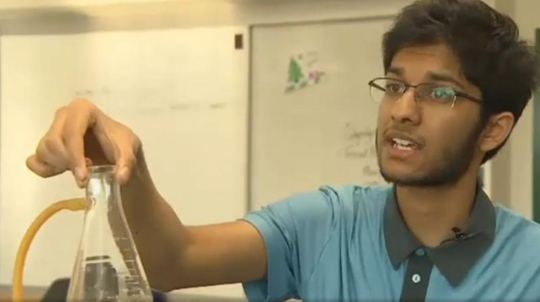
Chaitanya Karamchedu from Portland, Oregon, is turning heads across the country all because of a science experiment that began in his high school classroom.

The Jesuit High School Senior told KPTV that he has big plans of changing the world.

"1 in 8 people do not have access to clean water, it's a crying issue that needs to be addressed," said Karamchedu.

He made up his mind to address the matter himself.

"The best access for water is the sea, so 70 per cent of the planet is covered in water and almost all of that is the ocean, but the problem is that's salt water," said Karamchedu.

Isolating drinkable water from the ocean in a cost effective way is a problem that has stumped scientists for years.

"Scientists looked at desalination, but it's all still inaccessible to places and it would cost too much to implement on a large scale," Karamchedu said.

Karamchedu figured it out, on his own, in a high school lab.

"The real genesis of the idea was realising that sea water is not fully saturated with salt," he was quoted as saying.

By experimenting with a highly absorbent polymer, the teen discovered a cost effective way to remove salt from ocean water and turn it into fresh water.

"It's not bonding with water molecules, it's bonding to the salt," said Karamchedu.

"People have been looking at the problem from one view point, how do we break those bonds between salt and the water? Chai came in and thought about it from a completely different angle," said Jesuit High School Biology Teacher Dr. Lara Shamieh.

"People were concentrated on that 10 per cent of water that's bonded to the salt in the sea and no one looked at the 90 per cent that was free. Chai just looked at it and said if 10 per cent is bonded and 90 per cent is free, then why are we so focused on this 10 per cent, let's ignore it and focus on the 90," Shamieh said.

It is a breakthrough that is estimated to impact millions of lives if ever implemented on a mass scale.

"What this is compared to current techniques, is that it's cheap and accessible to everyone, everyone can use it," said Shamieh.

Scientists across the country are taking note. He won a USD 10,000 award from the US Agency for International Global Development at Intel's International Science Fair and second place at MIT's TechCon Conference where he won more money to continue his research.

"They were very encouraging, they could see things into it that I couldn't, because they've been working their whole lives on this," said Karamchedu.

Back in January, Karamchedu was also named one of 300 Regeneron Science Talent Search Semifinalists. The STS is thought to be one of the most prestigious competitions in the country for high school seniors.

Comments

James Freeman
 - 
Monday, 6 Feb 2017

Nestle (Pepsi, Coca Cola, etc.) certainly won't like this! It was Nestle Chairman, Peter Brabeck-Letmathe, who said '?ccess to water is not a public right.'?

I expect this breakthrough discovery will 'somehow' go nowhere, and this smart young man probably needs to start watching his back. Too much profit stands to be lost with this....

Add new comment

  • Coastaldigest.com reserves the right to delete or block any comments.
  • Coastaldigset.com is not responsible for its readers’ comments.
  • Comments that are abusive, incendiary or irrelevant are strictly prohibited.
  • Please use a genuine email ID and provide your name to avoid reject.
Agencies
April 17,2020

New Delhi, Apr 17: The Indian Railways turned 167 years old on Thursday and for the first time ever, its trains did not carry any passengers on its birthday and instead stood idle in the yards waiting for the nationwide lockdown to end.

On this day 167 years ago, the wheels of the first passenger train in the country from Mumbai to Thane started rolling.

In 1974, Indians experienced life without trains for the first time. In May 1974 during the strike of the railways that lasted for around three weeks, drivers, station masters, guards, track staff and many others went on 'chakka jam' demanding fixed working hours for train drivers and an across-the-board pay hike.

"I can recall those times vividly. I remember that our leader George Fernandes had almost secured a deal with the then railway minister, but it fell through when it was taken to the then Prime Minister Indira Gandhi," All India Railwaymens Federation General Secretary Shiv Gopal Mishra, who was an apprentice in the railways at that time, told PTI.

"Fernandes was arrested in Lucknow. The workers went through a lot at that time. But those were days that angry workers had refused to give in and took great risks to get their demands met," he said.

However, just like this time, four decades ago too freight trains carrying essential supplies were run and the unions agreed to let some passenger trains run on the trunk routes like the Kalka Mail from Howrah to Delhi.

"Never ever in its history, there has been such a long interruption of services. Not during the World Wars, not during the 1974 railway strike, or any other national calamity or natural disaster," a railway spokesperson said.

The first Indian Railways passenger train was flagged off on April 16, 1853, from Mumbai to nearby Thane.

On Thursday, the Railway Ministry wished the railways a happy birthday on Twitter - "Today, 167 years ago with the zeal of 'never to stop' the wheels of the first passenger train from Mumbai to Thane started rolling. For the first time, passenger services are stopped for your safety. Stay indoors & make the nation victorious," it said.

Railway has suspended all passenger services since March 25 till May 3 due to the coronavirus outbreak. Around 15,523 trains run by the railways have been affected including 9,000 passenger trains and 3,000 mail express services which are run daily. It caters to over 20 million passengers every day.

According to the Union health ministry, the death toll due to coronavirus rose to 414 and the number of cases to 12,380 in the country on Thursday.

Comments

Add new comment

  • Coastaldigest.com reserves the right to delete or block any comments.
  • Coastaldigset.com is not responsible for its readers’ comments.
  • Comments that are abusive, incendiary or irrelevant are strictly prohibited.
  • Please use a genuine email ID and provide your name to avoid reject.
Agencies
July 2,2020

Paris, Jul 2: Several interacting exoplanets have already been spotted by satellites. But a new breakthrough has been achieved with, for the first time, the detection directly from the ground of an extrasolar system of this type.

An international collaboration including CNRS researchers has discovered an unusual planetary system, dubbed WASP-148, using the French instrument SOPHIE at the Observatoire de Haute-Provence (CNRS/Aix-Marseille Universite).

The scientists analysed the star's motion and concluded that it hosted two planets, WASP-148b and WASP-148c. The observations showed that the two planets were strongly interacting, which was confirmed from other data.

Whereas the first planet, WASP-148b, orbits its star in nearly nine days, the second one, WASP-148c, takes four times longer. This ratio between the orbital periods implies that the WASP-148 system is close to resonance, meaning that there is enhanced gravitational interaction between the two planets. And it turns out that the astronomers did indeed detect variations in the orbital periods of the planets.

While a single planet, uninfluenced by a second one, would move with a constant period, WASP-148b and WASP-148c undergo acceleration and deceleration that provides evidence of their interaction.

The study will shortly be published in the journal Astronomy & Astrophysics.

Comments

Add new comment

  • Coastaldigest.com reserves the right to delete or block any comments.
  • Coastaldigset.com is not responsible for its readers’ comments.
  • Comments that are abusive, incendiary or irrelevant are strictly prohibited.
  • Please use a genuine email ID and provide your name to avoid reject.
News Network
May 7,2020

Toronto, May 7: Scientists have uncovered how bats can carry the MERS coronavirus without getting sick, shedding light on what triggers coronaviruses, including the one behind the COVID-19 pandemic, to jump to humans.

According to the study, published in the journal Scientific Reports, coronaviruses like the Middle East respiratory syndrome (MERS) virus, and the COVID19-causing SARS-CoV-2 virus, are thought to have originated in bats.

While these viruses can cause serious, and often fatal disease in people, bats seem unharmed, the researchers, including those from the University of Saskatchewan (USask) in Canada, said.

"The bats don't get rid of the virus and yet don't get sick. We wanted to understand why the MERS virus doesn't shut down the bat immune responses as it does in humans," said USask microbiologist Vikram Misra.

In the study, the scientists demonstrated that cells from an insect-eating brown bat can be persistently infected with MERS coronavirus for months, due to important adaptations from both the bat and the virus working together.

"Instead of killing bat cells as the virus does with human cells, the MERS coronavirus enters a long-term relationship with the host, maintained by the bat's unique 'super' immune system," said Misra, one of the study's co-authors.

"SARS-CoV-2 is thought to operate in the same way," he added.

Stresses on bats, such as wet markets, other diseases, and habitat loss, may have a role in coronavirus spilling over to other species, the study noted.

"When a bat experiences stress to their immune system, it disrupts this immune system-virus balance and allows the virus to multiply," Misra said.

The scientists, involved in the study, had earlier developed a potential treatment for MERS-CoV, and are currently working towards a vaccine against COVID-19.

While camels are the known intermediate hosts of MERS-CoV, they said bats are suspected to be the ancestral host.

There is no vaccine for either SARS-CoV-2 or MERS, the researchers noted.

Follow latest updates on the COVID-19 pandemic here

"We see that the MERS coronavirus can very quickly adapt itself to a particular niche, and although we do not completely understand what is going on, this demonstrates how coronaviruses are able to jump from species to species so effortlessly," said USask scientist Darryl Falzarano, who co-led the study.

According to Misra, coronaviruses rapidly adapt to the species they infect, but little is known on the molecular interactions of these viruses with their natural bat hosts.

An earlier study had shown that bat coronaviruses can persist in their natural bat host for at least four months of hibernation.

When exposed to the MERS virus, the researchers said, bat cells adapt, not by producing inflammation-causing proteins that are hallmarks of getting sick, but instead by maintaining a natural antiviral response.

On the contrary, they said this function shuts down in other species, including humans.

The MERS virus, the researchers said, also adapts to the bat host cells by very rapidly mutating one specific gene.

These adaptations, according to the study, result in the virus remaining long-term in the bat, but being rendered harmless until something like a disease, or other stressors, upsets this balance.

In future experiments, the scientists hope to understand how the bat-borne MERS virus adapts to infection and replication in human cells.

"This information may be critical for predicting the next bat virus that will cause a pandemic," Misra said.

Comments

Add new comment

  • Coastaldigest.com reserves the right to delete or block any comments.
  • Coastaldigset.com is not responsible for its readers’ comments.
  • Comments that are abusive, incendiary or irrelevant are strictly prohibited.
  • Please use a genuine email ID and provide your name to avoid reject.