



Indian teen discovers cheap way to make saltwater drinkable

February 5, 2017

San Francisco, Feb 5: An Indian-American student has found a cheaper and easier method to turn salt water into drinkable fresh water and his research has caught the attention of major technology firms and universities.
saltwater

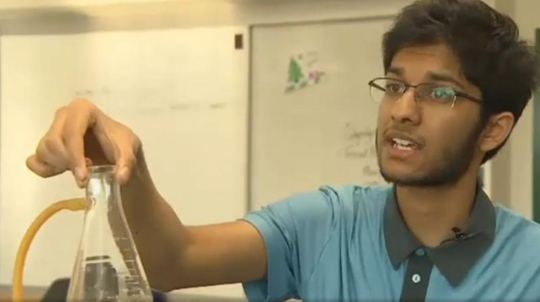
Chaitanya Karamchedu from Portland, Oregon, is turning heads across the country all because of a science experiment that began in his high school classroom.

The Jesuit High School Senior told KPTV that he has big plans of changing the world.

"1 in 8 people do not have access to clean water, it's a crying issue that needs to be addressed," said Karamchedu.

He made up his mind to address the matter himself.

"The best access for water is the sea, so 70 per cent of the planet is covered in water and almost all of that is the ocean, but the problem is that's salt water," said Karamchedu.

Isolating drinkable water from the ocean in a cost effective way is a problem that has stumped scientists for years.

"Scientists looked at desalination, but it's all still inaccessible to places and it would cost too much to implement on a large scale," Karamchedu said.

Karamchedu figured it out, on his own, in a high school lab.

"The real genesis of the idea was realising that sea water is not fully saturated with salt," he was quoted as saying.

By experimenting with a highly absorbent polymer, the teen discovered a cost effective way to remove salt from ocean water and turn it into fresh water.

"It's not bonding with water molecules, it's bonding to the salt," said Karamchedu.

"People have been looking at the problem from one view point, how do we break those bonds between salt and the water? Chai came in and thought about it from a completely different angle," said Jesuit High School Biology Teacher Dr. Lara Shamieh.

"People were concentrated on that 10 per cent of water that's bonded to the salt in the sea and no one looked at the 90 per cent that was free. Chai just looked at it and said if 10 per cent is bonded and 90 per cent is free, then why are we so focused on this 10 per cent, let's ignore it and focus on the 90," Shamieh said.

It is a breakthrough that is estimated to impact millions of lives if ever implemented on a mass scale.

"What this is compared to current techniques, is that it's cheap and accessible to everyone, everyone can use it," said Shamieh.

Scientists across the country are taking note. He won a USD 10,000 award from the US Agency for International Global Development at Intel's International Science Fair and second place at MIT's TechCon Conference where he won more money to continue his research.

"They were very encouraging, they could see things into it that I couldn't, because they've been working their whole lives on this," said Karamchedu.

Back in January, Karamchedu was also named one of 300 Regeneron Science Talent Search Semifinalists. The STS is thought to be one of the most prestigious competitions in the country for high school seniors.

Comments

James Freeman
 - 
Monday, 6 Feb 2017

Nestle (Pepsi, Coca Cola, etc.) certainly won't like this! It was Nestle Chairman, Peter Brabeck-Letmathe, who said '?ccess to water is not a public right.'?

I expect this breakthrough discovery will 'somehow' go nowhere, and this smart young man probably needs to start watching his back. Too much profit stands to be lost with this....

Add new comment

  • Coastaldigest.com reserves the right to delete or block any comments.
  • Coastaldigset.com is not responsible for its readers’ comments.
  • Comments that are abusive, incendiary or irrelevant are strictly prohibited.
  • Please use a genuine email ID and provide your name to avoid reject.
Agencies
January 10,2020

Indian enterprises were flooded with a whopping 14.6 crore malware threats in 2019 - a growth of 48 per cent (year-on-year) compared to 2018, a new report said on Friday.

Manufacturing, BFSI (banking, financial services and insurance), education, healthcare, IT/ITES, and the government were the most at-risk industries in the country, said the report from Seqrite, the enterprise arm of Pune-based IT security firm Quick Heal Technologies.

Interestingly, almost a quarter (23 per cent) of the threats were identified through 'Signatureless behaviour-based' detection by Seqrite, indicating how a growing number of cybercriminals were deploying new or previously unknown threat vectors to compromise enterprise security.

"With the latest Seqrite annual threat report, we want to empower CIOs, CISOs, business leaders and all key public stakeholders with the insights they need to combat the growing complexity of the threat landscape," said Sanjay Katkar, Joint Managing Director and CTO, Quick Heal Technologies.

The most prominent trend was the drastic increase in the volume, intensity, and sophistication of cyber-attack campaigns targeting Indian enterprises in 2019.

The rapid integration of IoT devices, BYOD (bring your own device), and third-party APIs into enterprise networks has created newer security vulnerabilities that might go unnoticed until a major breach occurs.

Threat researchers at Seqrite observed several large-scale advanced persistent threats (APT) attacks deployed against organisations in the government sector.

"The entry of nation-states and organised cybercrime cells into the fray is expected to add more complication to this situation and will require Indian government bodies and corporate enterprises to shore up their cyber defence strategies in 2020 and beyond," the report noted.

More alarming, however, was the continued lack of security awareness amongst enterprises and government organisations.

"Unsecured Remote Desktop Protocol (RDP) and Server Message Block (SMB) protocols continued to be targeted through brute-force attacks," said the report.

Spear phishing attack campaigns leveraging Office exploits and infected macros were also used extensively by cybercriminals to gain access to enterprise networks and steal critical data.

"India's digital journey depends on ensuring robust cybersecurity for all stakeholders within the enterprise ecosystem," said Katkar.

The sharp spike should be a cause of concern for CIOs and CISOs in the country, especially given the growing digital penetration within their enterprise networks.

"With network vulnerabilities and potential entry points increasing at a rapid pace, threat actors are expected to leverage artificial intelligence (AI) capabilities to power their malware campaigns in the future to capitalise on newer attack vectors," the report added.

Comments

Add new comment

  • Coastaldigest.com reserves the right to delete or block any comments.
  • Coastaldigset.com is not responsible for its readers’ comments.
  • Comments that are abusive, incendiary or irrelevant are strictly prohibited.
  • Please use a genuine email ID and provide your name to avoid reject.
News Network
May 7,2020

Toronto, May 7: Scientists have uncovered how bats can carry the MERS coronavirus without getting sick, shedding light on what triggers coronaviruses, including the one behind the COVID-19 pandemic, to jump to humans.

According to the study, published in the journal Scientific Reports, coronaviruses like the Middle East respiratory syndrome (MERS) virus, and the COVID19-causing SARS-CoV-2 virus, are thought to have originated in bats.

While these viruses can cause serious, and often fatal disease in people, bats seem unharmed, the researchers, including those from the University of Saskatchewan (USask) in Canada, said.

"The bats don't get rid of the virus and yet don't get sick. We wanted to understand why the MERS virus doesn't shut down the bat immune responses as it does in humans," said USask microbiologist Vikram Misra.

In the study, the scientists demonstrated that cells from an insect-eating brown bat can be persistently infected with MERS coronavirus for months, due to important adaptations from both the bat and the virus working together.

"Instead of killing bat cells as the virus does with human cells, the MERS coronavirus enters a long-term relationship with the host, maintained by the bat's unique 'super' immune system," said Misra, one of the study's co-authors.

"SARS-CoV-2 is thought to operate in the same way," he added.

Stresses on bats, such as wet markets, other diseases, and habitat loss, may have a role in coronavirus spilling over to other species, the study noted.

"When a bat experiences stress to their immune system, it disrupts this immune system-virus balance and allows the virus to multiply," Misra said.

The scientists, involved in the study, had earlier developed a potential treatment for MERS-CoV, and are currently working towards a vaccine against COVID-19.

While camels are the known intermediate hosts of MERS-CoV, they said bats are suspected to be the ancestral host.

There is no vaccine for either SARS-CoV-2 or MERS, the researchers noted.

Follow latest updates on the COVID-19 pandemic here

"We see that the MERS coronavirus can very quickly adapt itself to a particular niche, and although we do not completely understand what is going on, this demonstrates how coronaviruses are able to jump from species to species so effortlessly," said USask scientist Darryl Falzarano, who co-led the study.

According to Misra, coronaviruses rapidly adapt to the species they infect, but little is known on the molecular interactions of these viruses with their natural bat hosts.

An earlier study had shown that bat coronaviruses can persist in their natural bat host for at least four months of hibernation.

When exposed to the MERS virus, the researchers said, bat cells adapt, not by producing inflammation-causing proteins that are hallmarks of getting sick, but instead by maintaining a natural antiviral response.

On the contrary, they said this function shuts down in other species, including humans.

The MERS virus, the researchers said, also adapts to the bat host cells by very rapidly mutating one specific gene.

These adaptations, according to the study, result in the virus remaining long-term in the bat, but being rendered harmless until something like a disease, or other stressors, upsets this balance.

In future experiments, the scientists hope to understand how the bat-borne MERS virus adapts to infection and replication in human cells.

"This information may be critical for predicting the next bat virus that will cause a pandemic," Misra said.

Comments

Add new comment

  • Coastaldigest.com reserves the right to delete or block any comments.
  • Coastaldigset.com is not responsible for its readers’ comments.
  • Comments that are abusive, incendiary or irrelevant are strictly prohibited.
  • Please use a genuine email ID and provide your name to avoid reject.
News Network
February 21,2020

London, Feb 21: Scientists have discovered a new species of land snail, and have named it Craspedotropis Greta Thunberg in honour of the Swedish activist Greta Thunberg for her efforts to raise awareness about climate change.

According to the study, published in the Biodiversity Data Journal, the newly discovered species belongs to the so-called caenogastropods -- a group of land snails known to be sensitive to drought, temperature extremes, and forest degradation.

The scientists, including evolutionary ecologist Menno Schilthuizen from Naturalis Biodiversity Center in the Netherlands, said the snails were found very close to the research field station at Kuala Belalong Field Studies Centre in Brunei.

They added that the snails were discovered at the foot of a steep hill-slope, next to a river bank, foraging at night on the green leaves of understorey plants.

The effort aided by amateur scientist J.P. Lim, who found the first individual of the snail said, "Naming this snail after Greta Thunberg is our way of acknowledging that her generation will be responsible for fixing problems that they did not create."

"And it's a promise that people from all generations will join her to help," Lim said.

The researchers said they approached Thunberg who said that she would be "delighted" to have this species named after her.

The study work including, fieldwork, morphological study, and classification of identified specimen was carried out in a field centre with basic equipment and no internet access, the scientists said.

According to the study, the work was done by untrained ‘citizen scientists’ guided by experts, on a 10-day taxon expedition.

"While we are aware that this way of working has its limitations in terms of the quality of the output (for example, we were unable to perform dissections or to do extensive literature searches), the benefits include rapid species discovery and on-site processing of materials," the researchers wrote in the study.

Comments

Add new comment

  • Coastaldigest.com reserves the right to delete or block any comments.
  • Coastaldigset.com is not responsible for its readers’ comments.
  • Comments that are abusive, incendiary or irrelevant are strictly prohibited.
  • Please use a genuine email ID and provide your name to avoid reject.