



Indian teen discovers cheap way to make saltwater drinkable

February 5, 2017

San Francisco, Feb 5: An Indian-American student has found a cheaper and easier method to turn salt water into drinkable fresh water and his research has caught the attention of major technology firms and universities.
saltwater

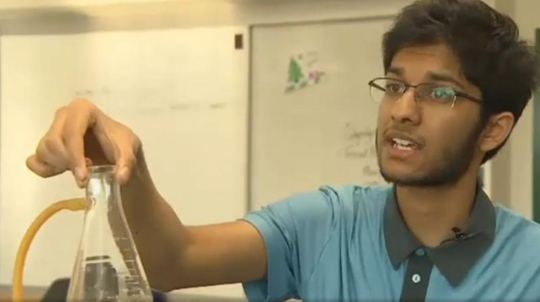
Chaitanya Karamchedu from Portland, Oregon, is turning heads across the country all because of a science experiment that began in his high school classroom.

The Jesuit High School Senior told KPTV that he has big plans of changing the world.

"1 in 8 people do not have access to clean water, it's a crying issue that needs to be addressed," said Karamchedu.

He made up his mind to address the matter himself.

"The best access for water is the sea, so 70 per cent of the planet is covered in water and almost all of that is the ocean, but the problem is that's salt water," said Karamchedu.

Isolating drinkable water from the ocean in a cost effective way is a problem that has stumped scientists for years.

"Scientists looked at desalination, but it's all still inaccessible to places and it would cost too much to implement on a large scale," Karamchedu said.

Karamchedu figured it out, on his own, in a high school lab.

"The real genesis of the idea was realising that sea water is not fully saturated with salt," he was quoted as saying.

By experimenting with a highly absorbent polymer, the teen discovered a cost effective way to remove salt from ocean water and turn it into fresh water.

"It's not bonding with water molecules, it's bonding to the salt," said Karamchedu.

"People have been looking at the problem from one view point, how do we break those bonds between salt and the water? Chai came in and thought about it from a completely different angle," said Jesuit High School Biology Teacher Dr. Lara Shamieh.

"People were concentrated on that 10 per cent of water that's bonded to the salt in the sea and no one looked at the 90 per cent that was free. Chai just looked at it and said if 10 per cent is bonded and 90 per cent is free, then why are we so focused on this 10 per cent, let's ignore it and focus on the 90," Shamieh said.

It is a breakthrough that is estimated to impact millions of lives if ever implemented on a mass scale.

"What this is compared to current techniques, is that it's cheap and accessible to everyone, everyone can use it," said Shamieh.

Scientists across the country are taking note. He won a USD 10,000 award from the US Agency for International Global Development at Intel's International Science Fair and second place at MIT's TechCon Conference where he won more money to continue his research.

"They were very encouraging, they could see things into it that I couldn't, because they've been working their whole lives on this," said Karamchedu.

Back in January, Karamchedu was also named one of 300 Regeneron Science Talent Search Semifinalists. The STS is thought to be one of the most prestigious competitions in the country for high school seniors.

Comments

James Freeman
 - 
Monday, 6 Feb 2017

Nestle (Pepsi, Coca Cola, etc.) certainly won't like this! It was Nestle Chairman, Peter Brabeck-Letmathe, who said '?ccess to water is not a public right.'?

I expect this breakthrough discovery will 'somehow' go nowhere, and this smart young man probably needs to start watching his back. Too much profit stands to be lost with this....

Add new comment

  • Coastaldigest.com reserves the right to delete or block any comments.
  • Coastaldigset.com is not responsible for its readers’ comments.
  • Comments that are abusive, incendiary or irrelevant are strictly prohibited.
  • Please use a genuine email ID and provide your name to avoid reject.
Agencies
January 16,2020

Claiming that e-commerce giants like Amazon import as much as 80 per cent of the items sold on their platforms, small manufacturers' body has said that their business models do not benefit local industry and are creating jobs of delivery boys only.

"Neither manufacturers nor traders are getting any benefit from the business models of Amazon and Flipkart because they largely import their products from China and Korea and sell here. Nearly 80 per cent of their products are imported," said Anil Bhardwaj, Secretary General, Federation of Indian Micro and Small & Medium Enterprises (FISME).

Bhardwaj said that the global e-commerce players generally source and sell products through their own preferred suppliers and as a result a large number of local manufacturers and traders get crowded out.

He listed out deep discounting and buying products from preferred companies as unfair practices.

"Even if they buy products from local suppliers the commission charged is very high," Bhardwaj said adding that the issues related to unfair practices have been raised with Commerce Ministry on multiple occasions.

FISME maintains that the technology-driven retail is way forward and one cannot be oblivious of the benefits it brings to consumers but at the same time the local industry can also not be ignored given its role in job creation.

"If both traders and local manufacturers are crowded out then how would the local industry survive and employment be generated?" asked Bhardwaj.

As Amazon Founder and CEO Jeff Bezos is currently on his three-day visit to India, the local traders are up in arms against the "unfair" trade practices of the tech giant. Delhi-based Confederation of All India Traders (CAIT) has launched a countrywide protest against the company and has organised protests across 300 cities.

In a setback to Amazon and Walmart-backed Flipkart, the fair market watchdog Competition Commission of India (CCI) has ordered probe into the business operations of both the companies on multiple counts including deep-discounts and exclusive tie-up with preferred sellers.

"For the first time some concrete step has been taken against Amazon and Flipkart who are continuously violating the FDI policy in indulging in a vicious racket of controlling and monopolising not only the e-commerce but even the retail trade as well," CAIT National Secretary General Praveen Khandelwal said after the CCI order.

Comments

Add new comment

  • Coastaldigest.com reserves the right to delete or block any comments.
  • Coastaldigset.com is not responsible for its readers’ comments.
  • Comments that are abusive, incendiary or irrelevant are strictly prohibited.
  • Please use a genuine email ID and provide your name to avoid reject.
Agencies
February 26,2020

Unnao, Feb 26: Ever heard of someone wishing a 'bright future' for the dead? In a bizarre incident in Uttar Pradesh's Unnao district, a village head issued a death certificate with the wish for an elderly man who had died last month.

The incident took place in the Sirwariya village in Asoha block where an elderly person Laxmi Shankar died after a prolonged illness on January 22.

His son went to the village head Babulal and requested him to issue a death certificate that he needed for some financial transactions.

Babulal not only issued the death certificate, but also 'wished' 'a bright future for the deceased' on the document.

The village head wrote in the death certificate -- "Main inke ujjwal bhavishya ki kaamna karta hoon (I wish him a bright future)."

The letter went viral on the social media on Monday after which the village head apologised for the error and issued a new death certificate.

Comments

Add new comment

  • Coastaldigest.com reserves the right to delete or block any comments.
  • Coastaldigset.com is not responsible for its readers’ comments.
  • Comments that are abusive, incendiary or irrelevant are strictly prohibited.
  • Please use a genuine email ID and provide your name to avoid reject.
Agencies
May 27,2020

Due to impacts of COVID-19, shipments of total mobile phones are forecast to decline 14.6% in 2020, while smartphone shipments will achieve a slightly slower decline of 13.7 % year over year to total 1.3 billion units this year, according to a Gartner forecast on Tuesday.

"While users have increased the use of their mobile phones to communicate with colleagues, work partners, friends and families during lockdowns, reduced disposable income will result in fewer consumers upgrading their phones," Ranjit Atwal, Senior Research Director at Gartner, said in a statement.

"As a result, phone lifetimes will extend from 2.5 years in 2018 to 2.7 years in 2020," said Atwal.

In 2020, affordable 5G phones were expected to be the catalyst to increase phone replacements, but now it is unlikely to be the case.

5G phones are now forecast to represent only 11% of total mobile phone shipments in 2020.

"The delayed delivery of some 5G flagship phones is an ongoing issue," said Annette Zimmermann, Research Vice President at Gartner.

"Moreover, the lack of 5G geographical coverage along with the increasing cost of the 5G phone contract will impact the choice of a 5G phone."

Overall, spending on 5G phones will be impacted in most regions apart from China, where continued investment in 5G infrastructure is expected, allowing providers in China to effectively market 5G phones.

The combined global shipments PCs, tablets and mobile phones are on pace to decline 13.6% in 2020, according to the forecast.

PC shipments are expected to decline 10.5% this year. Shipments of notebooks, tablets and Chromebooks are forecast to decline slower than the PC market overall in 2020.

"The forecasted decline in the PC market in particular could have been much worse," said Atwal.

"However, government lockdowns due to COVID-19 forced businesses and schools to enable millions of people to work from home and increase spending on new notebooks, Chromebooks and tablets for those workers. Education and government establishments also increased spending on those devices to facilitate e-learning."

Gartner said that 48 per cent of employees will likely work remotely at least part of the time after the COVID-19 pandemic, compared to 30 % pre-pandemic.

Overall, the work from home trend will make IT departments shift to more notebooks, tablets and Chrome devices for work.

"This trend combined with businesses required to create flexible business continuity plans will make business notebooks displace desk based PCs through 2021 and 2022," said Atwal.

Comments

Add new comment

  • Coastaldigest.com reserves the right to delete or block any comments.
  • Coastaldigset.com is not responsible for its readers’ comments.
  • Comments that are abusive, incendiary or irrelevant are strictly prohibited.
  • Please use a genuine email ID and provide your name to avoid reject.