



Indian teen discovers cheap way to make saltwater drinkable

February 5, 2017

San Francisco, Feb 5: An Indian-American student has found a cheaper and easier method to turn salt water into drinkable fresh water and his research has caught the attention of major technology firms and universities.
saltwater

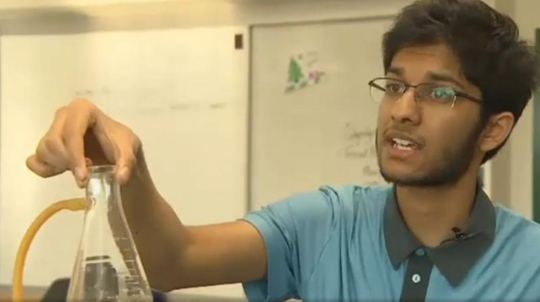
Chaitanya Karamchedu from Portland, Oregon, is turning heads across the country all because of a science experiment that began in his high school classroom.

The Jesuit High School Senior told KPTV that he has big plans of changing the world.

"1 in 8 people do not have access to clean water, it's a crying issue that needs to be addressed," said Karamchedu.

He made up his mind to address the matter himself.

"The best access for water is the sea, so 70 per cent of the planet is covered in water and almost all of that is the ocean, but the problem is that's salt water," said Karamchedu.

Isolating drinkable water from the ocean in a cost effective way is a problem that has stumped scientists for years.

"Scientists looked at desalination, but it's all still inaccessible to places and it would cost too much to implement on a large scale," Karamchedu said.

Karamchedu figured it out, on his own, in a high school lab.

"The real genesis of the idea was realising that sea water is not fully saturated with salt," he was quoted as saying.

By experimenting with a highly absorbent polymer, the teen discovered a cost effective way to remove salt from ocean water and turn it into fresh water.

"It's not bonding with water molecules, it's bonding to the salt," said Karamchedu.

"People have been looking at the problem from one view point, how do we break those bonds between salt and the water? Chai came in and thought about it from a completely different angle," said Jesuit High School Biology Teacher Dr. Lara Shamieh.

"People were concentrated on that 10 per cent of water that's bonded to the salt in the sea and no one looked at the 90 per cent that was free. Chai just looked at it and said if 10 per cent is bonded and 90 per cent is free, then why are we so focused on this 10 per cent, let's ignore it and focus on the 90," Shamieh said.

It is a breakthrough that is estimated to impact millions of lives if ever implemented on a mass scale.

"What this is compared to current techniques, is that it's cheap and accessible to everyone, everyone can use it," said Shamieh.

Scientists across the country are taking note. He won a USD 10,000 award from the US Agency for International Global Development at Intel's International Science Fair and second place at MIT's TechCon Conference where he won more money to continue his research.

"They were very encouraging, they could see things into it that I couldn't, because they've been working their whole lives on this," said Karamchedu.

Back in January, Karamchedu was also named one of 300 Regeneron Science Talent Search Semifinalists. The STS is thought to be one of the most prestigious competitions in the country for high school seniors.

Comments

James Freeman
 - 
Monday, 6 Feb 2017

Nestle (Pepsi, Coca Cola, etc.) certainly won't like this! It was Nestle Chairman, Peter Brabeck-Letmathe, who said '?ccess to water is not a public right.'?

I expect this breakthrough discovery will 'somehow' go nowhere, and this smart young man probably needs to start watching his back. Too much profit stands to be lost with this....

Add new comment

  • Coastaldigest.com reserves the right to delete or block any comments.
  • Coastaldigset.com is not responsible for its readers’ comments.
  • Comments that are abusive, incendiary or irrelevant are strictly prohibited.
  • Please use a genuine email ID and provide your name to avoid reject.
Agencies
June 9,2020

New Zealand's research institute in Antarctica is scaling back the number of projects planned for the upcoming season, in an effort to keep the continent free of coronavirus, it was reported on Tuesday.

The government agency, Antarctica New Zealand, told the BBC on Tuesday that it was dropping 23 of the 36 research projects.

Only long-term science monitoring, essential operational activity and planned maintenance will go ahead.

The upcoming research season runs from October to March.

"As COVID-19 sweeps the planet, only one continent remains untouched and (we) are focused on keeping it that way," Antarctica New Zealand told the BBC.

The organisation's chief executive Sarah Williamson said the travel limits and a strict managed isolation plan were the key factors for keeping Scott Base - New Zealand's research facility - virus free.

"Antarctica New Zealand is committed to maintaining and enhancing the quality of New Zealand's Antarctic scientific research. However, current circumstances dictate that our ability to support science is extremely limited this season" she said.

Earlier in April, Australia announced that it would scale back its activity in the 2020-21 summer season.

This included decreasing operational capacity and delaying work on some major projects.

Comments

Add new comment

  • Coastaldigest.com reserves the right to delete or block any comments.
  • Coastaldigset.com is not responsible for its readers’ comments.
  • Comments that are abusive, incendiary or irrelevant are strictly prohibited.
  • Please use a genuine email ID and provide your name to avoid reject.
News Network
March 18,2020

San Francisco, Mar 18: Facebook said a bug in its anti-spam system temporarily blocked the publication of links to news stories about the coronavirus. Guy Rosen, Facebook's vice president of integrity, said on Twitter Tuesday that the company was working on a fix for the problem.

Users complained that links to news stories about school closings and other information related to the virus outbreak were blocked by the company's automated system.

Later on Tuesday, Rosen tweeted that Facebook had restored all the incorrectly deleted posts, which also covered topics beyond the coronavirus.

Rosen said the problems were unrelated to any changes in Facebook's content-moderator workforce. The company reportedly sent its human moderators home this week because of the coronavirus outbreak.

A representative for Facebook did not immediately respond to questions on the status of Facebook's content moderators, many of whom do not work directly for the company and are not always able to work from home.

Comments

Add new comment

  • Coastaldigest.com reserves the right to delete or block any comments.
  • Coastaldigset.com is not responsible for its readers’ comments.
  • Comments that are abusive, incendiary or irrelevant are strictly prohibited.
  • Please use a genuine email ID and provide your name to avoid reject.
News Network
February 21,2020

London, Feb 21: Scientists have discovered a new species of land snail, and have named it Craspedotropis Greta Thunberg in honour of the Swedish activist Greta Thunberg for her efforts to raise awareness about climate change.

According to the study, published in the Biodiversity Data Journal, the newly discovered species belongs to the so-called caenogastropods -- a group of land snails known to be sensitive to drought, temperature extremes, and forest degradation.

The scientists, including evolutionary ecologist Menno Schilthuizen from Naturalis Biodiversity Center in the Netherlands, said the snails were found very close to the research field station at Kuala Belalong Field Studies Centre in Brunei.

They added that the snails were discovered at the foot of a steep hill-slope, next to a river bank, foraging at night on the green leaves of understorey plants.

The effort aided by amateur scientist J.P. Lim, who found the first individual of the snail said, "Naming this snail after Greta Thunberg is our way of acknowledging that her generation will be responsible for fixing problems that they did not create."

"And it's a promise that people from all generations will join her to help," Lim said.

The researchers said they approached Thunberg who said that she would be "delighted" to have this species named after her.

The study work including, fieldwork, morphological study, and classification of identified specimen was carried out in a field centre with basic equipment and no internet access, the scientists said.

According to the study, the work was done by untrained ‘citizen scientists’ guided by experts, on a 10-day taxon expedition.

"While we are aware that this way of working has its limitations in terms of the quality of the output (for example, we were unable to perform dissections or to do extensive literature searches), the benefits include rapid species discovery and on-site processing of materials," the researchers wrote in the study.

Comments

Add new comment

  • Coastaldigest.com reserves the right to delete or block any comments.
  • Coastaldigset.com is not responsible for its readers’ comments.
  • Comments that are abusive, incendiary or irrelevant are strictly prohibited.
  • Please use a genuine email ID and provide your name to avoid reject.