



Indian teen discovers cheap way to make saltwater drinkable

February 5, 2017

San Francisco, Feb 5: An Indian-American student has found a cheaper and easier method to turn salt water into drinkable fresh water and his research has caught the attention of major technology firms and universities.
saltwater

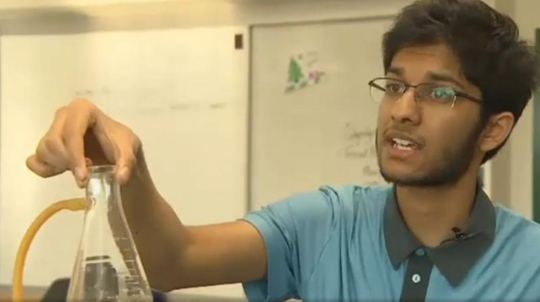
Chaitanya Karamchedu from Portland, Oregon, is turning heads across the country all because of a science experiment that began in his high school classroom.

The Jesuit High School Senior told KPTV that he has big plans of changing the world.

"1 in 8 people do not have access to clean water, it's a crying issue that needs to be addressed," said Karamchedu.

He made up his mind to address the matter himself.

"The best access for water is the sea, so 70 per cent of the planet is covered in water and almost all of that is the ocean, but the problem is that's salt water," said Karamchedu.

Isolating drinkable water from the ocean in a cost effective way is a problem that has stumped scientists for years.

"Scientists looked at desalination, but it's all still inaccessible to places and it would cost too much to implement on a large scale," Karamchedu said.

Karamchedu figured it out, on his own, in a high school lab.

"The real genesis of the idea was realising that sea water is not fully saturated with salt," he was quoted as saying.

By experimenting with a highly absorbent polymer, the teen discovered a cost effective way to remove salt from ocean water and turn it into fresh water.

"It's not bonding with water molecules, it's bonding to the salt," said Karamchedu.

"People have been looking at the problem from one view point, how do we break those bonds between salt and the water? Chai came in and thought about it from a completely different angle," said Jesuit High School Biology Teacher Dr. Lara Shamieh.

"People were concentrated on that 10 per cent of water that's bonded to the salt in the sea and no one looked at the 90 per cent that was free. Chai just looked at it and said if 10 per cent is bonded and 90 per cent is free, then why are we so focused on this 10 per cent, let's ignore it and focus on the 90," Shamieh said.

It is a breakthrough that is estimated to impact millions of lives if ever implemented on a mass scale.

"What this is compared to current techniques, is that it's cheap and accessible to everyone, everyone can use it," said Shamieh.

Scientists across the country are taking note. He won a USD 10,000 award from the US Agency for International Global Development at Intel's International Science Fair and second place at MIT's TechCon Conference where he won more money to continue his research.

"They were very encouraging, they could see things into it that I couldn't, because they've been working their whole lives on this," said Karamchedu.

Back in January, Karamchedu was also named one of 300 Regeneron Science Talent Search Semifinalists. The STS is thought to be one of the most prestigious competitions in the country for high school seniors.

Comments

James Freeman
 - 
Monday, 6 Feb 2017

Nestle (Pepsi, Coca Cola, etc.) certainly won't like this! It was Nestle Chairman, Peter Brabeck-Letmathe, who said '?ccess to water is not a public right.'?

I expect this breakthrough discovery will 'somehow' go nowhere, and this smart young man probably needs to start watching his back. Too much profit stands to be lost with this....

Add new comment

  • Coastaldigest.com reserves the right to delete or block any comments.
  • Coastaldigset.com is not responsible for its readers’ comments.
  • Comments that are abusive, incendiary or irrelevant are strictly prohibited.
  • Please use a genuine email ID and provide your name to avoid reject.
Agencies
March 14,2020

New Delhi, Mar 14: Excise duty on petrol and diesel was on Saturday hiked by ₹3 per litre as the government looked to mop up gains arising from fall in international oil prices.

Special excise duty on petrol was hiked by ₹2 to ₹8 per litre incase of petrol and to Rs 4 incase of diesel, an official notification said.

Additionally, road cess on petrol was raised by ₹1 per litre each on petrol and diesel to ₹10.

The increase in excise duty would in normal course result in a hike in petrol and diesel prices but most of it would be adjusted against the fall in rates that would have necessitated because of slump in international oil prices.

Comments

Add new comment

  • Coastaldigest.com reserves the right to delete or block any comments.
  • Coastaldigset.com is not responsible for its readers’ comments.
  • Comments that are abusive, incendiary or irrelevant are strictly prohibited.
  • Please use a genuine email ID and provide your name to avoid reject.
Agencies
January 22,2020

New Delhi, Jan 22: "Don't get into a trap. Your security is in your hands," the Border Security Force (BSF) has said issuing its social media rules for its officers and men. It has directed them not to use 42 mobile applications and show caution while using Facebook, Twitter and WhatsApp.

"Be cautious while using social media," said the BSF in a circular issued recently.

"Before using WhatsApp, Facebook, Twitter and other social media platforms, one needs to keep in mind that you are border guarding force and Central Civil Services (Conduct) Rules rule duly are applicable," it said.

It further pointed out that by commenting/writing about or forwarding unverified reports and rumours one violates laws of land.

"Several times unverified reports would be presented in way that they are absolutely true and start believing it. Seeing such post always use your commonsense and never get into the trap (sic.)," it state adding that the anti-national elements uses social media to propagate their agenda to cause unrest in India.

A picture clicked by Border Security Force personnel and posted on a social media platform remains there for always. Therefore, one should use officially approved pictures about any incident or untoward incidents related to Border Security Force, stated the circular. It pointed that unauthorised persons should not engage into taking pictures of the incidents.

It also highlighted how through social media, a few BSF personnel have fallen into trap of espionage racket carried out by enemy countries.

"Our security and respect is in our hands. Always think twice whether you are doing correct by accepting friendship requests from unknown persons, especially women and girls," it cautioned the troopers and officers.

It also highlighted that while going on leave and joining back the force, always follow the rules and regulations laid out for safety and security. "This is for your own safety," it stressed in the end.

The BSF has also issued a list of 42 mobile applications that needs to be completely avoided by serving BSF officers and jawans.

They are MI store, Weibo, Wechat, Shareit, Truecaller, UC News, UC Browser, Beautyplus, NewsDog, Viva Video - QU video Inc, Parallel Space, Apus Browser, Perfect Corp, Virus Cleaner - HI Security Lab, CM browser, MI Community, DU recorder, Vault Hide - No mobile Security, Youcam Makeup, Cachecleaner DU Apps Studio, DU battery saver, DU privacy, 360 security, DU Browser,Clean master - Cheeta Mobile, Baidu Translate, Wonder Camera - Bindu Inc, ES Ifle Explorer, Photo Wonder, QQ international , QQ music, QQ Mail, AA player, QQ News Feed, Wesync, QQ security Center, Selfie City, Mail Master, Mi Video Call -Xaomi and QQ launcher.

Comments

Add new comment

  • Coastaldigest.com reserves the right to delete or block any comments.
  • Coastaldigset.com is not responsible for its readers’ comments.
  • Comments that are abusive, incendiary or irrelevant are strictly prohibited.
  • Please use a genuine email ID and provide your name to avoid reject.
Agencies
May 17,2020

As millions of people get hooked to online dating platforms, their proliferation has led to online romance scams becoming a modern form of fraud that have spread in several societies along with the development of social media like Facebook Dating, warn researchers.

For example, extra-marital dating app Gleeden has crossed 10 lakh users in India in COVID-19 times while dating apps like Tinder and Bumble have gained immense popularity.

According to researchers from University of Siena and Scotte University Hospital led by Dr Andrea Pozza, via a fictitious Internet profile, the scammer develops a romantic relationship with the victim for 6-8 months, building a deep emotional bond to extort economic resources in a manipulative dynamic.

"There are two notable features: on the one hand, the double trauma of losing money and a relationship, on the other, the victim's shame upon discovery of the scam, an aspect that might lead to underestimation of the number of cases," the authors wrote in a paper published in the journal Clinical Practice & Epidemiology in Mental Health.

Around 1,400 dating sites/chats have been created over the last decade in North America alone. In the UK, 23 per cent of Internet users have met someone online with whom they had a romantic relationship for a certain period and even 6 per cent of married couples met through the web.

"The online dating industry has given rise to new forms of pathologies and crime, said the authors.

The results showed that 63 per cent of social media users and 3 per cent of the general population reported having been a victim at least once.

Women, middle-aged people, and individuals with higher tendencies to anxiety, romantic idealization of affective relations, impulsiveness and susceptibility to relational addiction are at higher risk of being victims of the scam.

Online romance scams are, in other words, relationships constructed through websites for the purpose of deceiving unsuspecting victims in order to extort money from them.

The scammer always acts empathetically and attempts to create the impression in the victim that the two are perfectly synced in their shared view of life.

"The declarations of the scammer become increasingly affectionate and according to some authors, a declaration of love is made within two weeks from initial contact," the study elaborated.

After this hookup phase, the scammer starts talking about the possibility of actually meeting up, which will be postponed several times due to apparently urgent problems or desperate situations such as accidents, deaths, surgeries or sudden hospitalizations for which the unwitting victim will be manipulated into sending money to cover the momentary emergency.

Using the strategy of "testing-the-water", the scammer asks the victim for small gifts, usually to ensure the continuance of the relationship, such as a webcam, which, if successful, leads to increasingly expensive gifts up to large sums of money.

When the money arrives from the victim, the scammer proposes a new encounter.

The request for money can also be made to cover the travel costs involved in the illusory meeting. In this phase, the victim may start having second thoughts or showing doubt about the intentions of the partner and gradually decide to break off the relationship.

"In other cases, the fraudulent relationship continues or even reinforces itself as the victim, under the influence of ambivalent emotions of ardor and fear of abandonment and deception, denies or rationalizes doubts to manage their feelings," said the study.

In some cases, the scammer may ask the victim to send intimate body photos that will be used as a sort of implicit blackmail to further bind the victim to the scammer.

Once the scam is discovered, the emotional reaction of the victim may go through various phases: feelings of shock, anger or shame, the perception of having been emotionally violated (a kind of emotional rape), loss of trust in people, a sensation of disgust towards oneself or the perpetrator of the crime and a feeling of mourning.

"Understanding the psychological characteristics of victims and scammers will allow at-risk personality profiles to be identified and prevention strategies to be developed," the authors suggested.

Comments

Add new comment

  • Coastaldigest.com reserves the right to delete or block any comments.
  • Coastaldigset.com is not responsible for its readers’ comments.
  • Comments that are abusive, incendiary or irrelevant are strictly prohibited.
  • Please use a genuine email ID and provide your name to avoid reject.